All the world’s a stage: A brief history of Renaissance Faires

Queen Elizabeth holding court

Today’s American Renaissance Faires (yes it’s spelled faire) are becoming quite mainstream. It seems you can’t throw a juggler’s ball far without hitting one. Just about every state in the union has at least one yearly faire, some, like California host several. The faires are now popular family, and school events. Some faires even host special family and student days, with activities designed for educational purposes. Of course no American faire is complete without its many vendors selling everything from Elizabethan costumes to modern body scrub. Thousands of people attend these commercialized faires so it might come as surprise to learn that the original faires were presented as part of the 1960’s counterculture movement, specifically as playful ways of protesting American consumerism and uptight social norms.

In her 2012 book, Well Met: Renaissance Faires and the American Counterculture, author Rachel Lee Rubio tells us that the 1964 Pleasure Faire and May Market, featured “an authentically attired ‘monk in full beard and hooded robes’ hawking papal indulgences and calling to fairgoers, ‘Let me absolve you of the punishments and everlasting torments of commercialism!’” The faire, for the California radicals who first participated in it, was not just an entertainment but also a criticism of the establishment and all it stood for.

The first American Renaissance faire was the brainchild of Phyllis Patterson, a Los Angeles schoolteacher. In 1963, she held a very small Renaissance fair as a class activity, in the backyard of her Laurel Canyon home. It was so successful she and her husband Ron Patterson, held a weekend fundraiser for a local radio station. 8,ooo people showed up. This must have been a very successful fundraiser.

Two years later the Patterson’s staged the first Renaissance Pleasure Faire in Angora California. The first commercial vendors were artisans and food merchants who were required to demonstrate historical accuracy or plausibility for their wares. Groups of volunteers were organized into “guilds” to focus on specific reenactment duties (jugglers, singers, actors, blacksmiths etc.). It was hoped that by presenting the faire as a living history event the Renaissance period would be brought to life so that attendees would be reminded of an early age, before the world, or at least America, became immersed in modern technology. What the Patterson’s may have over looked was that the Renaissance period was also a time of growing technology and consumerism. The 17th century Romantic era was pushback to this, the original counterculture movement, if you will. It is a little ironic that the Renaissance era, not the Romantic period was the theme of choice.

The Pattersons wanted full participation from the attendees. According to Rubio, one did not pay to attend the faires, one paid to play.

[A]ttending the Renaissance faire was, during the 1960s and 1970s, a sort of statement of purpose: of belonging in some way to the counterculture, of resistance to consumerism, of side-stepping — albeit briefly — the external constraints of social convention. Through the faire, people could demonstrate public participation in, and affirmation of, a new type of community that was resolutely transnational, transhistorical, transcultural, and one of choice rather than birth.

I wish I would have known about the history of the American faires, for now I can make better sense of what I saw and participated in last Saturday. It turns out there was a hidden message that I completely missed. In a way, the faires are American experimental theaters designed in a way as to break the fourth wall and pull the audience into the action and not just respond to the players.

I’v been a fan of Renaissance faires ever since I attended the Black Point Pleasure Faire, held yearly in Marin County. The Pattersons also started this faire, and apparently during the late 1970s (when I first attended) was still part of the counterculture movement.

These years I attend the Valhalla Renaissance Faire, held annually in Lake Tahoe California. I even met a Guild Master Saturday who mentioned she knew Phyllis Patterson, but at the time the name meant nothing to me.

As my friend Karen and walked around we were invited to participate in games, street performances, (I ended up quoting Shakespeare near the front gate never guessing I had become part of the play) and was even invited to join the Fellowship Guild (be part of a guild? Sign me up!) I had no idea that we were being asked to join a community, even if only for a day, dedicated to the idea of breaking free from the modern establishment. There was a lot of bawdy talk being bantered about; this too was part of the antiestablishment movement. I thought the vendors were getting into the spirit of Shakespearian humor. I giggled but lightly participated. Leave it to an academic to view the experience through a narrow lens.

It’s not all my fault I saw the faire as a window in Shakespeare’s world. For you see, it was promised to be the weekend that the Bard would finally show his face! I had every intention of interviewing him. I asked and got permission. Wouldn’t that of made a good article? Sadly, he was called away. In fact none of the Lord’s Chamberlain’s men made an appearance. I was disappointed, yet amused that the man remains elusive, even to a time traveler.

Ah, see there’s the rub. I was under the impression I was there as a traveling tourist. Someone who didn’t quite fit in yet wanted a close and upfront view of an alien world. Now I know better. In October California is hosting yet another faire, this one outside of the state Capitol (see I told you they are everywhere). We are making plans to go only this time I will have a better understanding of what will be asked of me. I will pay to play in the spirit of the counterculture movement. I will shake the bonds of both academe and society and let the inner hippie wench out.
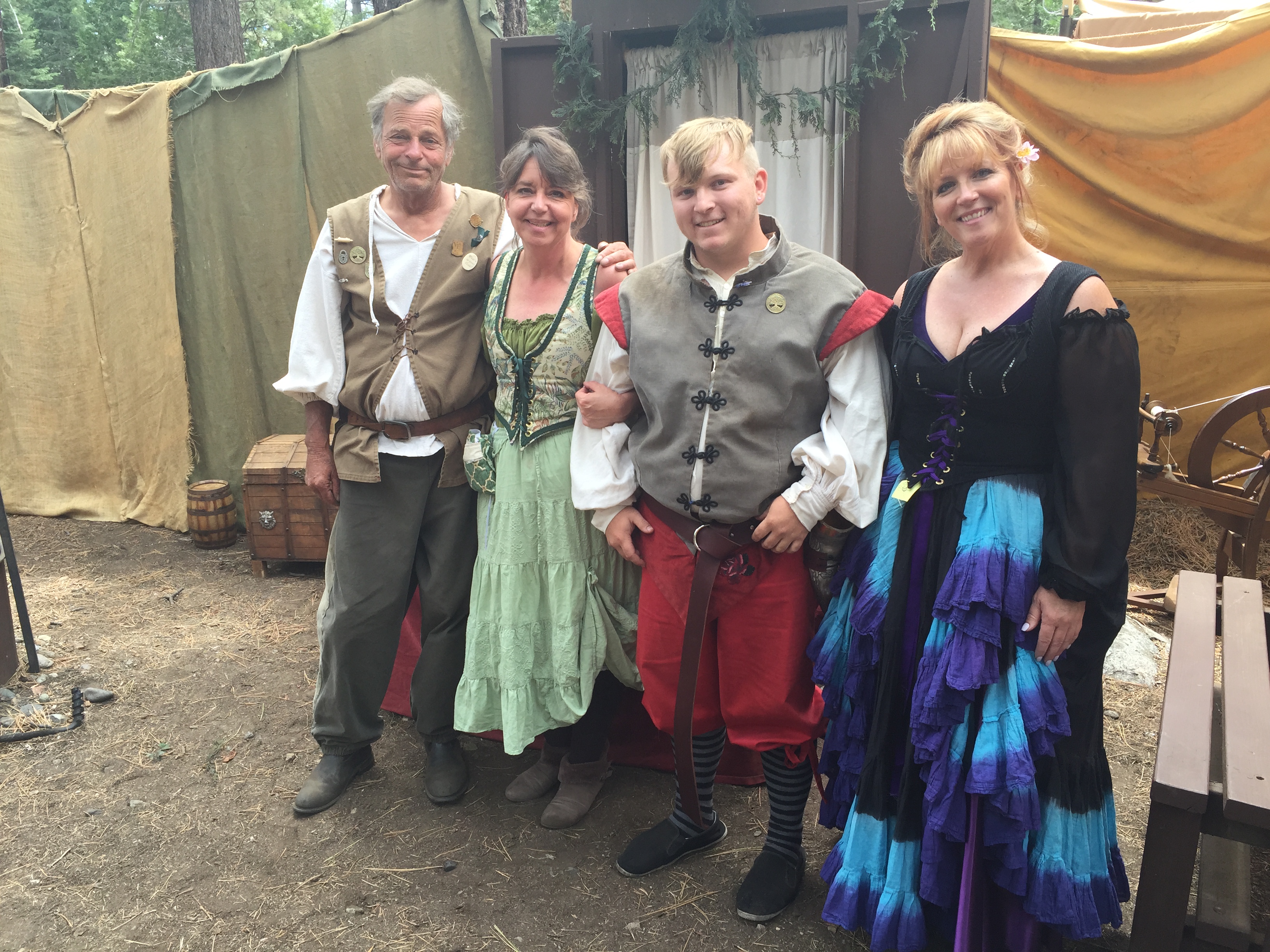
 

Meeting some of the Fellowship Guild members

If the history of Renaissance Faires is of interest, or you just like good biographies, I found this gem on Vimo. It’s a video for rent, titled, Faire: the American Renaissance. It was fun to watch some old home movies of the early days of the original faire.

Rubio’s book is another source for a fresh look at the counterculture movement.

Rubio, Rachel Lee. Well Met: Renaissance Faires and the American Counterculture. NY Press. 2012

The invisible woman

Tell me you see two people in this photo

This post is going to be a little different. You can either thank or complain to my son Alex about this. He is the one who challenged, nay dared me, to step out of my comfort zone. His philosophy on writing is that in order to grow as writers we have to climb out of our box and try a different shape. This way we develop our skills to include new ideas and modes of expression. In a way I agree with him, and as one who never backs down from a challenge, I agreed. So, here we go; it’s going to get personal. We are going to talk about the invisible woman, or to be succinct, how society ignores women over 50.

The idea of a women as invisible creatures never occurred to me prior to Saturday, but now it makes so much sense. It is why I’ve been stuck in my personal life for a couple of years now. It is why, when I go out of my way to connect with people, I come home feeling isolated.

The idea that society tends to devalue woman as they age hit me square between the eyes last Saturday afternoon. This is not a concept I’ve developed, nor am I the first woman to notice it. Hollywood and corporate women have been talking about this for years. It is a non-issue for most of us, until it happens to us.

My son asked me to join him Saturday for a belated birthday celebration. He found out that the local university was hosting a mini “Make a Fair”. An event designed to bring inventors, craftsmen, and Steampunk exhibits under one roof. Alex knew I would love it so off we went.

It started off on a high note. As Alex paid for our tickets I filled out a waiver so that we could participate in the interactive events. I gave an exaggerated groan when it came to writing my age down. I told the volunteer that this was the first time I had to write “51”. As much as I try to view age as just a number, it hit me that this was not a number I relished. Good god, I should be thinking about retiring, not starting a new career. The nice lady laughed and said, “I should be proud”, as I didn’t look 51. I smiled but then thought, “What’s wrong with looking 51”? It was a question I mulled as we walked down the aisle towards the first of the science exhibits.

When we came to the fossil exhibit I didn’t hesitate to ask the young man to tell me about them. During my first two years of college I waffled back and forth between science and history. History won, but I took as many natural science courses as time and my schedule allowed. I knew what I was looking at but it didn’t stop me from asking questions with child like wonder. Strangely my questions were met with vague dumbed- down answers. The young man turned to Alex and started to talk to him as if he had asked similar questions, only this time giving more in-depth answers. The funny thing was, Alex was not standing near me. He was a few feet away,less interested in the pieces than my reaction to the exhibit. When I asked the young man for information on the museum that housed the fossils he gave a brochure to Alex. It was as if I were a ghost that this man was determined to ignore.

Next we came to a man holding what I can only describe as a fire stick. It was a long decorated stick with a small torch attached to the top. I giggled when I saw it, because it was less science, more Burning Man apparel (if you don’t know what Burning Man is, look it up. Nevada is ground zero for this hippie event). I laughed and said to the fire stick man, “So, teach me about fire.” He responded by saying, Well, it burns”. He then pushed a button on the stick to show me how it worked. When I asked the follow up question, “What do you use it for?”, he turned to my son and said, “Here is when you’d use it”. He then went on to ask my son and his girlfriend their names and demonstrated the stick’s useful features. (As a pitchman he must of learned that this often helps sell a product). Once again, I was ignored.

This theme of talking to Alex while I was the one who asked questions continued. To be fair, some of the vendors talked to me, but only after noticing Alex’s seemingly disinterest. Alex had also observed my invisibility and tried to counter it by disengaging from any conversation. It made our visit a little awkward and not at all as fun as we had hoped. As an experiment I tried light flirting with an older man who was showing off his Steampunk car. Hell, I would have taken light banter, but nope, he answered my questions politely as if he was talking to a child.

You might think of this as an isolated event. It could have been that I had an off day, but it wasn’t. This has become my social life. It’s the social life of my friends as well. We can go out determined to have a good time, determined to connect with others on a human level only to be marginalized and ignored. Oh sure, we are fawned over by sales clerks and waiters, as we are the generation with money, but other than that we are invisible to the rest of the world. We no longer have strangers opening doors for us. We no longer have men vying for our attention at parties. We have become the ghosts that people walk by, noticed only in peripheral vision if at all.

Why? What happens to a woman when she turns 50? My roommate gave me an honest answer as to why men no longer open doors or smile across the room. To put it bluntly, he said, “In general men do not see women over 50 as possible sex partners”. He went to say that men still view women in their 40 this way, but there is something that stops them from giving any thought to a woman over 45. This doesn’t explain the female lack of interaction, other than to think maybe we are no longer perceived as threats, so there is little motivation to engage in friendly rivalry. Or perhaps society just doesn’t know what to do with women over 50.

All societies rely on each member to contribute something to the greater good. Those who are young are looked upon to either contribute by procreating, thus ensuring the continuation of society, or by being productive workers, ensuring that the society thrives. Those over 50 are viewed as burdens; something society will soon need to take care of, rather than look to for contribution. No wonder both older men and women slowly recede into the shadows, men too at some point (though many over 60 are still considered “hot”) find themselves invisible.

I will not go gently into that good night. I still have many things I want to do. I want to finish my book. I want to start a podcast. I want to teach. While you won’t find me dressing like a 20 year old or acting younger than I am, you will find me having a good time. I will not become a bitter old woman. If at some point you see an “older” lady rocking a brown bowler hat, you’ve found me. Come over and say hi, or at least smile. I refuse to be invisible.

Amazing Waste

Repurposing Food and Reducing Waste

measurestillformeasure

Shakespeare, Classics, Theatre, Thoughts

Nerd Cactus

Quirky Intellect for the Discerning Nerd

Sillyverse

Stories of magic and mystery

Commonplace Fun Facts

Mind-Blowing Facts You Didn’t Know

Fictionophile

Fiction reviews, Bookblogger, Fiction book reviews, books, crime fiction, author interviews, mystery series, cover, love, bookish thoughts...

Patrick W. Marsh

monsters, monsters, everywhere

Shakespeare for Kids Books

Opening the door for kids to love Shakespeare and the classics

desperatelyseekingcymbeline

The 10-year Shakespeare New Year Resolution

Katzenworld

Welcome to the world of cats!

booksandopinions.com

The Book Reviews You Can Trust!

The Book Review Directory

For Readers and Writers

thelitcritguy

screams from the void

Author Adrienne Morris

Step Into the Past—Lose Yourself in the Story.

crafty theatre

ideas inspired by crafty characters

Critical Dispatches

Reports from my somewhat unusual life

The Nerd Nebula

The Nucleus of the Universe for all Nerd Hacks!