Things you may not know about Charles Dickens

I’ve updated an older post in honor of Dickens’ Birthday.

Charles-Dickens-007

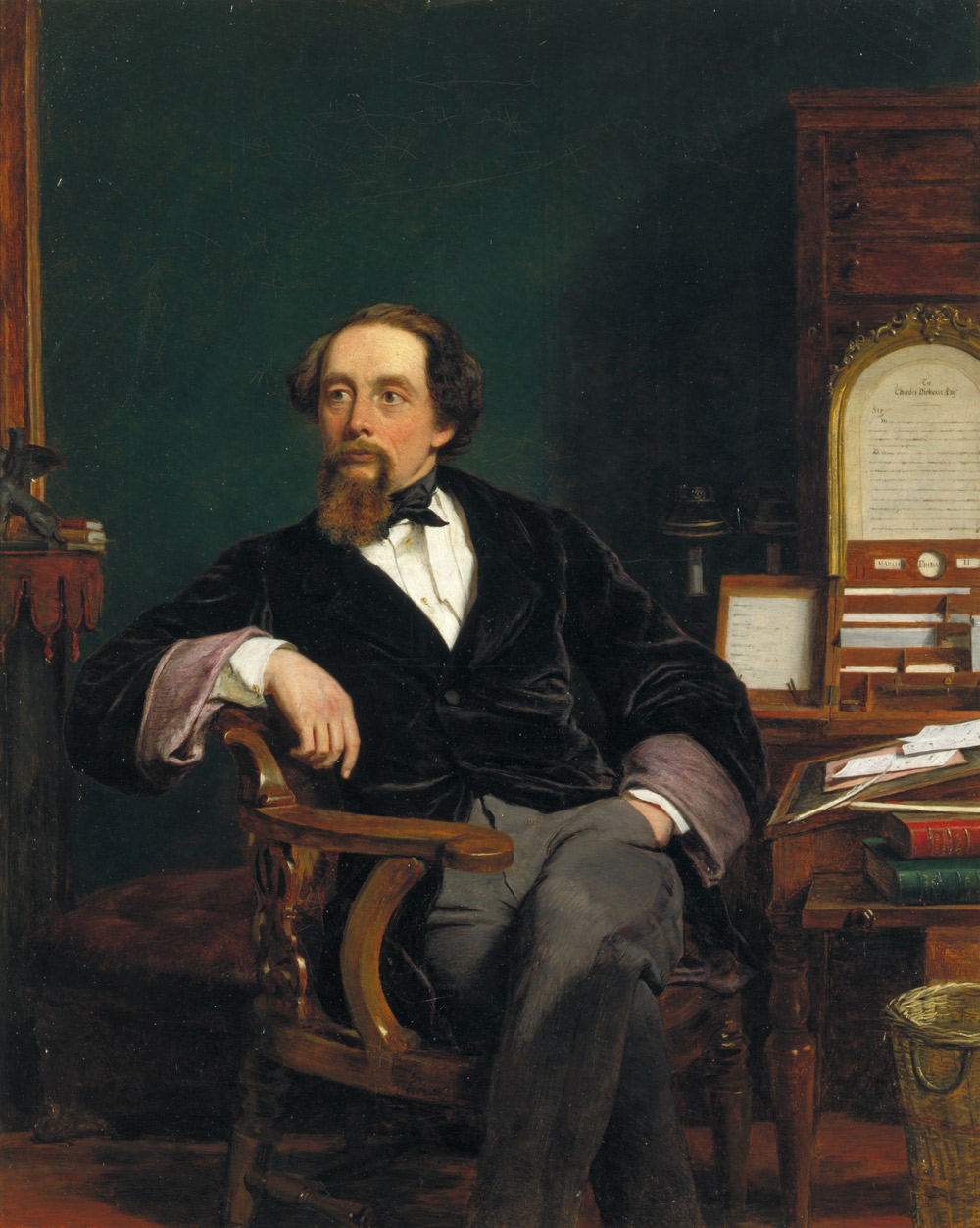
Charles Dickens was born on this day in 1812. Though his work is still highly praised, his personal life is ignored. While we shouldn’t judge a man’s work by his personal life, we must admit biography does sometimes bleed into writing. Let’s look at the complex man who shaped our modern view of Victorian England.

As with many beloved men in history, Dickens had a dark side. He was a very strict father, and left his wife because she had lost all “warmth and tenderness”. Yeah, Chuck, you try being witty and sexy after having 10 children and being left home with them. Dickens left his wife for a young actress who in turn left him when he was too old to be much fun. Karma baby!

I offer you:

“Things may not know about Charles Dickens”

The name “Dickens” was a curse, possibly invented by Shakespeare.

Instead of saying, “What the devil?” as a profanity, people exclaimed, “What the dickens?” The first usage of that word, according to the Oxford English Dictionary, was William Shakespeare’s The Merry Wives of Windsor.

He had first had experience with debtor prisons.

His father was imprisoned for debt and 12-year-old Dickens was sent to work in a boot factory to help support the family. This episode may have formed his worldview and colored everything he accomplished, though he never told the story except obliquely through his fiction. His book Hard Times was thought to be a hardline critique of Victorian society’s view of education and poverty.

He started writing at a young age.

Dickens first published fiction was A Dinner at Poplar Walk, published in Monthly Magazine. He wrote it at the age of 21 while working as a reporter at The Morning Chronicle.

He thought highly of himself but his children? Not so much.

Dickens gave himself a number of different nicknames, including “The Sparkler of Albion”, “Revolver” and “The Inimitable.” He also gave his children nicknames including “Chickenstalker” and “Plorn.”

Dickens kept a pet raven named Grip, which he had stuffed when it died in 1841.

He may have saved multiple lives of friends and strangers after a train crash.

According to the New York Times, Dickens was on a train that derailed over a bridge, in the only first-class carriage that didn’t plummet into a river. He not only found the key that freed his friends, he went to the carriages below and gave water and brandy to those who needed it. Then, the ailing 53-year-old “climbed back into the dangling carriage and retrieved from the pocket of his coat the installment of Our Mutual Friend that he had just completed and was taking to his publishers. The rescue of his fellow passengers and manuscript was kept quiet for many years. Why? Because he was traveling with his mistress the actress Ellen Ternan.

He helped create a home for “fallen women.”

In an era in which women had few options to support themselves and their families, prostitution was a common crime, but one that was severely punished. After an appeal from heiress Angela Coutts, he helped create “Urania House” where former prostitutes could learn to read and write, as well keep house.

Dickens interviewed potential candidates personally after looking in prisons and workhouses for them. He even established the house rules. Approximately 100 women “graduated” from Urania House.
2006AN3612_charles_dickens_painting

But what was he really hiding?

Dickens had a secret door built in his study which was designed like a bookcase filled with fake books rumored to include titles like Noah’s Arkitecture and a nine-volume set titled Cat’s Lives.

Dickens would have loved Stephen King.

Fascinated by all things paranormal, Dickens belonged to London’s famous Ghost Club, an organization that investigates “ghosts and “hauntings” . His passion for the uncanny began in his teens, when he pored over tales of phantoms, murder and cannibalism.

His last novel, The Mystery of Edwin Drood, remains a mystery.

Dickens had written half of a novel, The Mystery of Edwin Drood, before he died of a stroke in 1870. Edwin Drood was a young man engaged to Rosa Bud, who is also the object of his uncle John Jasper’s affections, as well as Neville Landless, a young man from Ceylon. After he and Rosa break their engagement, Drood disappears.

Dickens left no clues behind as to who killed his protagonist, although many suspect his jealous uncle. There have been multiple radio, television, and theater reworkings of the story, each with different endings.

In 1873, a young Vermont printer, Thomas James, published a version that he claimed had been literally ‘ghost-written’ by him channeling Dickens’ spirit. A sensation was created, with several critics, including Arthur Conan Doyle, a spiritualist himself, praising this version, calling it similar in style to Dickens’ work and for several decades the ‘James version’ of Edwin Drood was common in America.

And now you know!

Just for fun.
Shelving Shakespeare

IMG_0157

Not all books about Shakespeare are created equal. The motifs and subject matter vary to such a degree that would tax the very soul even the more seasoned librarian. We are familiar with the books that treat the great playwright as the subject matter; these are very easy to catalog, shelve them under biography and be done with it. But these are only the tip of the iceberg.

I bring this up because one of my weekend goals is to gather all my books that have “Shakespeare” in the title and give them a proper shelving. Right now they are scattered here and there with little rhyme or reason. That’s not to say I haven’t made past attempts to shelve them in some orderly fashion. I’ve got most of the books that deal with Hamlet on a nightstand, and my many editions of the 37 plays have been assigned to their own bookshelf which is sadly over crowded and is in terrible disarray. My Arden and Folger editions are fighting for space, while my Yale Complete Works and First Folio smugly look down from their top spot.

How shall we find the concord of this discord? (MSND)

I have books on the authorship question, books on the heavier themes found in the plays such as death and madness, and books that look at the cultural and political settings of Shakespeare’s world(s). Let’s not forget the lighter side too: Shakespeare’s Bawdy and Shakespeare’s Mythical Creatures are hidden between intro to Shakespeare books. Then there are the dictionaries and quotation books, which one would assume would go under the reference heading until you realize all of these books about the Bard are, in one way or another, reference books. I may be over thinking this a bit…

How well he’s read, to reason against reading! (LLL)

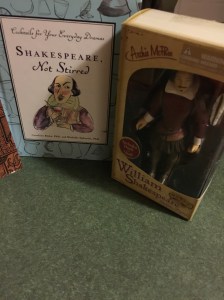
You’d think I would refrain from bringing any more books into this fray until I’ve sorted out my problem. In this you would be wrong. Just yesterday I received Cocktails for your everyday Dramas Shakespeare Not Stirred by Caroline Bicks and Michelle Ephraim. While officially a recipe book, there is enough Shakespeare tidbits and trivia to qualify as a reference guide. It is a fun book, not so much to enlighten but to lighten up your mood. How can you not help but giggle at chapters like, Shall I Campari to a Summer’s Day? and Get Thee to a Winery: Girl’s Night Out. The photographs (courtesy of the Folger’s Library) alone are reason enough to see to it that this book doesn’t get forgotten between Shakespeare’s Kitchen and The Skinny Bitch Diet (yes, Shakespeare has even found his way into my cookbook shelf).

My library was dukedom large enough (TT)

The scholarly books seem easy enough. Harold Bloom’s Shakespeare: The Invention of the Human should be near Margorie Garber’s Shakespeare and the Modern Culture as should be Becoming Shakespeare and Shakespeare in America, all dealing with the many ways in which Shakespeare shaped our culture, and to a lesser degree, how we shaped Shakespeare to our liking. But it takes a little bit of mental gymnastics to place William Shakespeare’s Star Wars in this mix.

Good wine is a familiar creature, if it be well used (O)

The smart thing to do would be to make up vague sub-genres and go from there. Or I could just alphabetize them by author or group them by color and make them part of my décor. But it occurred to me on this rainy Saturday that the really fun thing( and possibly sensibly) to do would be to whip up a batch of Rosalind’s Gender Blender and let the problem sort its self out.

                        Rosalind’s Gender Blender

                        2 oz vodka

                        ½ cup lemon sorbet

                        ½ cup frozen raspberries

                        ½ cup frozen blueberries

                        ¼ cup simple syrup

                        ¼ cup white wine

                                 Fresh Blueberries for garnish

In a blender, puree the vodka, lemon sorbet, frozen berries, simple syrup,     and white wine until pink and blue become a purple blur. Pour into heavy wineglass or goblet and top with fresh blueberries.                     

This is the first in a 2016 series in which I attempt to incorporate into a blog post, and or review, many of my Bard related books.

Works cited

Bicks, Caroline and Ephraim, Michelle: Cocktails for your everyday Dramas Shakespeare Not Stirred
Shakespeare, William: Love’s Labor Lost, Midsummer’s Night Dream, Othello, The Tempest

Amazing Waste

Repurposing Food and Reducing Waste

measurestillformeasure

Shakespeare, Classics, Theatre, Thoughts

Nerd Cactus

Quirky Intellect for the Discerning Nerd

Sillyverse

Stories of magic and mystery

Commonplace Fun Facts

Mind-Blowing Facts You Didn’t Know

Fictionophile

Fiction reviews, Bookblogger, Fiction book reviews, books, crime fiction, author interviews, mystery series, cover, love, bookish thoughts...

Patrick W. Marsh

monsters, monsters, everywhere

Shakespeare for Kids Books

Opening the door for kids to love Shakespeare and the classics

desperatelyseekingcymbeline

The 10-year Shakespeare New Year Resolution

Katzenworld

Welcome to the world of cats!

booksandopinions.com

The Book Reviews You Can Trust!

The Book Review Directory

For Readers and Writers

thelitcritguy

screams from the void

Author Adrienne Morris

Step Into the Past—Lose Yourself in the Story.

crafty theatre

ideas inspired by crafty characters

Critical Dispatches

Reports from my somewhat unusual life

The Nerd Nebula

The Nucleus of the Universe for all Nerd Hacks!