Doctor Who and Shakespeare No, they don’t mix

51E-uOdBLgL._SY344_BO1,204,203,200_

There are times in life when all you want is a chance to unwind and grab a piece of brain candy and let it do its trick. I’m sure, dear Reader that you can relate. We all have our own favorite brand of brain candy. For some it may be a historical romance, for others it may be time to let a familiar detective lead the way as he solves yet another case. For me, it usually something light and humorous; something that makes me laugh without having to think about why I’m laughing.

I started a new job a few weeks ago, and I am still adjusting to my expanded role as a program supervisor. Some nights I come home wanting nothing more than sleep, though I know this will only result in a very early wake up call from my body. I know if I go to sleep at 8, I will be awake at 4. This is not a viable solution to my brain melt.

Something has to occupy my mind without taxing my brain, which is why I decided to finally pick up a book I bought back in May. I had high hopes for this particular book. Doctor Who The Shakespeare Notebooks should have been savory piece of brain candy.

Regular readers of this blog will recognize right away why this title appealed to me. I am predisposed to like anything with Shakespeare in the title, and equally predisposed to giggle over anything Whovian. Combine the two and I am in geek heaven! At least this is what I thought.

The premise of the book centers on newly discovered “lost” Shakespeare notebooks; journals that William kept as he wrote his famous plays. The notebooks contain “lost” scenes and general re-workings of dialog and soliloquies. Peppered between all of this lost material are references to a certain strange man who pops in and out of William’s life via a blue box.

This is from the first page. It is a note about Hamlet

Hamlet- son of a dead king (hence “Prince of Denmark”) discovers his uncle murdered his father and married his mother to steal the throne. Probably drives him mad. Well, it would wouldn’t it?

How’s he find out? Possibilities:

Hidden papers – never very satisfactory

His mother confesses- except she wouldn’t know, would she?

His uncle confesses – Why? That’s asking for trouble!

He guesses – hummm.

A magician tells him – ah, most plausible. Such things are common in the theatre.

I sat in stunned silence after reading this. Had I been 12, this may have tickled my fancy. I may have even giggled. But as an adult, this fell flat, and left me wondering who was the attended audience was. “Damn”, I thought, “This is a kid’s book”! The thought that this was more of a children’s take on Shakespeare, allowed for the juvenile humor. I read on, attempting to get into the mindset of a pre-teen. It didn’t work. As I read on it only got worse.

The next part of the book talked about missing scenes from Macbeth. The notes, made by the authors who “found” the notebook, hinted that the play, one of the shortest of the tragedies, was originally just as long as Othello. One of the missing scenes involved Macbeth and Banquo meeting Doctor Who and two companions, not three witches. It is one of the companions who blurts outs, “You’re Macbeth the future King!” He knows this because he read a play about Macbeth. Huh? Shakespeare is writing a play about time travelers who meet Macbeth and tell him he will be king because it is written in a play? Oh, okay…. The Doctor is dismayed by this out burst and spends the the rest of his time in the play trying to stop Macbeth from becoming a murderer. This has to be a children’s book, right? No adult would buy this plot as the only sensible thing for the Doctor to do, would be to go back in time again, and stop his companion from meeting Macbeth. I know, I know, I am way over thinking this. This is one of many problems with this book; it’s not funny and makes little sense. The authors failed to realize those who read Shakespeare or can follow a Doctor Who plot are smarter than this. I say authors because there are five; one of which should have at least considered the idea that none of this would work.

Now, I know, I am being a little unfair. Pre-teens may enjoy the antics of a Time Lord popping into plays only to realize he has already read the play, but all I did was groan. This may have worked if the authors had written a Doctor Who Notebook. One in which the Doctor finds himself in a play, but having Shakespeare write these scenes just didn’t work. Oh, yes, I realize Shakespeare wrote plays within plays, but when he did it he separates the plays; his players watch other players. These authors may be trying to play with time, I’ll give them that, but the result is just one big wibbly wobbly timey wimey mess. I just couldn’t bring myself to finish the book.

I contemplated handing this to a friend’s pre-teen in exchange for a review. Surely my take on it would be harsh and unfair, as I am clearly not a member of the target audience. But before I did, I wanted to confirm the target. I would have felt bad if I had unknowingly given a young girl a book that contained bawdy parts. Wow, was I in for a shock; the Doctor Who The Shakespeare Notebook is labeled as an adult humors book! If this is adult humor, we are surely lost.

I can take heart by the fact that only 12 people bothered to review this book, and the reviews are mixed. While I don’t know the ages of the reviewers or their reading levels, I can argue with the two that said, “Fans of Shakespeare will like this book”. No. No, they won’t. This was a bitter disappointment, and a piece of brain candy I just couldn’t choke down.
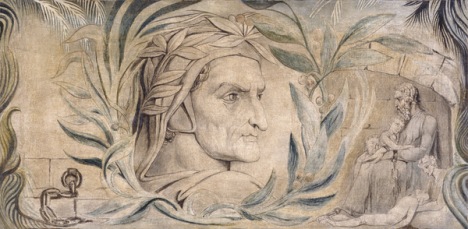
Blake, Dante and our own Hell

blakedanteportrait_0

Religion has been on my mind this last week. From Pope Francis’ view that humans, as God’s children are rejecting our parent, “When we exploit Creation we destroy the sign of God’s love for us”, to the Supreme Court’s ruling on marriage equality, and the Christian fundamentalist “the sky is falling” reaction to it, it would almost be impossible to think about anything else.

Perhaps this is why Eric Pyle’s book, “William Blake’s Illustrations for Dante’s Divine Comedy”, resonated with me. I picked it up as I have been meaning to read and review it for a few weeks now. McFarland Press, as part of Librarything’s Early Reviewer program, kindly sent it to me. I thank them both.

William Blake (1757-1827) was an early modern poet, artist, and theological philosopher. The last two years of his life was devoted to illustrating Dante’s epic poem. Blake’s works included watercolors and etchings. Sadly, he died before the work was complete, and tragically many of the finished products were either destroyed or edited after his death.

Pyle, a professor of Dante studies, collected copies of what remains of Blake’s work and his notes, and has produced a book that looks at both Blake’s criticism of Dante’s philosophy and his idea of the 9 circles of Hell. Blake lived during what we call the Romantic era, when artists and philosophers sought out social justice and fought against the idea of a cold soulless world. In many ways Blake’s drawings and accompanying notes updated Dante’s ideas of social injustice as seen through the Romantic point of view.

As I read the book and learned about Blake’s ideas, one thought stood out. It ties Blake to Dante and why the artist may have taken it upon himself to work on the project up to his dying day.

In one of his notes Blake writes about God and his handing the reins of good to his son and evil to Satan.

He (God) could have never have Builded Dante’s Hell nor the Hell of the Bible neither in the way our Parsons explain it. It must have been formed by the Devil himself. Whatever Book is for Vengeance for Sin and whatever Book is Against the Forgiveness of Sins is not of the Father but of Satan the Accuser and Father of Hell. (E.690)

Think about that for a second. What Blake is telling us is that evil, not love, created Hell and those who are unforgiving are part of this creation.

Pyle tells us that Blake “doesn’t think that a just God would send anyone to Hell for eternity.”(80) And, if I’m reading Pyle correctly, Blake believed that rather than creating an actual hell, humans construct hell out of their perception of good and evil. Unlike Dante, Blake believed not in a physical place but in an imagined Hell and that individuals condom themselves to it. But like Dante, Blake believed punishment reflects the evil actions. It gets a little deeper, but for brevity sake, let’s break it down to this, Blake believed that we create our own Hell, which can, depending on our perception of the world around us, show up as real and imagined social injustice while we are still living.

This self-styled Hell joins Dante’s lesson on self-responsibility and the type of punishment that follows when we “sin”. Yet it is the perceived social injustice this living Hell is what captured my attention. Let’s look at this a little more closely as it relates to the events of this last week.

It could be argued, by Blake’s ideas, that if you, as a fundamentalist Christian, truly believe that marriage equality will destroy your way of life, a personal Hell is forming in your mind. Your worldview becomes colored by the idea that there are threats or evil deeds going on all around you. As such, the way you perceive the world around you demands that you have locked yourself in a personal Hell; one that has you surrounded by “sinners”. This self-styled Hell is compounded upon by the intolerance, anger and hate you now feel. Let’s go back to Blake’s words; “Whatever Book is for Vengeance for Sin and whatever Book is Against the Forgiveness of Sins is not of the Father but of Satan the Accuser and Father of Hell”. By accusing others of sin, and acting to oppress the “sinners” are we not doing Satan’s work? Blake says yes and further more, by doing Satan’s work, we are creating a living Hell for ourselves, and society at large. It is when we find ourselves in such “dire” situations that we lash out and our personal hell bleeds out onto society. Perceived social injustice leads to actualized social injustice in the form of repressive laws and bigotry.

When we view the world as a scary place it manifests as a scary place, just as it becomes filled with wonder and awe when we are filled with love. Our perceptions become self-fulfilling; it is our choice to live in either Heaven or Hell. So instead of worrying about how others live, or trying to keep others down, wouldn’t it be better to look inward, to find some measure of peace so that we aren’t condemning ourselves to Hell?

Pyle, Eric. William Blake’s Illustrations for Dante’s Divine Comedy. Mc Farland Press 2015.

Amazing Waste

Repurposing Food and Reducing Waste

measurestillformeasure

Shakespeare, Classics, Theatre, Thoughts

Nerd Cactus

Quirky Intellect for the Discerning Nerd

Sillyverse

Stories of magic and mystery

Commonplace Fun Facts

Mind-Blowing Facts You Didn’t Know

Fictionophile

Fiction reviews, Bookblogger, Fiction book reviews, books, crime fiction, author interviews, mystery series, cover, love, bookish thoughts...

Patrick W. Marsh

monsters, monsters, everywhere

Shakespeare for Kids Books

Opening the door for kids to love Shakespeare and the classics

desperatelyseekingcymbeline

The 10-year Shakespeare New Year Resolution

Katzenworld

Welcome to the world of cats!

booksandopinions.com

The Book Reviews You Can Trust!

The Book Review Directory

For Readers and Writers

thelitcritguy

screams from the void

Author Adrienne Morris

Step Into the Past—Lose Yourself in the Story.

crafty theatre

ideas inspired by crafty characters

Critical Dispatches

Reports from my somewhat unusual life

The Nerd Nebula

The Nucleus of the Universe for all Nerd Hacks!