William Shakespeare’s Star Wars: a new hope for fans

130316023938_shakespeare-3_4_r536_c534It’s May 4th, or as we nerds say. it’s Star Wars Day! I thought I’d celebrate by brushing off a review I did a couple of years ago.

May the 4th be with you!

I’m a part of the Star Wars generation. The original movie came out the summer I turned 12. Back in 1977 no one had ever seen a movie quite like this. Between the special effects (who can forget the Death Star explosion) and makeup, it was Hollywood magic at its finest. Even my mother, a jaded movie critic gasped when Obi-Wan and Luke entered the cantina. Everyone I knew wanted to see Star Wars, and for many of us kids, once was not enough. By summer’s end I’d watched it 12 times.

Even today it holds a special place in my heart. Maybe because it came out in the twilight of my innocence. That last summer between adolescence and teen angst. Or maybe because I just remember how much fun my friends and I had watching it, acting it out, (yes, we were at that age where that sort of behavior was acceptable) and arguing over key moments in the movie; we were also of the age that philosophical thought started to creep into our discussions. Was Luke destined to be a Jedi, or was it dumb luck that cast his fate?

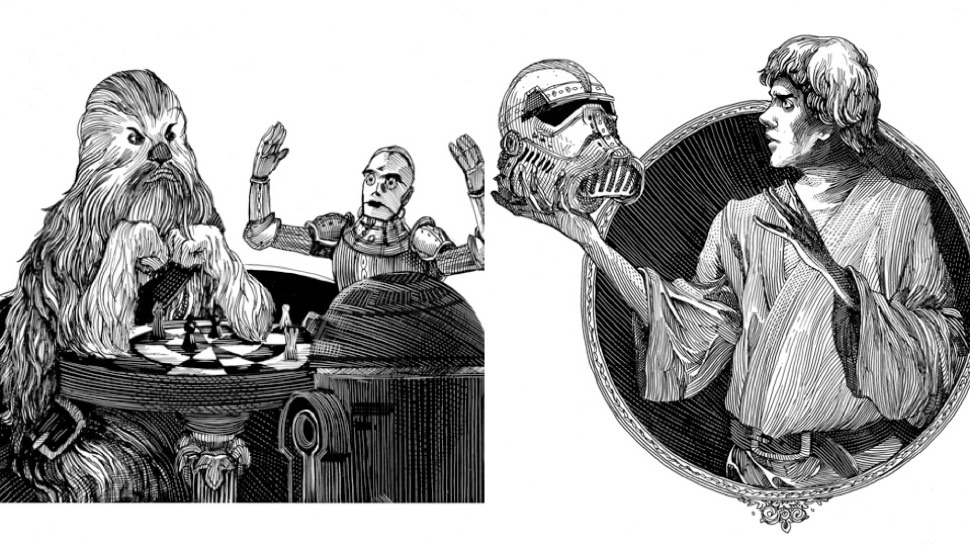
Star Wars remains one of my favorite movies. But as the years past I moved on, finding new loves and new subjects of philosophical debate. Shakespeare is now the topic of many long discussions; though I do recall one in which Hamlet and Luke were subjected to comparison. Both at times, hesitated to do what was needed and both have some serious daddy issues!
k-bigpic

Why am I bringing this up? Well, a few weeks ago I was offered the chance to review Ian Doescher’s book William Shakespeare’s Star Wars. The nerd in me jumped at the chance to read this mash-up. What science nerd/Shakespeare geek wouldn’t?

Of course I wondered if it would be any good and if the Bard scholar in me would find fault on every page. So how did it do?

The book exceeded my expectations; although to be fair, my expectations were rather low. I hoped for a few hours of light entertainment. What I got was a few hours of pure delight. From the opening lines to the last I was hooked.

C-3PO- Now is the summer of our happiness

Made winter by this sudden, fierce attack!

Our ship is under siege, I know not how.

O hast thou heard? The main reactor fails!

We shall most surely be destroy’d by this.

I’ll warrant madness lies herein!


The adult Shakespeare lover in my admired Doescher’s ability to stick to some of Lucas’ original words while giving them a Shakespearean make-over. But the biggest surprise and delight came from Doescher’s novel idea to place Shakespeare-like asides and soliloquies in key moments. These monologs offers Star Wars fans new vantage points to view the characters and their motivations. Take Luke’s inner struggle after finding his aunt and uncle’s chard remains:

Adventure have I ask’d for in this life,

and now have I too much of my desire.

My soul within me weeps: my mind, it runs

unto a thousand varied paths.

My uncle Own and my aunt Beru,

have they been cruelly kill’d for what I want?

As the soliloquy goes on,we get the idea that Luke feels guilt and pressure over this tragedy. He vows to fight so that his family will be “honor’d in their grave”.

From R2D2 to Vader, these innermost thoughts add depth to the story, and dare I say it?  Make it a little better. Yep, I am telling you that Doescher’s retelling breaths new life into the Lucas’ world.

I wish this book had come out when the other mash-up were popular. I got my son to read and admire Jane Austin with Pride Prejudice and Zombies. If he had read Doescher’s book in high school he may have had an easier time with Shakespeare. William Shakespeare’s Star Wars is a wonderful introduction into Shakespearean verse. Getting students used to “Shakespeare “speak” can be a challenge. Doescher’s book may ease some of their fear of Shakespeare.

Are there mistakes? Yes, the biggest is that Doescher doesn’t modify speaking styles; the higher class should be speaking in verse, and the lower in prose, a style  Shakespeare used to show the difference in classes. Am I complaining? No, not really, I had too much fun reading this book and I hope you will to.

Anon. May the verse be with you!

Words, words, words What opening lines tell us

700-00085036

I bet I can guess something about you. As a reader, first lines are important to you. In both literature and theater, we view first words as the opening gates into another world. As lovers of literature we yearn to cross the threshold beyond gates, and eagerly do so if the gates look inviting enough.

How do these gates entice us? What makes for a good opening line? For some, the words are so masterfully crafted that we can’t help but to read more. Take Gabriel García Márquez’s, One Hundred Years of Solitude opening line:

Many years later, as he faced the firing squad, Colonel Aureliano Buendía was to remember that distant afternoon when his father took him to discover ice.

Though we are warned this is a sad story, we are drawn into Márquez’s world by his sublime gift of storytelling. We understand and accept his challenge to our emotions because of the power of his words.

Some opening words compel us to cross the threshold if for no other reason than for the sake of curiosity. Here’s Samuel Beckett’s, Murphy, opening line:

The sun shone, having no alternative, on the nothing new.

I don’t know about you, but I have to know where Beckett is going with this. Ten words, just ten words, yet they beg many questions. Is this world so depressing that even the sun is melancholy? Or, is the sun trapped by fate; having no say it what it does? It shines because it has to, there is no other choice. And what is this place of “nothing new”? Perhaps this world is locked in a cycle of sameness, with little or no hope to escape the boredom and fatigue that these words hint at. Brave readers will have no problem entering this world. There is something oddly seductive yet sinister about this first line. As I sat and contemplated them, a vision came to mind: I saw an rundown, dusty carnival tent flap being held open by a grinning man wearing black, promising wondrous sights and sensations. Or, will it be nightmares and horrors?

There is more to the power of opening lines. Skillful writers can use them to set the stage. A good author, using just a few words, will instruct us as to what is in store; calling on us to pay attention to what we are about to read or see. Here is one of literature’s most famous opening lines

Two households, both alike in dignity, in fair Verona, where we lay our scene, from ancient grudge break to new mutiny, where civil blood makes civil hands unclean.

In case you haven’t guessed, this is from Shakespeare’s Romeo and Juliet. Here audiences are being warned that this will be a tragedy. These words ready us enter a world in which old wounds, not quite healed, will open up to rip anew. Oh, there will be blood!

As the play unfolds and battle lines are drawn, we the audience, try in vain to figure out who to side with. Do we offer our loyalties and sympathies to the proud and rash Montagues,or do we side with the noble yet oddly blind Capulets? Which is right?

Shakespeare knows all too well that his audience will struggle with this question. He, after all, is the master of human nature. That we will pick a side is an issue he deals with from the very start of the play. Shakespeare warns us not to do this in the first six opening words: Two households, both alike in dignity.

Shakespeare is telling us that we will see two sides, yet we should not pick one over the other, as both are equally worthy of our consideration and respect. He is telling us, in this particular play, there is no right or wrong. There is no good verses evil. These are two families that will be torn apart. And as they are alike in dignity they are equally alike in blame. By the end of the play, we realize both deserve our sympathy and scorn.

I am awed by these first six words. That it only took six words to tell us so much about the play. Break it down into four and it is even more awe inspiring; both alike in dignity. Shakespeare seems to be reminding us that there is no difference between these two families, and by extension, no difference between families in general. We know this, because this is what the play is about. It is about two normal families who struggle to navigate a world that demands adherence to social norms and traditions, no matter the cost. This was Shakespeare’s world. Class structure may have been a barrier between the wealthy and working class, (illustrated by the wall surrounding the Capulet’s garden) but yet we are asked to observe that each of these two families are alike in dignity. These two families represent traditional families, in the sense that there is nothing special about them. Shakespeare’s audience would have easily recognized themselves mirrored in the Capulets and Montages.

Shakespeare wrote these lines to remind his audience that these two families deserve our attention in equal measure; that there is no good guys or bad guys. And in a broader sense, all families are like in dignity. And that what we are about to watch cannot be judged on who is right, and who is wrong. Each deserves equal consideration. What a powerful opening message. Leave it to Shakespeare to master the art of first words.

Opening lines invite us to enter into new worlds by enticing us with their beauty. Yet many times they offer us fair warning of what we are about to see. We need to pay attention to the etchings on the gates so that we fully appreciate where we are going and what we are about to see.

Amazing Waste

Repurposing Food and Reducing Waste

measurestillformeasure

Shakespeare, Classics, Theatre, Thoughts

Nerd Cactus

Quirky Intellect for the Discerning Nerd

Sillyverse

Stories of magic and mystery

Commonplace Fun Facts

Mind-Blowing Facts You Didn’t Know

Fictionophile

Fiction reviews, Bookblogger, Fiction book reviews, books, crime fiction, author interviews, mystery series, cover, love, bookish thoughts...

Patrick W. Marsh

monsters, monsters, everywhere

Shakespeare for Kids Books

Opening the door for kids to love Shakespeare and the classics

desperatelyseekingcymbeline

The 10-year Shakespeare New Year Resolution

Katzenworld

Welcome to the world of cats!

booksandopinions.com

The Book Reviews You Can Trust!

The Book Review Directory

For Readers and Writers

thelitcritguy

screams from the void

Author Adrienne Morris

Step Into the Past—Lose Yourself in the Story.

crafty theatre

ideas inspired by crafty characters

Critical Dispatches

Reports from my somewhat unusual life

The Nerd Nebula

The Nucleus of the Universe for all Nerd Hacks!