The Scholar’s Golem

Shakespeare1

I’m back! Saturday I finished and turned in the last paper for my last class. What a relief! I now hold, for better or worse, a master’s degree in Humanities. It was a tough road, one I’d gladly take again but am very grateful the journey has ended. A new one begins. Now I can truly call myself a scholar.

For my Twitter followers who may wonder why I call myself @armchairscholar it’s because I got my degree online from The University of N. Carolina at Greensboro (go Spartans!). It is play on the old term for those who sat home and read scholarly works.

So, now that I’m a scholar, let’s talk about them. More specifically, let’s talk about Shakespearean scholars.

Matthew Lyons, a wonderful historian posed an interesting question on a blog post titled, Who’s to blame for the Shakespeare authorship controversy? The post argues that Shakespearean scholars who use conjecture as their basis of fact are not better than the anti-Stratfordians who use similar methods when arguing their points. Both sides of the authorship controversy plea special knowledge and insight into the truth, yet in doing so offer little more than speculation and well argued guesswork.

It’s a great post and gets right to the heart of the matter with Desmond McCarthy’s wonderful quote about Shakespearean biography:

Trying to discern Shakespeare’s personality, McCarthy said, is like looking at a portrait set behind darkened glass in a gallery. At first the portrait seems flat and lifeless. But the more intently you regard it, the more the sitter’s features seem to come to life: eyes at first dull now spark and gleam; the solid brushstrokes around the jaw soften, melt to flesh; the mouth parts, as if exhaling a long-held breath. Only then do you realize that it is, in fact, your own face you are admiring, reflected in the glass.

See, this is the problem with many Shakespearean scholars. They are intent on breathing life into the man but only end up with a Golem: a soulless creature that is alive through the scholar’s own written word. This Golem ends up behaving in ways in which scholars envision him and we are no closer to knowing the real man, despite the many words written about him.

You would think, after so much time and effort there would be no stone left unturned in the archeological digs for Shakespeare’s life, but you would be wrong.

Terri Bourus, an associate drama teacher (yes a drama teacher, no less) has written a book titled, “Young Shakespeare’s young Hamlet” in which she tries to solve the “mystery” surrounding the first printed version of Hamlet. While her argument for a young Shakespeare writing and then re-writing Hamlet as he aged, may have merit, but her excitement over her ability to “to discuss the personal relationship between Shakespeare and his friend and longtime colleague Richard Burbage” is suspect. How did Bourus come to such a conclusion? What, did she find that others had not?

Not much according the reviews (and there are not much in the way of reviews). Once again we have someone who has dazzled a few with a circular argument; the times and plays inform us about Shakespeare, who in turn, informs us about the plays. All this from her conclusion that the printers were key to learning about Shakespeare.

After all, without the printing houses, we would not have Shakespeare’s plays today,” Bourus said. “Shakespeare’s plays come down to us, not only on the stage, but primarily from the page.” Who can argue with that logic?

Scholars are supposed to come up with facts. Oh how I wish Bourus had come up with facts! Letters, diary entries, anything that proved a young Shakespeare first worked on Hamlet; proof of knowledge about the personal relationship between Shakespeare and Burbage. But alas, she has not. All we have is her personal Golem and more fodder for the anti-Stratfordians.
http://news.iupui.edu/releases/2014/11/hamlet-young.shtml

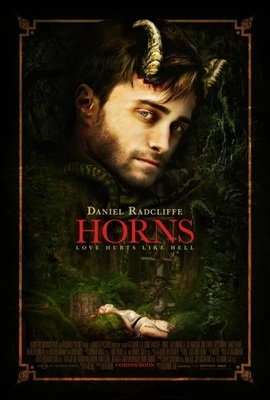
As a movie “Horns” is out of tune


Horns_Official_Movie_Poster

This morning I learned that the movie adaption of “Horns” is available as a limited release before it hits the theaters. Is this a sign of a bad movie or a very good marketing ploy? I decided to find out.

There’s a scene in which a character goes on a very bad trip after swallowing a plate full of pills and snorting a bag of coke. His mind races between several disturbing images, climaxing with his body being pulled into a nasty forest. This sums up Alexandre Aja’s adaptation of Joe Hill’s novel “Horns”.

We all know movie adaptations often deviate from the novel that it’s based on. Given time constraints it is never surprising when changes occur; characters and events are cut out, etc. As book /movie lovers we accept this. Oh we may grumble here and there at minor changes, but overall we accept that what we read may not be what we see. What we should not accept is a director rewriting the plot. It is unforgivable that a director would decide that the original material is not good enough to sell. This is exactly what what Aja has done. He has taken a really good book and turned it into sludge. I couldn’t tell if what I was watching was supposed to be a dark comedy or a campy horror movie. I have a sneaky suspicion even Aja could decide which it should be. The results are disastrous.

For those of you unfamiliar with Horns, here is a review I wrote after reading it for a second time. In short, it is an intellectual horror story that begs the question, “At what point do we become the person others expect us to be?” To sum it up, Ig Perrish is accused of murdering his girlfriend after several witness see them fight on the night of her murder but there is no proof. For this Ig is carries around the stigma of murderer. After a night of heavy drinking he wakes up to find he has grown horns. As the story progresses Ig must decide how he is going to cope with his devilish problem. His moral dilemma is deciding what kind of person he truly is.

The novel centers on Ig and the psychological damage inflicted on him by others. We watch as Ig tries to navigate through personal trauma. We sympathize with Ig and come to understand his emotional move from numbness to blind rage. The movie centers on Ig’s transition and his use of it in order to find his beloved’s killer. There is not a lot of sympathy with this Ig, as he seems all to happy to embrace his situation, and uses his new powers, not because he feels pushed to do so, but because he takes joy in hurting others.

Sometimes the written word does not translate well into spoken dialog. This is never truer than with Horns. In the novel the scenes in which the towns people interact with Ig are creepy and lased with malicious undertones. In the movie these same lines are played for laughs. It does not help that several of the secondary actors are so bad that their lines feel forced, as if they cannot believe what they have to say. What could have been truly ugly and horrifying came across as campy at best, and worst, I’d say this movie would be a Razzies winner.

Aja has Ig narrate several of the scenes, as if as he is unsure of himself as a director. At the beginning of the movie he has Ig set the plot, as if the movie audience would be too dumb to figure out the movie’s subtle theme; st least in the book the theme is subtle. Ig’s transition from outcast to devil is not always clear, yet we know the change is happening. I don’t know why Aja bothered with narration. In his version it is very obvious what is happening as the movie goes from an odd murder mystery to a very campy horror story. They say the devils in the details, but Aja doesn’t bother with details. His way of storytelling is to hit his audience over the head with obvious plot points by over use of dialog and gore.

The body count in Aja’s movie is high, the deaths are unnecessary and implies that the director was out for blood. The ending is absurd and so thick with religious imagery I wouldn’t have been shocked to see God come down and point his finger at the killer. This illustrates Aja’s limited understanding of the novel. That Joe Hill seems happy with the movie is surprising. Sorry Joe, stick a pitchfork in this turkey, it’s done.

If you read the book, don’t bother seeing this mess of a movie, but if you like campy cheesy horror movies, movies that make you laugh at inappropriate places, by all means watch the movie. It may be one of the best cheesy movies you’ll ever see.

Amazing Waste

Repurposing Food and Reducing Waste

measurestillformeasure

Shakespeare, Classics, Theatre, Thoughts

Nerd Cactus

Quirky Intellect for the Discerning Nerd

Sillyverse

Stories of magic and mystery

Commonplace Fun Facts

Mind-Blowing Facts You Didn’t Know

Fictionophile

Fiction reviews, Bookblogger, Fiction book reviews, books, crime fiction, author interviews, mystery series, cover, love, bookish thoughts...

Patrick W. Marsh

monsters, monsters, everywhere

Shakespeare for Kids Books

Opening the door for kids to love Shakespeare and the classics

desperatelyseekingcymbeline

The 10-year Shakespeare New Year Resolution

Katzenworld

Welcome to the world of cats!

booksandopinions.com

The Book Reviews You Can Trust!

The Book Review Directory

For Readers and Writers

thelitcritguy

screams from the void

Author Adrienne Morris

Step Into the Past—Lose Yourself in the Story.

crafty theatre

ideas inspired by crafty characters

Critical Dispatches

Reports from my somewhat unusual life

The Nerd Nebula

The Nucleus of the Universe for all Nerd Hacks!