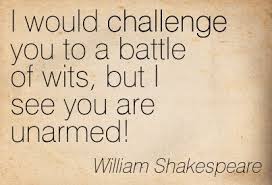
12 Higher brain insults

Shakespeare insult

We’ve all done it. At some point a hammer has missed its mark, a box has landed on a foot or a head has been knocked by an open cabinet or car door. And then, oh then, without thought an obscenity flies out! Maybe just one word or two, but the word(s) are spoken with venom and spite. Though if one is unaccustomed to using coarse language the object of one’s wrath may be merely dammed. Whatever the word(s) we feel better by cursing.

Experiments have shown that test subjects are able to keep their hands in freezing water longer when they repeat a swearword. Scientists believe that swearwords occupy a different part of our brain than does polite language. Most speech is a “higher brain” function while swearwords are stored in the “lower brain” the Limbic system, which is responsible for our emotions and autonomic nervous system. Swearwords may activate endorphins, which in turn interact with the opiate receptors in the brain to reduce our perception of pain. This would be all well and good if we only used swearwords as automatic pain reducers but we do not. Over the centuries we have directed curses, oaths and obscenities to our fellow man, and we are not the better for it. It has become the lazy vocabulary of our culture. When we cannot come up with something clever to say, we resort to ignorant language.

The reason I bring this all up is because I’m reading Melissa Mohr’s book, Holy Sh*t. A brief history of swearing. In it she reminds us that linguistically, a swearword is one that” kidnaps our attention and forces us to consider its unpleasant connotations”. The connotation gives the word its emotional punch. The connotation of f*cking, could mean really, really bad or working hard at something, depending on its use. The word itself is only taboo because of its connotation.

We use swearwords for a variety of reasons but no matter the reason or connotation we want to get across, we are engaging our lower brain when we do so. The idea that we sometimes allow our Limbic system to take over when telling someone off leads to questions. Does the act of telling someone off itself activate our lower brain or is it the language that we use? Do we do a double stoop by not only resorting to course language but also by wanting to? These are the kinds of questions that keep me in the shower longer than I should or reading further into Mohr’s book. I started making some notes because I wanted to know if there was a better way to tell someone off, or describe a horrible person while still using our higher brain? Of course we could just stop saying bad things to and about people, but sometimes there is no better option. Sometimes people need to be told off and described in harsh honesty.

Luckily I came up with an answer, one that allows us to use our higher brain and stops us from using lazy and ignorant language. Of course the answer is Shakespeare! Our Will was a master of insults and barbs. Many of his plays would not work as well without them. Of course he threw in an Elizabethan swearword or two to get his point across, but overall he showed us that a witty turn of a phrase was just as effective. So the next time you are forced to mentally dual with someone, yell at a teammate for a bad play or have the last word, I give you

 12 Shakespeare insults.

Each one was picked for how quickly it can be memorized and how seamlessly it fits into today’s language.  *Modern spelling is an option.

 As you like it

Let’s meet as little as we can

I do desire we may be better strangers

In civility thou seem’st so empty

All’s well that ends well

You show yourself highly fed and lowly taught

Henry VI part 2

That is too much presumption on thy part

The Tempest

Hell is empty and the devils are all here

You freckled whelp hag-born

Look, he is winding up the watch of his wit: by and by it will strike

You are living drollery

King Leer

I have seen drunkards do more than this in sport

Love’s Labour Lost

Come, come, you talk greasily: your lips grow foul

O! thou monster Ignorance, how deform’d dost thou look

5 books that have influenced my life

I’m back! And I have a list!

neil-gaiman-meme-author-quote

I saw this meme last night and it got me thinking. Now, I don’t know if Gaiman actually said this, as memes are known to be inaccurately quoted but the message is true. What self-professed bibliophile could come up with a short list of 5 of their most beloved books? I certainly can’t. But the message did get me thinking; could we come up with a short list of 5 books that have had the most influence on our lives? Let’s try. To make this challenge even more meaningful, don’t think too hard about this. Pick the 5 that pop immediately into your head. Those that rise in your thoughts first probably have had the greatest impact. Here are mine.

The Nancy Drew series. Now before you call me out as a cheater, hear me out. No one Nancy Drew mystery comes to mind. It is the series and how it influenced my behavior that stands out. The Nancy Drew series was not my introduction into literature (that would be Goldilocks and the Three Bears) but it was the gateway to my reading addiction. Between the ages of 10 and 14 I would rather read a ND then watch TV. To this day, I prefer books to any other hobby or habit.

Two of my friends and I decided to become the neighborhood detectives. We combed the streets looking for a good mystery to solve. Many a Saturday afternoon was spent peering into back yards and around the small industrial shops that surround our urban houses. We were the first to figure out that the old MacDonald” sisters” were not sisters at all. Surely no two sisters held hands and kissed as they sat sipping tea in their backyard. Mr. Cinnomini liked to sneak flowers to Miss Clarks porch; he was married she was not. While we never did find a mystery worth solving for money, we did exercise our minds and bodies while we looked for clues. The most important lesson I learned from ND was that even young girls could be independent and smart.

Macbeth. I think I have talked about my early introduction to Shakespeare before, so forgive me if I am repeating myself. In my senior year of high school our English instructor took a leave of absence. The school’s only other English teacher was generous enough to take on our class. He was teaching Shakespeare in his class, so it made sense to do the same in ours. This was at a time when I found myself at a cross-road. My peers were pulling me in two directions. I could let the less desirable of my friends influence my behavior or I could spend more time with my studious friends and get serious about college. The damage that Lady Macbeth inflicted on her mind woke me up. Her famous, “Out damn spot” speech hit a nerve. I credit Mr. Foster’s acting while reading the lines for my final decision. To this day, I strive to make damn sure I never do anything that I would regret to the point to permanently stain my mind and soul. Guess which of my peers won.

The Divine Comedy. My introduction to the humanities was Dante’s classic work. My humanities professor, Mr. Hobart was obsessed with the poem and spent an entire semester teaching its meaning to us wide-eyed college freshmen. I too learned to love the poem-I have 6 translations- and it influenced my attitude towards classic literature. Even after dropping out of college I felt the pull of Dante and his warning of “you reap what you sow”. It is Dante who turned me once again towards higher education. I wanted to redeem myself and prove that I could be graced with intellect. This is not as snobby as it sounds. I wanted to show myself I was smarter than I gave myself credit. I did not want to abandon the hope that if I worked hard enough, I, like Dante could find my way out of the woods of ignorance and fear.

A Flash of Lightning in the Dark of Night.  For a while I was lost in a dark wood. Even though I was married and had a wonderful child something was not right. Like a lot of people I turned to eastern philosophy in the hopes of correcting my troubles. The Dali Lama has had a huge impact on my life. So much so that it would take a separate blog post to explain. But it is this book of his that really changed my life. He talks a lot about victimhood in this book and how many of us continue to identify with and hold onto old wrongs. This was me and why I felt so damaged. His message was simple yet powerful. If you cannot forgive those that have hurt you, at least forgive yourself for allowing the hurt to continue. Let it go and move on! The only person who makes you feel victimized is you. Once that sunk in, I felt something I had never felt before, control of my life and attitude.

A Brief History of Nearly Everything. Bill Bryson is my hero! Upon returning to college one of my first classes was in natural science. I quickly realized I lacked any scientific knowledge (okay, that’s not true, I was a gardener but had not connected the two until this book). Bryson’s book not only brought me up to speed on science, but allowed me to explore a part of me I didn’t know existed. I learned I love science! After Bryson I read anything and everything from books on quantum mechanics to astrophysics. Had I been younger and not a mother, I would have switched majors and headed to New York to intern at the Natural History museum. As my bio says I have morphed from a spiritual hippie to a science geek. All because of Bill Bryson.

Okay, that’s my list. What’s on yours?

Amazing Waste

Repurposing Food and Reducing Waste

measurestillformeasure

Shakespeare, Classics, Theatre, Thoughts

Nerd Cactus

Quirky Intellect for the Discerning Nerd

Sillyverse

Stories of magic and mystery

Commonplace Fun Facts

Mind-Blowing Facts You Didn’t Know

Fictionophile

Fiction reviews, Bookblogger, Fiction book reviews, books, crime fiction, author interviews, mystery series, cover, love, bookish thoughts...

Patrick W. Marsh

monsters, monsters, everywhere

Shakespeare for Kids Books

Opening the door for kids to love Shakespeare and the classics

desperatelyseekingcymbeline

The 10-year Shakespeare New Year Resolution

Katzenworld

Welcome to the world of cats!

booksandopinions.com

The Book Reviews You Can Trust!

The Book Review Directory

For Readers and Writers

thelitcritguy

screams from the void

Author Adrienne Morris

Step Into the Past—Lose Yourself in the Story.

crafty theatre

ideas inspired by crafty characters

Critical Dispatches

Reports from my somewhat unusual life

The Nerd Nebula

The Nucleus of the Universe for all Nerd Hacks!