Science books on my wish list.


So what have you all been up to? As I write this we are having our second thunderstorm this week. This may not seem unusual to most, but here in N. Nevada we do not often have these. Our electricity is going off and on and we may get some flooding. I love rain so I am enjoying the weather but can live without the flickering lights.  The storm is supposed to last a few days; hopefully no one is hurt or the flooding harmful. I love that that my trees and plants are getting a lot of water; we are a desert so any rain is to be celebrated.
I have been busy with school and in my new capacity as a copy-editor. I am enjoying my second job but as you may have noticed, it is taking time away from my first loves; reading and blogging.
As long time followers know I am a huge fan of podcasts. I love to listen while I work. Since I have not been reading much lately I decided to catch up on some book related podcasts from NPR. Wow, I had no idea so many good science books have come out in the last few months! I researched a few titles and thought I would share them with you. All of these are on my wish list. Are they on yours? What science books have you read and recommend? Help me grow my science list; the holiday season is just about here and I need some titles for my list.
https://images-na.ssl-images-amazon.com/images/G/01/misc/transparent-pixel._V192551059_.gif
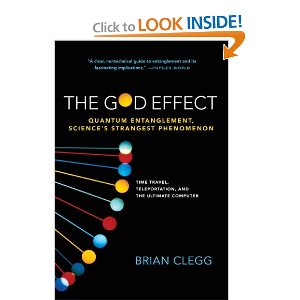
by Brian Clegg I enjoyed the review of Clegg’s book. It is written for the layman who wants to understand quantum physics. Here is from a review”
The opening chapters set up the discovery of quantum entanglement, which occurred during the professional debate between Max Bohr and Albert Einstein as they discussed the nature of quantum physics. Clegg then provides historical understanding and the potential applications of entanglement to advance current technologies. Those chapters read like a science-fiction novel–an unbreakable secure communications system, teleportation, and supercomputers that think all become possibilities.
https://images-na.ssl-images-amazon.com/images/G/01/misc/transparent-pixel._V192551059_.gif
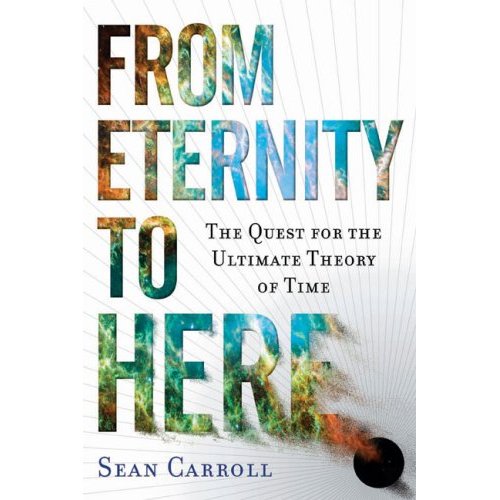
by Sean M. Carroll. I listened to a half hour interview with Carroll who explains what time may really be (Einstein may be wrong) and what this means to our world view.
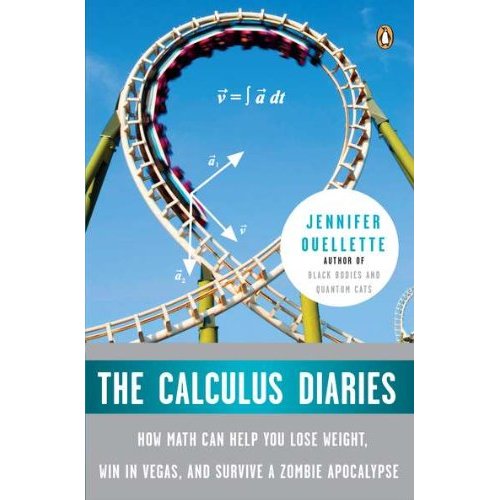
The Calculus Diaries: How Math Can Help You Lose Weight, Win in Vegas, and Survive a Zombie Apocalypse by Jennifer Ouellette. Now I do not usually read math books but this may help me understand why we need math and how it is all around us. Math scares me but Jennifer insisted she wrote the book for people just like me. Oddly enough she is married to Sean Carroll. He is the geeky science husband she talks about in her book.
https://images-na.ssl-images-amazon.com/images/G/01/misc/transparent-pixel._V192551059_.gif
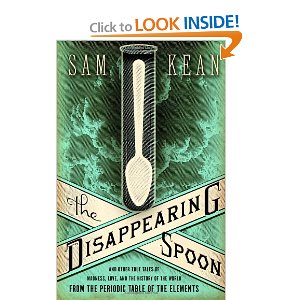
by Sam Kean . I had to laugh when I first heard Kean being interviewed. Writing a book about Periodic Table, seriously? Oh, but he had such great stories all connected to the elements.
From Publisher’s Weekly:
Science magazine reporter Kean views the periodic table as one of the great achievements of humankind, “an anthropological marvel,” full of stories about our connection with the physical world. Funny, even chilling tales are associated with each element, and Kean relates many. The title refers to gallium (Ga, 31), which melts at 84ËšF, prompting a practical joke among “chemical cognoscenti”: shape gallium into spoons, “serve them with tea, and watch as your guests recoil when their Earl Grey ˜eats™ their utensils.” Along with Dmitri Mendeleyev, the father of the periodic table, Kean is in his element as he presents a parade of entertaining anecdotes about scientists (mad and otherwise) while covering such topics as thallium (Tl, 81) poisoning, the invention of the silicon (Si, 14) transistor, and how the ruthenium (Ru, 44) fountain pen point made million for the Parker company. With a constant flow of fun facts bubbling to the surface, Kean writes with wit, flair, and authority in a debut that will delight even general readers.
The total science nerd in me wanted to leave work and rush to buy this book. Sadly, Borders does not carry it, so I will have to order it, if I do not get it as holiday gift. See I am trying to hold off on buying any books before December, but oh this one has me wanting to push the “buy it button”.

What am I doing? I read

Anyone who has attempted to or mastered a second language can tell you it is hard grasp the idea that other languages do not include the word do or the ending ing. English grammar dictates that we answer the question “what are you doing?”, with” I am reading”. The translation from all other languages would be “I read”. Of course the person would also wonder what you mean be doing. Doing is not translatable in any other tongue.  Once we understand that English is the oddball when it comes to case endings and verb placement it is a little easier to learn another language.  But since we are not taught that our language is the only one who dropped gender nouns, case endings and moved our verbs we have a hard time learning foreign languages.  Our brains have been trained to think and speak unlike anyone else on the planet. We should understand that when someone says “I read”, they are not uneducated they are speaking they way they were taught.
Fun facts I just learned: The words: beef, pork, bacon and poultry are French terms used by the English royalty during the Middle Ages.  After the Norm Conquest of 1066, royalty, the courts and nobles spoke and corresponded in French. The peasants spoke what is now called Old English. Royal chefs did not cook cow, he/she would have served beef. Nor would the upper nobility eat chicken or pig; they would eat pork, bacon or poultry (spelled poultier). Over the years these words would come to mean what is cooked. We may still raise cows, pigs and chickens but we serve beef, pork and poultry.  I had always thought the meat industry came up with these words to order to sell us on the idea of eating animal flesh on a daily basis. I love facts like this!
The reason I bring all of this up is because I am reading two good books on the history of the English language.  I am also seriously looking into learning Old English; it would be a great tool as I study the Middle Ages and would help me master German.
The first book I picked up on the history of English is Bill Byrson’s The Mother Tongue. Bryson is a master at nonfiction. No matter what the subject, he manages to make it interesting and fun.  One of his skills is taking a complicated subject and watering it down just enough to appeal to a layman but not so much that you feel as if you are being talked down too. Sometimes when I watch the History Channel’s The Universe, with all their computer graphics and prop driven explanations I wonder who their attended audience is, a bunch of fifth graders? Bryson never makes a reader feel dumb. If anything his writing reminds us that yes we can learn hard subjects if only someone would explain them in plain terms.
The second book I picked up is John McWhorter’s Our Magnificent Bastard Tongue. McWhorter’s work is a nice complement to Bryson’s as this book looks a little bit deeper at the history of our language and why ours is the oddball. It is a little on the dry side, though he does attempt some humor.  The only complaint I have is slight, and is my fault. Because he is a linguistic he uses terms I am unfamiliar with. My knowledge of grammar rules and terms is woefully inadequate. I am desperately trying to catch up but at times I am bogged down with terms and explanations. Bryson explains things in terms I can understand and Mcwhorter takes it to the next level. If you are a grammar nut I highly recommend these two books. If not, perhaps the book I received in the mail yesterday may appeal to you.
I love Bram Stoker’s Dracula; I have read it three times. Two years ago I learned he wrote a collection of short stories and Penguin Classics put them together in Dracula’s Guest and Other Weird Stories.  I had this book on my wishlist over at Paperback Swap and earlier this week another member posted it. I am hoping to read it this weekend.
So here is a call to all my grammar nut followers: do you have a favorite grammar book? Have you mastered anther language? If so, I want to hear from you.
Amazing Waste

Repurposing Food and Reducing Waste

measurestillformeasure

Shakespeare, Classics, Theatre, Thoughts

Nerd Cactus

Quirky Intellect for the Discerning Nerd

Sillyverse

Stories of magic and mystery

Commonplace Fun Facts

Mind-Blowing Facts You Didn’t Know

Fictionophile

Fiction reviews, Bookblogger, Fiction book reviews, books, crime fiction, author interviews, mystery series, cover, love, bookish thoughts...

Patrick W. Marsh

monsters, monsters, everywhere

Shakespeare for Kids Books

Opening the door for kids to love Shakespeare and the classics

desperatelyseekingcymbeline

The 10-year Shakespeare New Year Resolution

Katzenworld

Welcome to the world of cats!

booksandopinions.com

The Book Reviews You Can Trust!

The Book Review Directory

For Readers and Writers

thelitcritguy

screams from the void

Author Adrienne Morris

Step Into the Past—Lose Yourself in the Story.

crafty theatre

ideas inspired by crafty characters

Critical Dispatches

Reports from my somewhat unusual life

The Nerd Nebula

The Nucleus of the Universe for all Nerd Hacks!