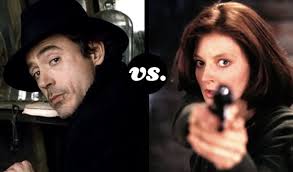
New Rules For The Modern Detective

imagesAs a tribute to Sir Arthur Conan Doyle, born on this day in 1859, I thought I pulled this from the archive. Doyle did not invent the detective story (that would be Poe) but he did give us one of the first who had some serious issues. So just for fun, let’s talk about the flawed detective.

Why are today’s detective fiction protagonists so full of angst? Along with crime solving we are forced to watch as the well-educated Kay Scarpetta has a tragic affair with a married man. It’s fun to watch gritty John Rebus solve homicides in Scotland’s underbelly, but not so much to watch him battle his alcohol addiction. The Alex Deleware books were fun, until his personal life became the major plot points of Kellerman’s books. Yes, we do want fictional characters to have personalities and quirks so we can identify with them, but at some point we’d probably tell our best friends they needed help if they had the problems we see with today’s fictional detectives.

It wasn’t always like this. During the Golden Age of Detective Fiction, authors adhered to the Rules of Fair Play. These rules were put in place as a sort of pact with their readers. Detective fiction in the late 1920’s and 30’s assured readers that if proper attention was given to a book, they too could solve the crime right along with their favorite detective. This is why when Agatha Christy published “And then there were none” in 1939, both critics and readers were outraged as she purposely ignored the pact and guidelines. But even Christy would not dare over-humanize (yes, I just made that up) her characters.

This was the beauty of early detective fiction, there was less attention given to the characters so that the bulk of the story could center on the crime in question. Oh sure Holmes had his addiction, but Doyle did not make this a major plot point. Come to think of it, it would be kinda fun to read “Holmes and the Rehab Center”. Here Holmes could face his dependence while pointing out character flaws in the other patients. Many novelists today would do well to dial back the angst and instead focus on getting rid of plot holes or doing away with the surprise villain. Villains who come out of nowhere because the author was so busy attending to characterization that he or she forgot to figure out “who dun it”.

The rules of the game were codified in 1929 by Ronald Knox and agreed upon by the British authors Detective Club.  According to Knox, a detective story:

“Must have as its main interest the unraveling of a mystery; a mystery whose elements are clearly presented to the reader at an early stage in the proceedings, and whose nature is such as to arouse curiosity, a curiosity which is gratified at the end.”

Knox’s “Ten Commandments” are as follows:

  1. The criminal must be mentioned in the early part of the story, but must not be anyone whose thoughts the reader has been allowed to know.
  2. All supernatural or preternatural agencies are ruled out as a matter of course.
  3. Not more than one secret room or passage is allowable.
  4. No hitherto undiscovered poisons may be used, nor any appliance which will need a long scientific explanation at the end.
  5. No Chinaman must figure in the story. (No he wasn’t being a racist, perhaps just tired of the many Fu Manchu books being churned out. Okay, it still sounds racist)
  6. No accident must ever help the detective, nor must he ever have an unaccountable intuition which proves to be right.
  7. The detective himself must not commit the crime.
  8. The detective is bound to declare any clues which he may discover.
  9. The “sidekick” of the detective, the Watson, must not conceal from the reader any thoughts which pass through his mind: his intelligence must be slightly, but very slightly, below that of the average reader.
  10. Twin brothers, and doubles generally, must not appear unless we have been duly prepared for them

Historians now think Knox was being sarcastic, yet it is well documented that the British Detective Club took them rather seriously. They called Christy out and Sayers blatantly broke the rules with Gaudy Night.

We can laugh at these rules, but for almost 20 years they helped form the genre we now call “cozy mysteries”. Perhaps what we need is a new set of rules, even if they are taken as sarcasm.

  1. No detective can have more than one love interest at a time.
  2. Villains cannot appear out of then air. They have to be at least mentioned once prior to being named the culprit.
  3. Addictions cannot be made public. If fictional characters are to remain true to life, then any addiction must be hidden from the public, this includes the reading public
  4. Twists cannot be so convoluted as to make the writers of Mission Impossible spit out their coffee and yell, “no body would believe that shit”! (I’m looking at you Dan Brown)
  5. If you insist on writing a historical crime novel do some research. And no, watching the entire Downton Abbey and Brother Cadfael series does not count. I for one do not want to read another medieval mystery in which one character turns to another and says, “See you next weekend”. Medieval life was nasty, brutish and short. And they sure as hell didn’t get the weekends off.

Okay, so I started the list. What do you think? What would you add to it?
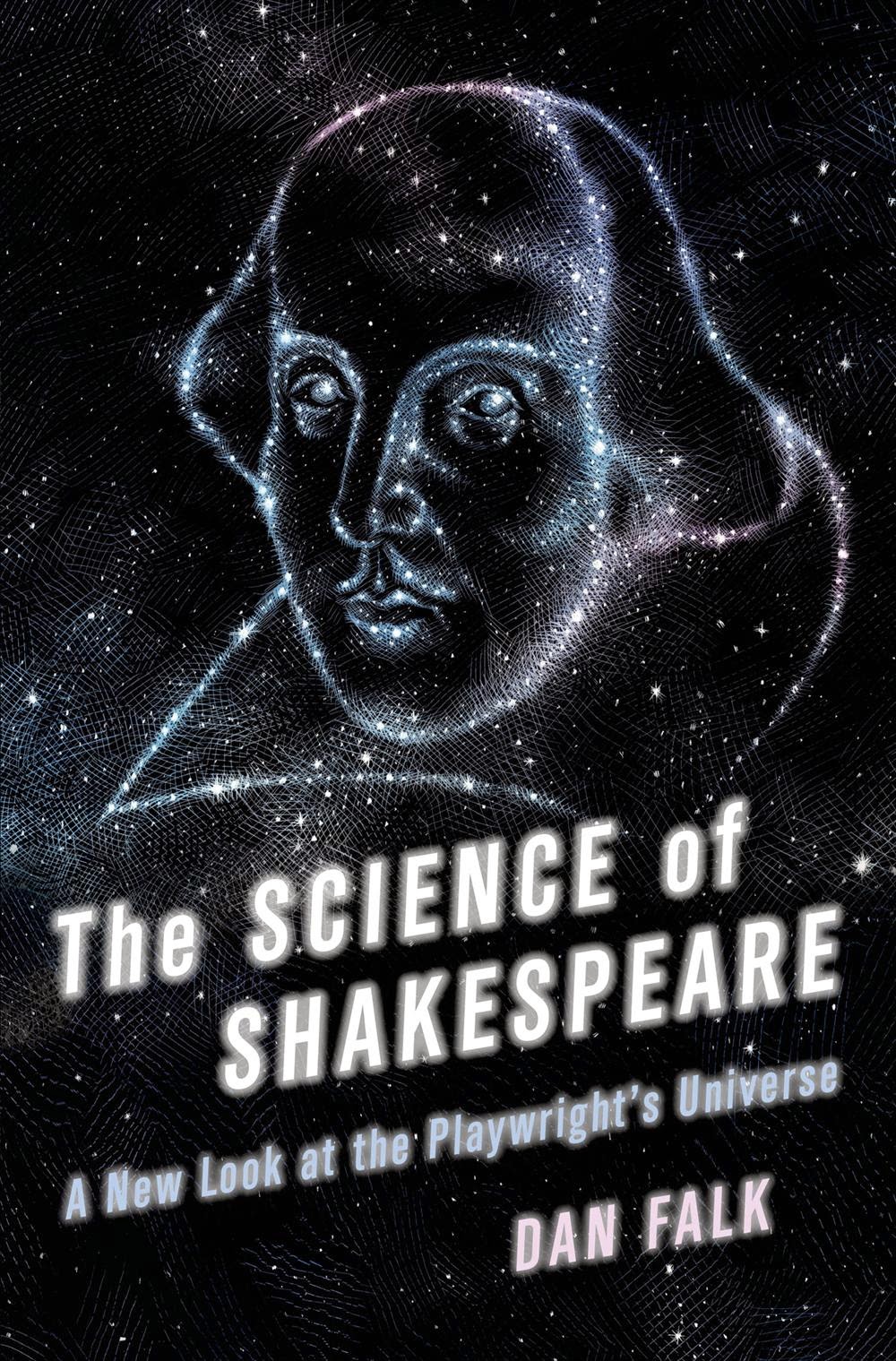
The Science of Shakespeare, a review

Science+of+Shakespeare,+The

In 1996, during a meeting of the American Astronomical Society astronomer Peter Usher presented a usual paper titled “A new reading of Shakespeare’s Hamlet”. In the paper Usher argued that Hamlet was written as an allegory about competing cosmological models. It is always a little alarming whenever someone announces they’ve peered into Shakespeare’s mind and unlocked its secretes, but in this case Usher’s paper begged a very good question: what, if any influence did science have on Shakespeare’s work?

Dan Falk tries to answer this question in his tour de force, The science of Shakespeare. Falk reminds us that,“William Shakespeare lived at a remarkable time—a period we now recognize as the first phase of the Scientific Revolution. New ideas were transforming Western thought, the medieval was giving way to the modern, and the work of a few key figures hinted at the brave new world to come: The methodical and rational Galileo, the skeptical Montaigne”. The obvious question is, did any of this have an impact on Shakespeare’s writing? If so can we find hints of scientific ideas in Elizabethan pop culture?

From the very start Falk admits to be walking a thin line. It’s one thing to analyze Shakespeare’s work in order to form an opinion on what he might have thought; it is another to conjecture based on one’s own thoughts. That an astronomer thinks Hamlet is some sort of scientific thesis should gives us pause. Yet Falk is open to the idea that Shakespeare was indeed influenced by the events and people around him and that this influence is peppered through out the plays.

Does Falk present a convincing argument? I think so. First, we have to admit that it is not unusual for a writer to be influenced by current events and public figures. Shakespeare would not have such a lasting impact on us if he had not commented on society. Yet this idea of science in Shakespeare shows us that there is more going on than just simple acknowledgment of the changing times. Drawing on new ideas and discoveries, Shakespeare may be telling us how they affected society. After all, his audience would have to have some basic understanding of them in order to understand his words.

Falk makes his case by introducing us to some of history’s most compelling thinkers. Men like Thomas Digges, the publisher of the first English account of the “new astronomy” and who just happened to live in the same neighborhood as Shakespeare; Tycho Brahe, whose observatory-castle stood within sight of Elsinore and whose family crest happened to include the names “Rosencrans” and “Guildensteren (did you know that? I didn’t) and my favorite (I have to thank Falk for introducing him to me) Michel de Montaigne, a skeptical thinker whose motto Que sais-je? (What do I know), mirrors my own. Falk shows us how each of these men and others, in one way or another influenced Shakespeare’s work.

Take for instance, Montaigne. His essays on his thoughts on life and the universe clearly show up in Shakespeare’s The Tempest. Montaigne talks about a group of Tupinamba people who were brought to France by French explorers. He writes:

It’s a nation….that hath no kind of traffike, no knowledge of Letters, no intelligence of numbers, no name of magistrate nor politke superiorite; no use of service, or riches or of poverty…”

Now take Gonzalo’s view of a utopian society:

I’th’ commonwealth I would by contraries

Execute for all things, for no kind of traffic

Would I admit; no name of magistrate;

Letters should not be known; rich, poverty

And use of service none.

This does not prove Shakespeare argued for a utopian society, but it does show us that he was reading and thinking about recent publications and events. As I read this I wondered if The Tempest was indeed a critical allegory to colonization, and if so, was it Montaigne who planted the seed of doubt in Shakespeare’s mind?

Around 1610, Galileo’s book, The Starry Messenger was a hot topic in English intellectual society. The book sold out. Thomas Hobbes had a hard time getting his hands on a copy. Galileo’s observation of Jupiter’s four “satellites” showed that Copernicus’ model of a heliocentric universe just might be right after all.

This had to be big news and to ignore it would be to ignore the changing views of our place in the universe. Shakespeare could have written a play about this had it not been controversial and a little boring for two hour play, but instead seems to have planted the idea in a convoluted scene in Cymbeline. In the scene, Posthumus, finds himself jailed. In his cell Posthumus has a dream in which four ghosts visit him and move around him in a circle. They call upon the god Jupiter to help him. Humm.. four satellites and the god Jupiter? This is either an odd coincidence or Shakespeare’s way of introducing his audience to idea of this discovery.

Of course we will never know. Though the book is filled with more examples, some more convincing than others, Falk never makes the claim that these are proof that Shakespeare used science. We are left to form our own opinions. This is one of many reasons this is a compelling read. Falk explores many theories on Shakespeare and science, yet rarely comments on them. The one exception may be his agreement that Prospero may be based on Thomas Digges rather than John Dee. I do not agree, for the simple reason Dee was both a man of science and a magician who claimed to talk to the angel Uriel (just as Prospero talked to Ariel).

If nothing else this is a wonderful look at the history of science and the men who brought about the scientific revolution. It had me questioning some of the modern assumptions about Shakespeare’s work. It just might be my choice for best read of 2014.

Amazing Waste

Repurposing Food and Reducing Waste

measurestillformeasure

Shakespeare, Classics, Theatre, Thoughts

Nerd Cactus

Quirky Intellect for the Discerning Nerd

Sillyverse

Stories of magic and mystery

Commonplace Fun Facts

Mind-Blowing Facts You Didn’t Know

Fictionophile

Fiction reviews, Bookblogger, Fiction book reviews, books, crime fiction, author interviews, mystery series, cover, love, bookish thoughts...

Patrick W. Marsh

monsters, monsters, everywhere

Shakespeare for Kids Books

Opening the door for kids to love Shakespeare and the classics

desperatelyseekingcymbeline

The 10-year Shakespeare New Year Resolution

Katzenworld

Welcome to the world of cats!

booksandopinions.com

The Book Reviews You Can Trust!

The Book Review Directory

For Readers and Writers

thelitcritguy

screams from the void

Author Adrienne Morris

Step Into the Past—Lose Yourself in the Story.

crafty theatre

ideas inspired by crafty characters

Critical Dispatches

Reports from my somewhat unusual life

The Nerd Nebula

The Nucleus of the Universe for all Nerd Hacks!