The Gospel of VALIS

Not too long ago I dated a man who asked “why do you spend so much time on the internet? You do realize you don’t know these people”. Well it turns out it was him who I did not know. When he said “I love you” what he really was saying was,” I like what I’m getting out of this relationship”. Once he had to put some effort into it he was gone.

I agree we don’t always know other people, but I will argue there are different degrees of knowing someone. Sharing ideas and reading other people’s work is a way to get to know someone else. Sadly, no I would not know many of you if we passed on the street, but I know you enough to want to spend time reading your work and joking with you on Twitter. I consider you my friends. So with that in mind I’m sharing a piece of me.This is my way of saying thank you for being there when I called out for encouragement.

This is a short essay I wrote for class. The class is titled “Literature and Religious Imagination”. This is the first graduate class in which the professor has asked us for short concise essays. I am not sure what I am mastering in this class other than the skill of brevity.

For those of you unfamiliar with Philip K Dick, he was a science fiction writer, whose best known for Do Androids Dream of Electric Sheep? The book is the basis for the movie Blade Runner. Dick wrote VALIS at at time in his life when he was suffering from a self diagnosed mental break-down. VALIS is the first in a series of books in which Dick explores religious ideas and fuses them with self confessions. As much as I enjoyed the book, and recommend it, I must confess, I felt he did go off the deep end in this book. The core premise is what kept me up at night; what if our creator was insane?

philip_k_dick_valis_ltdfull

The Gospel of VALIS

            To paraphrase reverend Horselover Fat, “The universe is the physical manifestation of an irrational mind”. Fat is not too far off from what many philosophers and scientist have been arguing for thousands of years, though he is the first to say irrational mind. Plato believed the universe and everything in it is the physical manifestation of perfect nonphysical “forms”. That everything we see and experience are imperfect copies of perfect metaphysical forms.  Yet, what if the physical is imperfect because the non-physical is also imperfect? Could we not argue that we are imperfect because there is no other way to be? Plato was wrong to call his forms perfect, because perfect cannot make imperfect. If it did, it would no longer be perfect.

Professor Paul Davies argues in his book The mind of God that, “the universe is a kind of gigantic computer”.(16). He goes on to argue that the universe is no minor byproduct of mindless forces. That it works as if it is a mind. Davies does not believe that a god created the universe for his pleasure, rather the universe is the mind of what we in the West call God and what the Hindus call Brahman. Hindu philosophy says Brahman is the universe and everything in it are bits and pieces of Brahman. Taken as a whole, everything makes up Brahman.

Professor Amit Goswami argues in his book The Self-Aware Universe, how consciousness creates the material world, that consciousness affects how atoms behave. They act rational because a rational consciousness controls them. Quantum physics tells us atoms and partials do not always act rational. Could this be because the consciousness that controls them is irrational? This could explain the odd behavior of quantum mechanics.

The reverend Horselover Fat, I call him reverend because he shares his new religion with anyone who will listen, believes that the universe is made up of living information able to replicate itself. “Replicating not through information, information as information.”(225) Fat argues that atoms are living information that come together to create the universe. He believes Plato’s forms and the Greek Logos are living information, or as Professor Goswami would say “consciousness”. Because Fat considers himself and everyone around him crazy, he goes to say, “A streak of the irrational permeated the entire universe, all the way of up to God.”(201). He believes that “God” or the “Ultimate Mind” suffered a terrible loss and that “From loss and grief the mind has become deranged. Therefore we, as part of the universe are partly deranged.”(201) We need to keep in mind it is Fat who suffered a terrible loss, and from this loss came his revelations and new found religious beliefs. Even so, could he be on to something? Let us look at his idea through two viewpoints; that of religion and science. Let us argue his points for him.

Let us suppose the universe is the physical manifestation of a mind so advanced that its very thoughts became living information; that all matter is made up of this information. We will call this mind God. If our supposition were right, this would explain why we humans are irrational beings and why we cannot get along. Our emotions are irrational! We act as we are, irrational beings living in an irrational universe. It is hard for many to believe a perfect mind would create such irrational beings yet this is what we are told. This creator, if we are to believe the stories, at times is irrational. He places the Tree of Knowledge on the Garden of Eden then tells his creations no to eat from it. If he did not want them to eat from it, why did he put it there in the first place? This is not rational. He gives his creations free will then punishes them with destruction for using free will. He tells a group of his creations they are now his chosen group and then instructs them to kill another group of his creations. None of this is rational behavior. If this is all playing out in the Ultimate Mind, we must assume the Ultimate mind is deranged just as Fat tells us.

If we assume the Big Bang was consciousness creating matter as Professor Goswami says or the universe is played out in a gigantic computer as Davies tells us, then we must ask, what kind of mind is this? The stars and planets are unstable; quantum mechanic laws vary depending on observation. Science believes quantum mechanics to be unstable. Is this because the mind or consciousness that created them is itself unstable? Could it be that we humans are irrational because of this unstable mind? Or as Fat thinks, are there some things that this mind cannot control? If so, it would be yet another argument for an unstable mind, one that cannot control its own physically manifested thoughts.

How often have we looked around and observed that the world is irrational? We pacify ourselves with the idea that we are imperfect creatures and have come up with rational explanations for our imperfections. We use medical science, psychology and sociology to justify our irrational behavior. Natural science explains our unstable planet, yet none of this adequately explains the deeper question of “why does this have to be so”? Why do we have to have mental illness, why do we have to have earthquakes? Why is the universe in all its glory so irrational and unstable? Reverend Horselover Fat is on to something when he preaches the universe is the physical manifestation of an irrational mind.

Works Cited

Davies, Paul. The Mind of God. New York: Touchstone, 2001.

Dick, Philip K. VALIS. New York: The Library of America, 2000.

Goswami, Amit. The Self-Aware Universe how consciousness creates the material world. New York: Putnam Books, 1993.
Medieval Children

I have a good friend who designs sets for the local playhouse. I’m her go-to guide to all things medieval. She called this afternoon looking for some pictures for costume ideas for an upcoming production of “The Princess and the Pea”. She has to make costumes for children and adults.We started talking about medieval children; what they wore and how they lived. As we sat chatting in my kitchen, it occurred to me that there are a lot of misconceptions about medieval childhood. We tend to see them as hard working miniature adults, never able to laugh and play. Popular myth tells us for them, childhood ended at the age of 6.

This was a subject I found frustrating when I first started studying the medieval period. Oh I found many books on medieval life, but often these books excluded any mention of children ,as if they were mere shadows of adults, hiding from sight until they became old enough to marry. Did we know anything at all about medieval children?

9780300097542

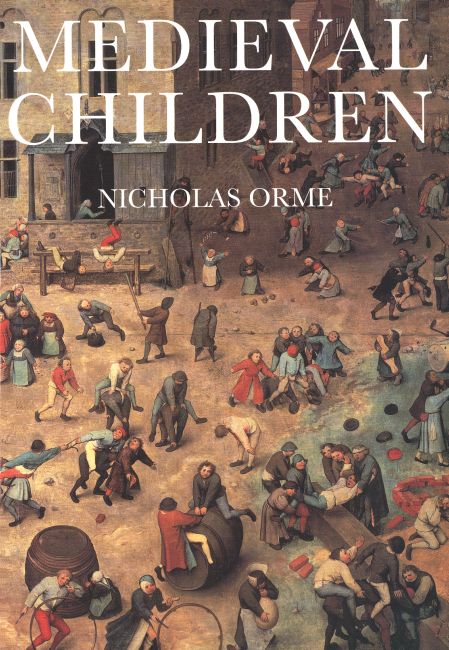
A few years back another friend sent me Nicholas Orme’s Medieval Children for Christmas. It has been a favorite ever since. I pulled this out along with Marjorie Rowling’s Life in Medieval Times so I can give you:

Things you may not know about medieval Children

The Nuclear Family

We often think of medieval peasants as having many children due to lack of birth control and wanting many hands to help in the fields. This is not the case. Medieval families had the same amount of children we see today. The average family had three living children. The number of “stillbirths” would have been around 6.

Medieval families consisted of parents and their offspring. We think of medieval families of consisting of grandparents, parents and children, but again, they lived as we do, with grandparents close by if they were lucky enough to live to see grandchildren.

Pregnancy

Much of what we know of medieval understanding of pregnancy comes from the Franciscan friar Bartholomew the Englishman. What he knew came from Aristotle.

Medieval medicine said a child is formed from the father’s seed and some “matter” from the mother. An embryo growing on the right side of the womb would become a boy, on the left a girl. Medieval philosophy said the dominating characteristics of the parents determined the future child’s character. If a male child was nothing like his father, paternity was questioned. No wonder King Henry IV was so devastated by Prince Hal’s wanton ways and wondered if he and Henry Percy were switched at birth.

Medieval medicine said gestation time varied from 8 to 10 months. Girls took longer to form, as the elements that formed boys were hotter. Boys apparently “cooked” at higher temperatures and in less time.

tumblr_m05z4uW9AL1qfg4oyo1_1280

Birth

Giving birth was seen as a life-threatening ordeal. So much so, that women were encouraged to give confession just as labor set in. Women, seeking divine assurance that all would be well, would have Church relics tied to their skirts or laid out on the bed. For those who could not afford them or were not near a Church had parchments of Biblical sayings tied to their skirts. Sometimes mineral stones would do the trick. Midwives assisted with labor, as it was unseemly work for a man to assist with childbirth. A Midwife were supposed to register with the local Church so as not to be seen as a witch.

I will spare you all the gory details of what could go wrong (and often did) due to misconceptions and lack of medical training. What is interesting to note, is that if a women died while in childbirth the Church ruled that a caesarian operation could be performed to save the child. Because girls married at a young age and gave birth in their early teens, they were the ones who often died.

Dangers and Death

Just because a child was successfully delivered does not mean it would live to adulthood. Orme reminds us of the many perils medieval children faced. The list is long and not very kind. I give you the three most common.

Infanticide and or abuse may occur when a parent is cold, shamed, indifferent or suffer from mental illness. If a child is deemed to be deformed, either mentally or physically, it may be killed or abandoned at the local Church.

Childhood diseases were the number 1 killers of children followed by accidents. Remember this was a time when a simple cut could lead to gangrene or other types of life ending infections.

fullsize

Play

Medieval children who escaped death had their playtime. In fact play was seen as the dividing line between child and adulthood. Youth was seen as wild, fearless and inconsistent. This was a time when young people could act in reckless abandon and innocently enjoy life. The games they played were varied but as with all things in medieval life, had laws and rules issued by the ruling authorities. Some games you would find medieval children playing would be familiar to us.

Closh (a kind of Croquet)

Camping (a type of football or hocky)

Tables (Backgammon)

Quck (like checkers)

Dice

Chess

Medieval children model 1

Children were encouraged to play during festivals and market days. You may be surprised to learn that during religious holidays, market days and fairs, children in large groups could be found playing any number of games. Socialization was important to medieval culture. The children were not just playing; they were learning to act as a group. In this way they were learning social skills and cultural norms. Boys especially were encouraged to play rough games as this they were seen as the first step towards combat skills. Schoolmasters and Church leaders observed boys at play and assessed which would be most suited to the religious life and who would be valued as soldiers.

english450tops

Toys

There is no better argument for a medieval childhood than a list of toys. Toys are the symbol of the celebration of childhood. Even when we cannot afford them we would rather go hungry than deny a child a toy. It a parents “sacrificial” gesture, made solely to please a child. Medieval children were given handmade toys, yet they are not much different than what modern parents buy today.

Rattles

Child’s Bell (a noise maker)

Wooden tops

Windmills (we call them spinners)

Wooden swords

Dolls

Puppets

Kites

Miniature houses

As you can see all of this shows us there was much to medieval childhood and I haven’t hit on the stories, songs and lullabies medieval children would have heard. For more I suggest picking up Medieval Children by Nicholas Orme.

This is a mass produced toy knight from the 1300.
Amazing Waste

Repurposing Food and Reducing Waste

measurestillformeasure

Shakespeare, Classics, Theatre, Thoughts

Nerd Cactus

Quirky Intellect for the Discerning Nerd

Sillyverse

Stories of magic and mystery

Commonplace Fun Facts

Mind-Blowing Facts You Didn’t Know

Fictionophile

Fiction reviews, Bookblogger, Fiction book reviews, books, crime fiction, author interviews, mystery series, cover, love, bookish thoughts...

Patrick W. Marsh

monsters, monsters, everywhere

Shakespeare for Kids Books

Opening the door for kids to love Shakespeare and the classics

desperatelyseekingcymbeline

The 10-year Shakespeare New Year Resolution

Katzenworld

Welcome to the world of cats!

booksandopinions.com

The Book Reviews You Can Trust!

The Book Review Directory

For Readers and Writers

thelitcritguy

screams from the void

Author Adrienne Morris

Step Into the Past—Lose Yourself in the Story.

crafty theatre

ideas inspired by crafty characters

Critical Dispatches

Reports from my somewhat unusual life

The Nerd Nebula

The Nucleus of the Universe for all Nerd Hacks!