
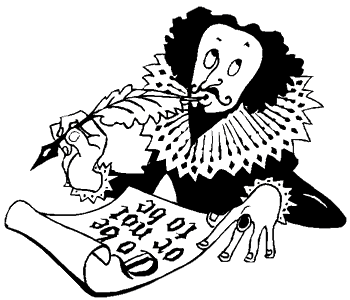
O for a Muse of fire, that would ascend. The brightest heaven of invention, A kingdom for a stage, princes to act. And monarchs to behold the swelling scene!
Back in early October there was a bit of a shake-up in the world of Shakespeare scholarship. Okay, it turned out to be a slight rattle, but for a few days it appeared to be big news. Oxford University Press announced that its next edition of the complete works of William Shakespeare will include a credit to Christopher Marlowe as a co-author on the three Henry VI plays.
It’s been long suspected by some that Shakespeare’s earliest writing included language that strongly suggested ties to Marlowe. There has been an on-going debate between the idea that Shakespeare borrowed words from Marlowe and the idea that the two briefly worked together. But this announcement by OUP is the first time Marlowe has been formally tied to Shakespeare.
Oxford’s decision to credit Marlowe stems from some recent data analysis done by several teams of scholars, and mathematicians that came to the same conclusion; words and phrases associated with Marlowe show up in several of the Henry plays, most notably in Henry VI. Now, while this may indeed be in the case, I feel, as do many other Shakespeare scholars, that Oxford went a little to far when they suggested the two playwrights collaborated together on the Henry plays.
Here is what Gary Taylor, one of the editors of new Oxford Complete Works, had to say on NPR about the two playwrights:
Shakespeare was not a fraud. Marlowe did not write all of Shakespeare’s works. He did something, instead, that was perfectly normal in the Elizabethan theatre, which is he collaborated with another playwright, in this case Shakespeare.
It’s one thing to offer up some data analysis that shows that Marlowe’s “voice” is found in several places in Shakespeare’s plays, but it is quite another to say it proves that the two sat in a pub and wrote a couple of plays together. It may be a little more complicated that what Taylor is suggesting. In fact, the only big news that comes from the analysis is just how quickly OUP jumped to some rather far-reaching conclusions. One would have hoped that they would have reached out to scholars in order to do some type of peer-review on their assumptions. This assumption is all they have to go on, and you know the saying about assuming…
There are numerous other reasons Marlowe’s voice may have appeared in Shakespeare’s plays. Let’s list them out. I know how much many of you like my lists. So, give you
Reasons why it appears Marlowe had a hand in Shakespeare’s work
Marlowe and Shakespeare were buddies
Let’s start with Taylor’s assumption that Marlowe and Shakespeare were friendly rivals. Perhaps Marlowe took a liking to the young actor turned playwright, and offered to help the upstart crow. Keep in mind that the Henry plays were among the earlier history plays that turned Shakespeare’s fortunes. Maybe, just maybe, Shakespeare was sitting in a pub desperately trying to come up with a good play when Marlowe, who just happened to be there too, offered some assistance. Just like in the Movie Shakespeare in Love.
The younger Will didn’t always have the words he was looking for
It is no secret that Shakespeare borrowed stories and plot devices from earlier works, so it is not out of the realm of possibilities that he borrowed words and phrases from well known authors. Marlowe, who gets little credit outside of academia, was the first to use blank verse in conversation. Shakespeare perfected this style, which is one reason his work stands the test of time, rather than Marlowe. Is it possible that the young Will, looking for his voice, borrowed more than just a literary device from Marlowe?
There are only so many words a person can use
The data analysis only shows that certain word use is more commonly found in Marlowe’s work than Shakespeare’s, but this in no way proves beyond a doubt it is because Marlowe used them in the Henry plays. Every writer is a creature of habit; there are certain words we use more than others but every once in a great while we go out of our way to sound different or find uses in our work for words that otherwise don’t normally appear in our work. I’ve always wanted a reason to use the word honorificabilitudinitatibus, but just because it now appears in my writing doesn’t mean the ghost of Shakespeare and collaborated on this post.
The actors who worked with Shakespeare also worked with Marlowe
This one seems a little more plausible to me. The young Will started out as an actor in a troupe that may have acted in Marlowe’s plays. It is not uncommon for writers to take suggestions from actors. It is done today. There is an iconic scene in the first Indiana Jones movie in which a sword-wielding giant confronts our hero. The original script called for a sword fight between the two, but on the day of shooting Harrison Ford came down with the flu, making it impossible for him to perform any action stunts that day. Instead, he asked, “Why can’t I just shoot him?” It made perfect sense, as Indy carried a gun. It worked. The scene was one of the comedic highlights of the movie. Is it possible, that as a group, the actors offered line suggestions to Shakespeare? Carol Rutter and I agree on this point. The professor of Shakespeare offered this same idea to the BBC.
It’s much more likely that he started his career working for a company where he was already an actor, and collaborated not with another playwright but with the actors — who will have had Marlowe very much in their heads, on the stage, in their voices. … They were the ones putting Marlowe’s influence into the plays.”
The truth may be somewhere in the middle. Perhaps Marlowe having to pay off some gambling debts was paid to write with Shakespeare. Perhaps Shakespeare and his troupe, wanting his early plays to succeed, borrowed from Marlowe in order to make the plays more appealing to an audience who at the time adored the older writer. I think we can all agree, that no matter how Marlowe’s words made their way into a few Shakespeare plays, the world of theater it better for them.
Works cited
Marlowe as Shakespeare’s co-writer. BBC http://www.bbc.com/news/entertainment-arts-37750558
Christopher Marlowe credited as co-author on the Henry VI plays. NPR http://www.npr.org/2016/10/24/499199341/christopher-marlowe-credited-as-shakespeares-co-author-on-henry-vi-plays
William Shakespeare, Henry V Folger Press




 The View From Sari's World
You must be logged in to post a comment.