
I am thy father’s spirit,
Doom’d for a certain term to walk the night,
And for the day confin’d to fast in fires,
Till the foul crimes done in my days of nature
Are burnt and purg’d away

Do you believe in ghosts? A recent Pew Research Center poll claims that one in five Americans believe in ghosts. 29% of those polled said they’ve seen a ghost. Over in the UK, a YouGov poll found that 1 in 3 people believe in ghosts. Yet, not all who believe in ghosts agree on what a ghost is. Some feel that ghosts are trapped souls due to a traumatic or untimely death. It is believed these trapped souls have unfinished earthly business and cannot break free of their earthly bonds until they complete their work. This is why these ghosts attempt to contact the living; they want our help. Others believe ghosts are memory charged energy. These ghosts don’t contact us. Instead, they wander old houses and walkways, paying us no attention at all. As if they are nothing more than a moment in time, doomed to play out over and over again.
The belief in ghosts and the argument over their nature is not a modern invention. Some of man’s earliest ideas about life after death involve the supernatural. Depending on one’s religious beliefs, ghosts can be a source of comfort or utter terror. The belief in ghosts is ingrained in our collective psyche, so much so that we find them in ancient writing and oral narratives. Whether we believe in them or not, ghosts it seems, have always been a part of the human condition.
One of the most widespread ideas about the nature of ghosts is the idea that ghosts appear to the living in order to exact justice. These ghosts have come to be known as “Vengeful Ghosts”. We find these ghosts in almost every culture. In ancient Greece they were known as the Keres, in China, the Mogwai. The generic term for them in Japan is the Onryo, though they have broken down into sub-ghosts, depending on the type of revenge they are seeking. Vengeful ghosts can be found in almost every ancient and modern culture, though for our purposes, we will be looking at them as part of the history of western plays.
The first recorded play dealing with vengeful ghosts comes from the Roman playwright Seneca. His tragedy Agamemnon begins with the Ghost of Thyestes provoking his son, Aegisthus, to revenge the wrongs inflicted on him by his brother Atreus and to foretell of coming events
“But at length, though late and coming after death, the promise of dim prophecy is fulfilled to me, worn with my woes; that king of kings, that leader of leaders, Agamemnon, following whose banner a thousand ships once covered the Trojan waters with their sails, now that, after ten courses of Phoebus, Ilium is o’erthrown, now is he near at hand – to give his throat into his wife’s power. Now, now shall this house swim in blood other than mine; swords, axes, spears, a king’s head cleft with the axe’s heavy stroke, I see; now crimes are near, now treachery, slaughter, gore – feasts are being spread. The author of thy birth has come, Aegisthus. Why dost hang thy head in shame? Why doth thy trembling hand, doubtful of purpose, fall? Why doest take counsel with thyself, why turn the question o’er and o’er whether this deed become thee? Think on thy mother; it becomes thee well”.
Seneca’s influence is very clear in Thomas Kyd’s The Spanish Tragedy, first staged around 1590. This features the Ghost of Andrea, a Spanish nobleman, who opens the play with a rather long soliloquy, at the end of which he is promised by the personified spirit of Revenge that he will witness the killing of Don Balthazar, ‘the author of thy death’. Though the influence is clear, there is a noted difference. In Kyd’s play the living does not interact with the dead. The supernatural is shown as emotions personified. Leaving us to wonder if Kyd is uncomfortable with the idea of ghosts as souls.
As revenge plays rose in popularity a recurring trope had the ghost appearing somewhere in a corner moaning or wailing “revenge, revenge!” Of course this overused trope attracted some critics. The anonymously written play, A Warning for Fair Women, (late1590s), begins with a debate between personified Comedy and Tragedy in which the former mocks the latter for often featuring “a filthy whining ghost”.
Kyd’s Spanish Tragedy is widely regarded as having much influenced Shakespeare’s Hamlet, though the often mentioned but lost Kyd play we call Ur-Hamlet, seems to be the one that Shakespeare really drew from with one notable exception; Shakespeare’s ghost not only talks to the living, he gives direction to his son just as Seneca’s ghost instructed his. Shakespeare borrowed Kyd’s plot, yet it is Seneca’s ghost that we see in Shakespeare’s play.
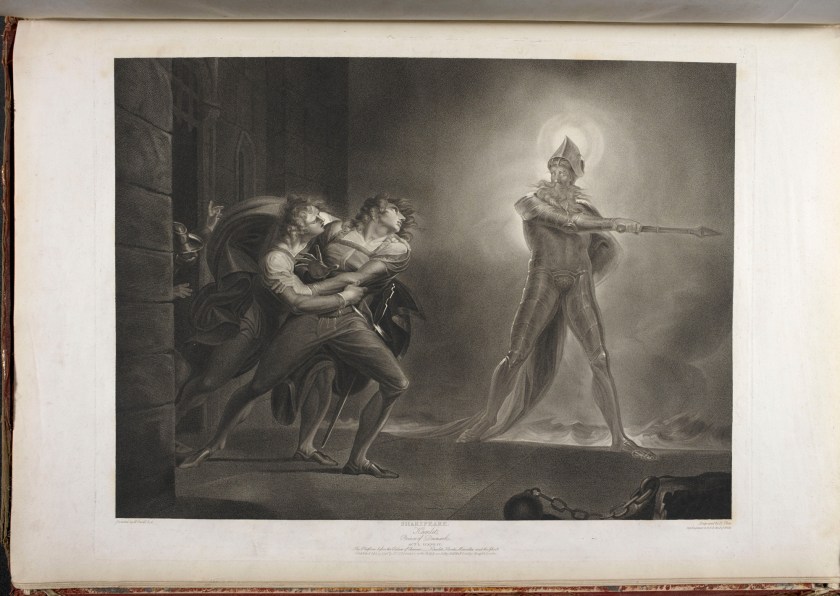
Hamlet’s ghost appears in act 1. Though he is mute to those that see him first, it is clear he has something to say. The night watchmen alert Horatio, thinking the ghost will talk to a educated man. “Thou art a scholar; speak to it, Horatio”. When this doesn’t work, Horatio decides to tell Hamlet. As we all know, the ghost finally speaks.
I am thy father’s spirit,
Doomed for a certain term to walk the night
And for the day confined to fast in fires
Till the foul crimes done in my days of nature
Are burnt and purged away. But that I am forbid
To tell the secrets of my prison house,
I could a tale unfold whose lightest word
Would harrow up thy soul, freeze thy young blood,
Make thy two eyes, like stars, start from their
spheres,
Thy knotted and combinèd locks to part,
And each particular hair to stand on end,
Like quills upon the fretful porpentine.
But this eternal blazon must not be
To ears of flesh and blood.
Unlike Thyestes, Hamlet the elder does not spend time foretelling of future events, which is too bad as he could have saved Hamlet’s life, but instead, chooses to talk of his own fate and tell the story of his murder at the hands of his brother. He instructs his son to revenge his “murder most foul”. He ends his story by telling Hamlet to “Remember me”, thus demanding that his memory be best kept alive by killing his murderer.

It is possible that had this been the only point in the play that we see and hear the ghost, his appearance may not be so haunting (yes pun intended) but as the play progresses, and Hamlet seems to be losing his way, the ghost appears again; this time to remind Hamlet of his duty to his memory and to stop Hamlet from verbally abusing his mother; to see her spiritual innocence as it battles with her earthly passions.
“Do not forget: this visitation
Is but to whet thy almost blunted purpose.
But, look, amazement on thy mother sits:
O, step between her and her fighting soul:
Conceit in weakest bodies strongest works:
Speak to her, Hamlet”.
In Hamlet, Shakespeare has given us a ghost that while vengeful, is not blinded by his rage. He wants only to punish his murder; his wife’s weakness is tolerated because she is only hurting herself. Only the queen can save her own soul, though the King asks that she be comforted and understood. The ghost is one of the few characters in the play that portrays compassion and kindness.
Because of this, we see that Shakespeare re-imaged ghosts as fully fleshed out characters. Shakespeare’s ghosts, though not always chatty, move away from the shadows and enter the drama center stage. As noted in my previous post, A quick guide to Shakespeare’s Ghosts, Shakespeare’s use of ghosts advances how they are used in western drama. But Hamlet is not the only time we see Shakespeare’s ghosts influence human drama.
In Macbeth, the ghost of Banquo serves to illustrate Macbeth’s unraveling. Banquo’s mute ghost sitting in Macbeth’s chair causes a mental breakdown and quietly predicts the end of Macbeth’s reign of terror.
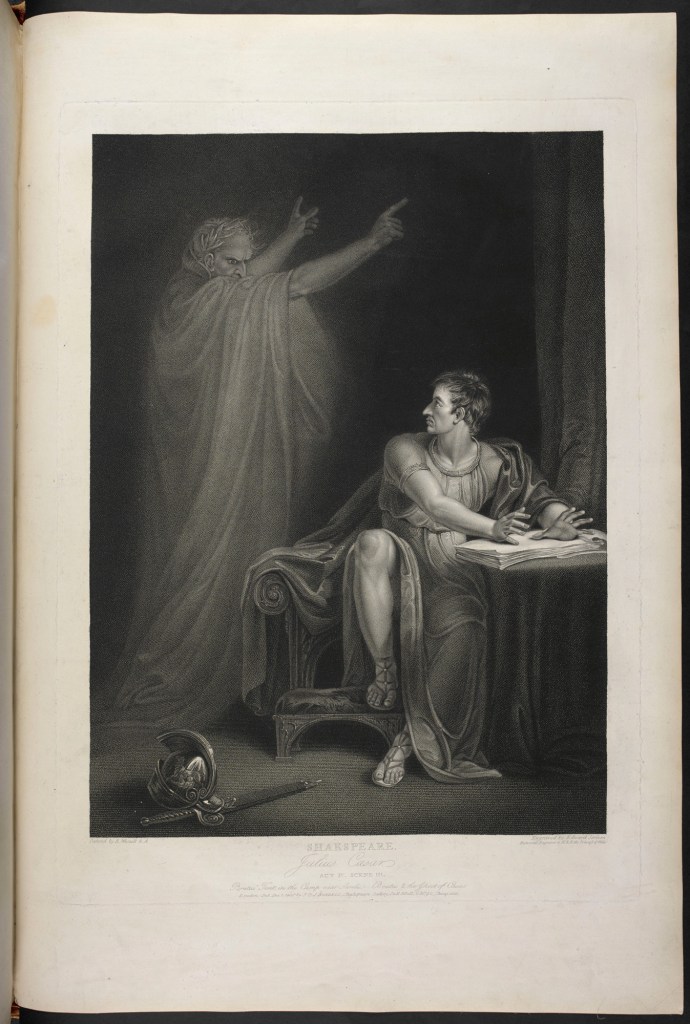
The same could almost be said for the Ghost of Julius Caesar when he visits Brutus. Though this time the ghost does speak and promises Brutus he will see him in battle. This interaction between the two could be seen as the result of Brutus’ mind playing tricks on him as his guilt over Caesar’s death begins to take its toll. But for our argument, let us assume it is a ghost.
Shakespeare’s masterful use of ghostly characters influence how we view literary ghost today. A good example is Dickens’ chain rattling Marley. He is a result of Hamlet’s ghost. Here we have a ghost who also talks of his ‘after-life” and attempts to influence the living.
It is required of every man, that the spirit within him should walk abroad among his fellowmen, and travel far and wide; and if that spirit goes not forth in life, it is condemned to do so after death. It is doomed to wander through the world, oh, woe is me! And witness what it cannot share, but might have shared on earth, and turned to happiness!”
This ghost not only warns Scrooge that he will share this fate and wear similar chains if he does not change his way, he summons three more ghosts to visit his partner in order to effect the change he seeks. And again we see a ghost display more compassion than the does the main character.
Shakespeare gave a voice to ghosts. His ghosts were not one dimensional characters; often they were supernatural characters that exhibited human qualities. And with out this, we wouldn’t have Gothic and modern horror we have today. Without Shakespeare, ghosts may be nothing more than filthy whiny sectors. I will leave that up to you to decide if this is a good or bad thing.
Next up, we will look at what 16th century religious turmoil influenced how Shakespeare used ghosts.
Works Cited
Anonymous A Warning for Fair Women Kessinger Publishing Print edition
Charles Dickens. A Christmas Carol Penguin Classic. Print edition
Theol Text Library SenecaAgamemnon. Web Site
William Shakespeare Hamlet Folger print edition
 The View From Sari's World
You must be logged in to post a comment.