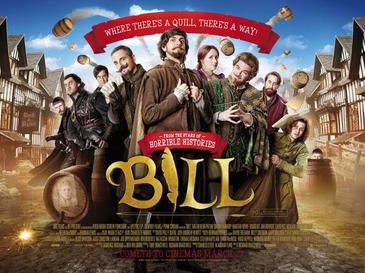
We saw “Bill” and had Shakespeare all to ourselves

Billposter

If you live in the U.K. and are a fan of the TV show Horrible Histories then I bet you were excited to see the cast finally on the big screen in the movie Bill, a comedy based on the early life of Shakespeare. If you live in the U.S. and have no idea what I’m talking about, chances are you had no idea this move even existed. Conversely, if you live in the Reno area, like Shakespeare but not comedies based on his life, chances are you skipped this movie. This is evident from the picture below. For a community that boasts a yearly Shakespeare Festival, the support this movie received was nonexistent. What a shame as this turned out to be a very enjoyable film.

On April 11 Cinemark Theaters hosted a one-night only showing of Bill. Selected Cinemark movie theaters across the country screened the movie as part of the 400th anniversary of Shakespeare’s death. This is the same movie house company that participates in one-night only live broadcasts of the Globe Theater. This is how I was able to see Hamlet live a few months back. Thank you Cinemark!

I, unlike many of my fellow local Shakespeare fans, will attend almost any production that has an association to the Bard. This is why Monday night I spent the evening enjoying a bit of silly British culture.

For those unfamiliar with the British series, Horrible Histories a brief note of explanation is fitting.

Horrible Histories (HH) ran from 2009-2015. The show was a series of silly skits designed to teach school children a little about history and a lot about satire. The show was a hit and the franchise expanded to include games, books, magazines, live theater productions, and educational material. Adults became big fans of the series as well because, unlike American children’s entertainment, Horrible Histories is smart and at times, subversive with subtle adult humor thrown in. Think Monty Python lite as it is obvious the model for HH was Ripping Yarns. And, if you are unfamiliar with that, well you have a lot of catching up to do.

Back to Monday night. A friend, who I am happy to report, is learning to really like Shakespeare, and I made plans to have dinner before heading to the movie. And, like all good groundlings, I enjoyed a glass of wine with dinner. If it was a proper theater I would have enjoyed another glass. America, what we really need are old fashion serving wenches! Hell, crusty ol’ wine stewards would work too.

As we entered the theater my friend jokingly made a comment about us being the only ones in attendance. I laughed, but as we turned towards the seats we were shocked to find that there was only one other person in the theater! For a moment I wondered if the management would cancel the viewing. We were joined by one other person, an older man who must have been lost because when the movie started he got up and left.

This lady was only to happy to let me take her picture. She was glad for the company

The plot revolves around Shakespeare’s very early days in London. To be specific, his first few weeks in London and the events that “led to his discovery”. Queen Elizabeth has invited King Phillip of Spain to England in order to secure the return of Richard Hawkins. As a way of showing that England “has the finest culture”, she demands that one of her courtiers write a great play after he boasts about being a the best playwright in all of England. Meanwhile, Phillip plots to use the play as a “Trojan Horse” in order to kill the queen (“not a real horse” he has to keep explaining to his inept assassins).

The plot is as silly as any of Shakespeare’s early comedies; for those who know their Shakespeare, the in-jokes are a lot of fun. Bill, as he is known, is a lute player in the “Mortal Coil” troupe. But, after rocking out one too many times, they kick him out and tell him to “shuffle off”. Actually the music is quite good; I hope there is soundtrack to the movie. Being a failed musician, Bill sets his sights on writing and the London stage.

What makes this movie so enjoyable is the writing and silly situations our players find themselves in. There are nods to Monty Python, Star Wars, and of course, quotes from Shakespeare’s plays. What would have made this movie even better was if Shakespeare had only quoted Shakespeare, as the real joy came at the end when “Shakespeare”, having found his “voice” gives a speech that was a mash-up of some of the best lines of his plays. My favorite Shakespeare moment comes when he is giving advice to the players, Hamlet style. Had one of the players asked if he could play a lion, I would have really lost it.

The movie moves along quickly, with one-liners and jabs coming at the audience at a steady pace. This works in a comedy yet doesn’t allow for the audience to capture the whole thing; between the quips and background antics I felt we might have missed some good stuff. It’s definitely a movie worth a second viewing. But maybe that’s the point. The producers certainly know that one reading or performance is never enough when it comes to Shakespeare. There are many layers to his work; there is something fresh every time we revisit his world. And if we get the chance, another viewing this movie will bring new delights to giggle over.

If you live in the U.K. and have not seen the film you are in luck. It’s due to be released in DVD form this month. For those of us outside of the U.K. we can only hope HH understands we know the movie’s the thing and uses it to catch the conscience of a whole new audience.

Christopher Marlow: Saying things in a short snappy way instead of a long drawn-out way is the soul of wit.

Bill Shakespeare: You mean brevity?

Horrible Histories

The Mystery of Shakespeare’s death

Is this Shakespeare's death mask? Professor Stanly Wells says "No".
Is this Shakespeare’s death mask? Professor Stanly Wells says “No”.

As you know 2016 marks the 400th anniversary of Shakespeare’s death. What we don’t know is the exact cause his untimely death. The man was 52 years old and from all accounts seemed to be in good health. Yes, he did retired early, but given that he was a wealthy man this shouldn’t be all that surprising. Perhaps he was burned out; London or the stage’s allure may have finally run thin. The quiet country life he escaped from as a young man may all of a sudden seem like the ideal place to escape to.

Shakespeare’s cause of death remains a mystery. What little factual information we have of his death comes from an entry in the diary of John Ward, the vicar of Holy Trinity Church in Stratford (where Shakespeare is buried). In the diary, Ward notes that “Shakespeare, Drayton, and Ben Jonson had a merry meeting and it seems drank too hard, for Shakespeare died of a fever there contracted.”

We know people just don’t catch fevers from drinking, unless the drinks in question contain some type of infectious bacteria, and given the hygienic practices of the day, this could be a possibility. Yet we know that Shakespeare amended his will only a month before his death. Is it possible Shakespeare knew he was dying?

Like with so many other “Shakespeare mystery’s” some scholars think that yes, not only did he know he was dying, they go on to suggest this is why he retired early and amended his will. We will get into another possible reason for this sudden change in a moment.

But first, let’s look at some other possibilities for his early death, or as some might say, death conspiracies.

Shakespeare’s own son –in- law John Hall is purported to claim:

I have formed the opinion that it was more likely than not in the nature of a cerebral hemorrhage or apoplexy that quickly deepened and soon became fatal. There are three reasons for this. Firstly, the hurried reconstruction and inter-lineated clauses of the Will not allowing time for it to be copied afresh before signature; Secondly, the earliest and clearest impressions of the Droeshout frontispiece of the First Folio show outstanding shadings, suggesting marked thickening of the left temporal artery– a sign of atheroma and arterio-sclerosis; and thirdly, such a termination is quite common in men who have undergone such continuous mental and physical strain over a prolonged period as our actor-manager-dramatist must have been subjected to throughout his, undoubtedly, strenuous career. Richard Burbage who daily shared the same theatrical life, himself died of such a seizure after twenty-four hours illness [in 1619]”

It has to be pointed out that of all people, Hall had the most to gain from a sudden death explanation. Hall was not only Shakespeare’s son-in-law; he was  the family doctor. To note that the playwright’s sudden death was caused by “mental and physical” strain” may have been an attempt to absolve himself of his father-in-laws death. He may have been trying to deflect blame in order to save his own reputation.

As I said earlier, Shakespeare amended his will a month before his death. This fact has led some scholars to believe the man was in very poor health and at death’s door. They point to his “shaky” signature as proof of their claim. The problem with this is two fold. One; Shakespeare’s signature always appears shaky, and two; Shakespeare’s youngest daughter had just become engaged, causing Shakespeare to adjust what he felt she was owed and to include provisions for any future children she may have.

They all look Shaky to me
  1. a)  From the 1612 Mountjoy suit deposition:  Willm Shackper
    b)  From the 1612 Blackfriars Gatehouse deed:  (William) Shakspear
    c)  From the 1612 Blackfriars mortgage:  Wm Shakspea
    d)  From the 1615 will, page 1:  William Shackspere
    e)  From the will, page 2:   Shakspere
    f)  From the will, page 3:  (by me William) Shakspear

Author Simon Andrew Sterling takes the prize for the most outlandish idea. In his 2013 book, “Who Killed Shakespeare”, Sterling not only suggests Shakespeare was murdered but was killed by Protestant spies, (Shakespeare being a closeted Catholic) “in order to curry favor with the court”. Sterling seems to have forgotten that Shakespeare’s theater group was called “The Kings Men” because he loved their plays, so killing the King’s favorite author would not be the best way to curry his favor.

Life in 17th century was surrounded by death. Despite the myth that 17th century life was short, the fact is, it was possible to live a long life, if you were lucky. Death could come in many forms: war; disease; (the plague broke out twice in Shakespeare’s life time) poverty; bad hygiene; and religious persecution just to name a few. Yet despite all of this, we know from records that wealthy people with access to a proper diet did live to see old age. So this again makes us wonder, just what did Shakespeare die of? Was it cancer, tuberculosis or god forbid, syphilis?

Let’s take one more look at the diary of John Ward. At first glance his words may sound silly, but records from 1616, the year of Shakespeare’s death, inform us that a new strain of typhus was spreading across England. The name of this mortal infection? The new fever. So yes, Shakespeare may have died of a fever after all.

Works referenced

C. Martin Mitchell,The Shakespeare Circle

Politicworm. Shakespeare Authorship

Shakespeare Birthplace Trust

Shakespeare-Online

Simon Andrew Sterling, Who Killed Shakespeare?


Amazing Waste

Repurposing Food and Reducing Waste

measurestillformeasure

Shakespeare, Classics, Theatre, Thoughts

Nerd Cactus

Quirky Intellect for the Discerning Nerd

Sillyverse

Stories of magic and mystery

Commonplace Fun Facts

Mind-Blowing Facts You Didn’t Know

Fictionophile

Fiction reviews, Bookblogger, Fiction book reviews, books, crime fiction, author interviews, mystery series, cover, love, bookish thoughts...

Patrick W. Marsh

monsters, monsters, everywhere

Shakespeare for Kids Books

Opening the door for kids to love Shakespeare and the classics

desperatelyseekingcymbeline

The 10-year Shakespeare New Year Resolution

Katzenworld

Welcome to the world of cats!

booksandopinions.com

The Book Reviews You Can Trust!

The Book Review Directory

For Readers and Writers

thelitcritguy

screams from the void

Author Adrienne Morris

Step Into the Past—Lose Yourself in the Story.

crafty theatre

ideas inspired by crafty characters

Critical Dispatches

Reports from my somewhat unusual life

The Nerd Nebula

The Nucleus of the Universe for all Nerd Hacks!