
The What if game: how humans evolved from apes to Shakespeare

Bradshaw rock paintings  Western Australia
Bradshaw rock paintings
Western Australia

What a piece of work is a man! How noble in reason, how infinite in faculty! In form and moving how express and admirable! In action how like an Angel! In apprehension how like a god!   Hamlet

The second book in Terry Pratchett’s “The Science of Discworld, the globe” tackles an important question in the evolution of man. How did humans go from being ape like creatures to ones that can write eloquent poetry? In other words, how did the human mind evolve to think beyond its immediate surroundings?

Science has proven that our closest relative is the chimpanzee. We share 98% of our genomes with them, yet we have little in common. That 2% difference seems to be a pretty big deal.

Jack Cohen and Ian Stewart, Pratchett’s co-authors, walk the readers through the evolution of the human brain. It’s a rather convoluted story, one with gaps and seemingly full of conjectures* (*This is what one scientist thinks when another disagrees) . The biggest mystery and subject of debate is how over time we acquired a large brain, and how that brain developed the capacity to think beyond instinct. We know from the fossil records that 8 millions years ago the ancestors of humans and chimps parted, and since then the human brain has tripled in size. What we don’t know is why.

In two recent studies, researchers from Duke University suggest the human brain boost may have been powered by a metabolic shift that meant more fuel for brains, and less fuel for muscles.

Two researchers from the UK noted “the human brain uses more energy, pound for pound, than any other tissue. Yet our body burns the same number of calories as other primates our size”. They think we may have diverted our energy to the brain, allowing it to develop. This may also be the reason why our muscle mass differs from apes and chimps; what we gained in brain mass we lost in muscle mass.

Yet another theory, the Aquatic Ape theory, suggests at some point millions of years ago our ancestors moved from the Savannahs and back into the water. While most scientists balk at this suggestion it does answer some questions on why we look much different from our ape cousins. The theory suggests that a diet rich in seafood would account for brain development. If you would like to read a truly wonderful article on this subject I highly recommend reading Martin Clemens, “Aquatic Ape theory: An argument for our water origins.

Yet none of these theories explain how we developed into the philosophical apes we are today. As Cohen and Stewart explain, it’s not the big brain that counts; it’s what we do with it. They map out what they think is important to human evolution: the idea that by becoming storytellers we gained language and culture.

It is a large map, one too big to fully flesh out here, but the idea goes something like this: Our early ancestors learned to play the “What if game”.

Imagine one of our ancestors out in the Savanna plains, just chilling and taking in the breeze when he or she, notices a lion in the grass to the right, and possibly one to the front. Instead of acting on instinct or freezing in place, our ancestor thinks, “What if?”. What if I slowly back up towards that tree?” What if one runs out before the other, could I make it to the tree?” A story of what if starts to play out in our ancestor’s mind, and from that an idea of escape begins to form. Now let’s say he does escape and goes back to his clan and tells the story of how he escaped. His experience is shared with others. This is the beginning of what Cohen and Stewart call “extelligence”. The idea that shared knowledge benefits a clan as a whole and allows for group survival. As early humans began to share more and more information or stories, the more structured their world became. Structure led to stability and stability led to civilizations. This makes sense, yet I found myself asking a question: What allowed for the development of the what if game, and how did our earliest ancestors share this knowledge? Here is where some of my own conjecture comes in, so take it for what it’s worth.


“To sleep, perchance to dream” Hamlet

We know animals learn and share their experiences. Parents pass down survival methods to their young and we see group think in many species. Yet without the ability to communicate we cannot be sure if this is intentional or instinct. And even if it is intentional, we are the only animal to find creative ways to express our ideas and share them with our clan. What was the catalyst for our development of language and art?

Anthropologist Kate Glaskin, in her article, “Dreams, memory, and the ancestors: Creativity, culture, and the science of sleep” reminds us thatEthnography from Aboriginal Australia attests to the significance of dreams in the creation of new songs, designs, and ceremonies”. We know this from drawings, and oral traditions that talk of how early Aboriginals shared knowledge gained through dreams. Other early cultures such as the Native Americans did the same. Before written language and possibly before fully developed language, dreams played an important role in the development of early culture. Glaskin notes, “Advances made in neuroscience mean that, increasingly, scientists are able to map neural activity occurring in different sleep phases. Can this capability help us to understand the emergence of creativity, such as that which appears to have its origins in dreams?”

If it is true that creativity emerged from dreams, couldn’t it also be true that storytelling, a form of creativity, also emerged from dreams? Perhaps early man learned to play the what if game because he may be the only animal to have complex dreams? Let’s play the game.

What if our early ancestors found themselves dreaming of past events, only in the dream the outcome was different. And, what if they used these same dreams as learning tools? Early man may not have just learn to be creative on cave walls and in song from dreams, he may have used dreams as a way of learning to think beyond the immediate and start asking himself and his clan, “What if”? If these dreams became oral teachings then we would have our first storytellers and shared emerging extelligence.

I have had a most rare vision. I have had a dream—past the wit of man to say what dream it was. Bottom, Midsummer’s Night Dream

Clemens, Martin. Aquatic Ape theory: An argument for our water origins. Mysterious Universe. org

Glaskin, Kate. Dreams, memory, and the ancestors: Creativity, culture, and the science of sleep. The Journal of the Royal Anthropological Institute JSTOR.com

Scientific American. How did human brains get to be so big? Scientific American.com
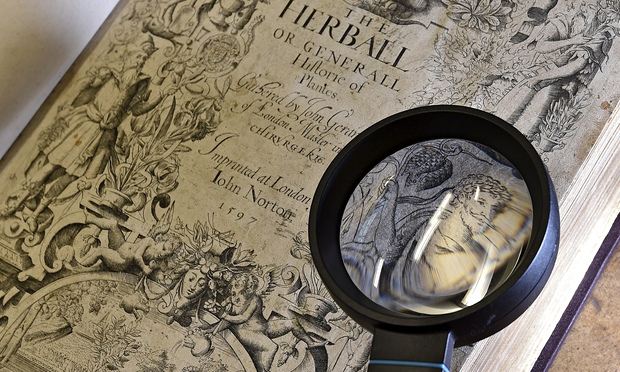
To be or not to be, Shakespeare?

Shakespeare portrait claimed in illustration John Gerard The Herball

George Sumner is an environmental impressionist painter, specializing in ocean scenes. 20 years ago you would have found his work in galleries across America including Hawaii. In fact, 20 years ago, you couldn’t have visited the island chain without tripping over a painting or lithograph of his. His popularity has waned over the years and now his work is limited to Northern California.

My mother fell in love with his work during the height of his popularity. She had a condo in Hawaii that was decorated with his lithographs. An art dealer, sensing a true patron, got her in touch with Somner’s ex-wife. The ex had a painting of his for sale. It was a painting that wasn’t cataloged as he had painted for his wife, now ex-wife. My mother jumped at the chance to own a one of a kind piece of work. A piece that was never reprinted for sale; very few people know it even exists. After my mother tired of it (it’s huge and doesn’t fit in her scaled down lifestyle) she sold it to another collector who was also happy to have a one of a kind piece.

Now, let’s say that collector keeps it in the family for several generations, and in, let’s say 100 years from now, Sumner is popular once again. Can you imagine the thrill the art world would feel if the owner of the piece comes forward with this unknown painting? The origin story makes the piece all that more interesting.

These things happen. Just recently there’s been a discovery of a previously unknown Van Gogh. A Rembrandt scholar thinks he has found 70 misidentified paintings. Who knows how many unknown or misidentified works of art are waiting to be found? How many are actually hidden in plain sight?

According to the latest edition of Country Magazine, a botanist found a book that contains a picture of Shakespeare hidden in plain sight. The article in Country Magazine makes the claim that what they have, reveals an astonishing new image of William Shakespeare, the first and only known demonstrably authentic portrait of the world’s greatest writer made in his lifetime.

The go to explain:

Botanist and historian Mark Griffiths reveals in this week’s issue of Country Life magazine, how he cracked a many-layered Tudor code and revealed the living face of Shakespeare for the first time, on the title page of The Herball by John Gerard, a 16th century book on plants, 400 years after it was first published.

Upon reading this my first thought was, “Oh great, another code cracker. Had Griffiths read one too many Dan Brown novels?” But of course I had to keep an open mind, so I spent a few hours reading the various takes on what Country Magazine calls “the find of the century”.

139af321-11aa-4fcb-9cb7-067289f6a50a-2060x1236

Griffiths claims that while studying the life of John Gerard, he started researching the title page of The Herball in order to determine who the four figures are that make up the edges of the page. He noticed some Latin under each of them and after doing some Robert Langdon style deciphering, came up with a theory that they are Gerard himself, the Flemish botanist Rembert Dodoens, Queen Elizabeth’s chief minister Lord Burghley, who was Gerard’s patron, and the man dressed in a Togo, William Shakespeare. “At first, I found it hard to believe that anyone so famous, so universally sought, could have hidden in plain sight for so long,” Griffiths said. But he is convinced that this is only reasonable explanation for this figure. I’m still trying to find a reasonable explanation for the code. Ready? Here is it as spelled out by Telegraph newspaper:

The number four + the letter ‘E’ – translating in Latin as ‘quater-e’, meaning ‘to shake’

The letters ‘OR’ – the heraldic term for gold, a reference to the Shakespeare family coat of arms

The code can also be read from left to right, top to bottom, as ‘quat-e-or’, a Renaissance spelling of ‘quatior’, meaning ‘I shake’

A rebus representing a spear – put together these say ‘shake-spear’

A letter ‘W’ to represent William

He goes on to suggest, the man in the portrait is holding an ear of sweetcorn, a fleur-de-lys and a fritillary (a flower of the lily family) in references to Titus Andronicus, Henry VI Part I and Venus and Adonis respectively.

Now that’s some code! No wonder no one else in 400 years has pointed to this as Shakespeare. It makes me wonder what Mr. Botanist smokes in his spare time. Just for fun I consulted a couple of my Latin dictionaries to see if indeed quatere translates into “to shake”. I found out that there are several Latin words that translate into shake, depending on the context, but only one that means “to shake”; Exhorresco. Quarter translates into 4. But my dictionaries could be wrong….

John Overholt, a Harvard scholar says, not so fast. This same “code” or device is nothing more than a printer’s mark. He has found the same code listed as a printer’s mark in the William and John Norton Compendium of Printer’s Stamps, published in 1749. Oxford Professor Edward Wilson, who backs up Griffiths’ claim, quipped back that the Nortons must have made an error in judgment in saying that this is a printer’s mark. Easy to say when the men in question have been dead for over 300 years and can’t defend themselves.

Many Shakespeare scholars think that what Griffiths has come up with is utter nonsense. Micheal Dobbs and Paul Edmonson both laugh at the idea. While I want to keep an open mind, I am on the side of scholars for a couple of reasons.

If this is a code, it’s a pretty far-reaching one. If this truly is supposed to be Shakespeare, why go to such lengths to hide it? Why not make it obvious for all to see?

Second, even if this is a depiction of Shakespeare, it isn’t self evident that this is a true to life likeness. For all we know it may be the artist’s interpretation of what he thinks the great poet is supposed to look like. It is a big leap to say this might be a nod to Shakespeare and a monumental leap to say this is the only known demonstrably authentic portrait of the world’s greatest writer made in his lifetime, as Country Life is claiming.

We aren’t exactly sure what Shakespeare looked like. The only known authentic likenesses of Shakespeare are found in the First Folio and on the effigy on his monument at Holy Trinity church in Stratford-upon-Avon. Both of these were commissioned posthumously. Ah, and there’s the rub. Is this to be or not to be a realistic picture of the young playwright? We may never know. But, I am betting against it, as Country Life has made a far greater claim, one that should have been the lead story. Next week they are going to present us with a newly discovered play penned by non-other than Shakespeare!

I smell a book deal in the works.


Country Life, Shakespeare His true likeness reveled at last

The Guardian Shakespeare: writer claims discovery of only portrait made during his lifetime

Charles Murry Latin to English Dictionary

John Stone, Latin for the illiterati

The Telegraph, William Shakespeare: Newly-discovered image revealed

Amazing Waste

Repurposing Food and Reducing Waste

measurestillformeasure

Shakespeare, Classics, Theatre, Thoughts

Nerd Cactus

Quirky Intellect for the Discerning Nerd

Sillyverse

Stories of magic and mystery

Commonplace Fun Facts

Mind-Blowing Facts You Didn’t Know

Fictionophile

Fiction reviews, Bookblogger, Fiction book reviews, books, crime fiction, author interviews, mystery series, cover, love, bookish thoughts...

Patrick W. Marsh

monsters, monsters, everywhere

Shakespeare for Kids Books

Opening the door for kids to love Shakespeare and the classics

desperatelyseekingcymbeline

The 10-year Shakespeare New Year Resolution

Katzenworld

Welcome to the world of cats!

booksandopinions.com

The Book Reviews You Can Trust!

The Book Review Directory

For Readers and Writers

thelitcritguy

screams from the void

Author Adrienne Morris

Step Into the Past—Lose Yourself in the Story.

crafty theatre

ideas inspired by crafty characters

Critical Dispatches

Reports from my somewhat unusual life

The Nerd Nebula

The Nucleus of the Universe for all Nerd Hacks!