What ifs about Shakespeare

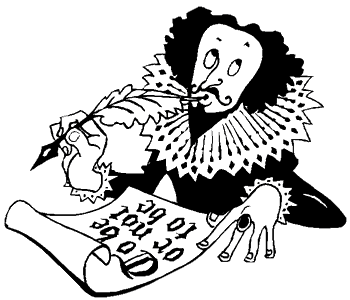
The Thinker, Shakespeare style

As some of you might know, I am working on notes for my own book about Shakespeare, an introduction to our beloved Bard and how to enjoy the plays. It’s a groundling’s guide to Shakespeare if you will. I do rather like that for a title.

As part of my research (and continuing education) I’m listening to various podcasts as well as reading books and academic papers. Of all of my research, I am finding the podcasts to be most informative. Sometimes I hear things mentioned, usually as an aside, that gets my imagination going. Unfortunately for me, this usually happens at work. I scribble myself a note for later use.

Some of the things I hear starts me down the path of speculation. Oh, if that is true, could this also be true? Of course, we know so little about the man we are left with a lot of holes to fill. Holes we should reserve for our own pleasure, our own entertainment value. Since we cannot prove anything, the path should be narrow and short so that we don’t venture into the wild weeds of conjecture.

I have to admit, musing on Shakespeare’s life is an entertaining intellectual exercise. When I start down the path, I find myself using my knowledge of history and Elizabethan social norms. Of course no intellectual exercise is complete without a little research. As I mentioned, the path is short, and I end up putting my thoughts aside for more useful endeavors. But I thought it would be fun to share some of my ideas as part of Shakespeare Week

I give you three What ifs about Shakespeare

I’ve taken many classes on Shakespeare and in each the subject of his relationship with his wife always comes up. Students, who hear about his gift of the second best bed in his will for the first time, assume this is a dig. They couple this with his move to London as proof that he did not love Anne. It is also assumed that Anne, being older and pregnant when they married, must have tricked him into it. This idea seems to be popular with male scholars too. In Shakespeare’s Wife, Germaine Greer argues that too many scholars paint Anne as a scheming woman who set a trap for poor young will as she is getting on in years (26 is old for women of her day). But what if it was the other way around? What if he talked her a relationship? What if it was Will, not Anne who pursued the relationship? What if he wrote this sonnet for her, as some scholars suggest?

Those lips that Love’s own hand did make,
Breathed forth the sound that said ‘I hate’,
To me that languished for her sake:
But when she saw my woeful state,
Straight in her heart did mercy come,
Chiding that tongue that ever sweet
Was used in giving gentle doom;
And taught it thus anew to greet;
‘I hate’ she altered with an end,
That followed it as gentle day,
Doth follow night, who like a fiend
From heaven to hell is flown away.
‘I hate’, from hate away she threw,
And saved my life, saying ‘not you’.

Scholars believe line’s 13 and 14 seem to be puns on Anne’s name. “hate away’ sounds very close to Hathaway, and “and saved my life” could be a play on “Anne saved my life”. If this were true, then we could say she did not like him at first, yet in the end, she “saved his life” by marrying him. This would offer us a new way of looking at their marriage.

Other scholars have pointed out that Sonnet writing would not come into fashion for another 9 years. This type of poetry was started by Phillip Sydney. But that doesn’t mean we should throw out the idea that Shakespeare wrote this for his wife. Who knows, maybe he wrote as an anniversary present?

Speaking of marriage, did you know young Elizabethan married men couldn’t be apprentices? I learned this from one of the many Shakespeare related podcasts I listen to. Sadly, I failed to note which one. It was an off-handed remark about Shakespeare’s early employment or lack of. I thought, wait a minute. This may tell us something; Shakespeare, having gotten married at 18 would have had difficulty in securing employment. What if this was the reason he left for London? Not because he wanted to get away, having just been through a shotgun wedding, but because his options were limited?

The Tudor “Poor Laws, enacted in 1536, says “male apprentice must be cared for until they reach the age of 21 or marry”. Okay, new path to follow, what if, at 18 Will either hated being an apprentice (he would have started at 14) or was finally being pushed to find employment with a master by his father, chose to get married instead? What would make a man leave his wife and children in the country for the big city? Fame, money? Possibly, or maybe he had no real prospects in the country. Or maybe he did want to get way from Anne….

He’s starting to sound like a jerk. Perhaps we should leave this path all together.

Speaking of sounding like a jerk…

One of the most talked about holes in Shakespeare’s life is the explanation for why he only left Anne the “second best bed” in his will. This has been debated ever since the will was found in 1747. Scholars, historians, and critics of Shakespeare have argued over the reason for this gift. Bonner Miller Cutting sifts through them all in his essay, Alas, Poor Anne: Shakespeare’s Second-Best Bed” in Historical Perspective. He argues that given what we know about Elizabethan wills and marriage laws, this was a deliberate dig by Shakespeare. He left his estates to his daughter Susanne and her husband John. Cuttings asks, “if Shakespeare wanted to ensure his wife was well cared for but not given the best of things, why not the second best house”? It is a fair question.

The question surrounding the “second best bed” has intrigued me for a long time. It is not something I think about a lot but once in while the question pops into my head. It wasn’t until I heard an episode of the History Extra podcast did I give it any serious thought.

The episode talked about the changes in childbirth; from medieval times to the present day. It was noted that during the Elizabethan era births were moved from the marriage bed to a birthing/sick bed. As houses became bigger, rooms were given over to the infirm. Women were advised to stay in bed for three day after giving birth in order to regain their health. What, if this second best bed was the birthing bed? What if, instead of being a dig at his wife, Shakespeare gave her the bed as a token of his appreciation for her as a wife and mother?

This is all speculation of course, but it does make our favorite playwright less of a jerk and more to our liking. And isn’t that the point? We speculate about Shakespeare’s life and fill in the holes as we see fit. We want him to be perfect, just as we view his work to be. But, in reality, he was human, and as such was complicated. What we really need to do is appreciate the work, and forgive his flaws.

Bonner Miller Cutting, “Alas poor Anne”

William Shakespeare, Sonnet 145

Joseph Tanner, “Tudor Constitutional Laws”

Post-show wrap ups A case for why we need the Humanities

Future dragon trainer?

Last night was the 5th season premier of Game of Thrones. No, don’t worry. This isn’t a recap or review of the show. Nor will there be spoilers. I use this as a reminder as to why we need to keep the study of the Humanities in our classrooms.

Humanities, at least in America, are being pushed aside for more STEM (science, technology, engineering and mathematics) classes .We apparently want our children to learn how to make technological advances, but not ask questions about these advances like, “is this a good thing to do? And, how will it benefit mankind?

The Humanities teaches us critical thinking skills and asks us to search our worldview and ourselves. What does it mean to be human? is a question posed not just by science alone but by the Humanities as well.

A lot of students find these classes boring and whine because they are asked to read and consider the Classics. What they don’t realize is that humanity expresses itself through words, art, drama, architecture, and religious worship. These symbolic gestures form our world. To know what it means to be human is to study and understand these very same symbolic gestures.

Once upon a time (really not that long ago) one of the foundation stones of a college education was acquiring critical thinking skills. This meant that one was not easily swayed by bullshit. A measure of one’s education was knowing when to ask questions and look beyond whatever was being presented. “Does that make sense? Is there more than what meets the eye? How do I know this is true?” Those who mastered these skills were equipped to view the world without the use of cultural and gut-feeling filters. They were able to draw upon their education when faced with symbolic gestures and could easily place them in proper context. Humanities majors made good use of these skills, with many becoming novelists and journalists. These were the people who knew what it meant to be human and could translate world events through storytelling or news reporting.

Today there is a push for specialized fields. My son was a journalist major for three years and never once did he have to take a Humanities course. Rather than focusing on learning why things happen, and then learning to write about it, the focus is on how to get the story out. This is disheartening to me, as the first question should always be, “is this true?”, not, “how do I get my Twitter followers to read my news article?”

We have yet to see the full ramifications of this new breed of journalists, but we are starting to get an idea of how this type of approach can be damning. One has to look no further than the recent Rolling Stone article about a campus rape. The story went viral and caused public outcry as well as damage to the University of Virginia (where the rape allegedly took place). The story started to unravel as more experienced journalists started asking questions. A review into the story led to the conclusion that Rolling Stone failed its readers by not asking the right questions. Most of what the young girl claimed turned out to be false. You can read a great analysis of the review here.

Rolling Stone made a lot of mistakes, and many people are to blame, yet all of them could have been avoided by first, asking one simple question: how do I know this is true?

Another example of this new breed of “journalists” can be found on social media. There is a growing trend of podcasts on YouTube and iTunes that call themselves “After Show wrap ups”. Afterbuzz TV, a very popular collection of these shows says this: “For decades, sports fans have been treated to post-game wrap up shows after watching games. Thanks to AfterBuzz TV, at long last, TV fans can do the same”. What they fail to realize is that sport post-game wrap up shows are hosted by former players and sports journalists who know what in the hell they are talking about. This new breed, not so much.

I like to watch Game of Thrones, but because most of my friends do not I have no one to talk to discuss it with. I decided to download an episode of one of these post-show wrap ups. I thought I would be offered some insight into things that I might have missed as I stared dreamily at Peter Dinklage. What I got instead was a train wreck.

I looked at the bio of the hosts for clues as to their stupidity. I won’t name them, as I do not want to cause them embarrassment. They do this to themselves just by opening their mouths.

Would it surprise you to learn they all claimed to have college degrees? Would it be equally surprising to learn that these are specialized degrees? I doubt one of them took a Humanities course or if they did, slept through it and dreamed about being famous.

It would appear obvious that in order to successfully talk about storytelling, one would have to possess a good understanding of the medium. Since the Game of Thrones is primarily about the human condition, one should have a solid foundation for this too. These hosts do not.

Picture yourself watching a scene in which a very large religious statue is being pulled from atop of a pyramid by an army who had just conquered the city. The statue crashes down in spectacular CGI fashion and breaks a part upon impact. You my dear readers do not need to be told what the breaking of the statue represents. Yet here are the hosts talking about it:

Female Host: “ I don’t get it. Why did they pull the statue down?”


Male Host: “I guess to show them who is in charge?”

WTF? They just watched an army conquer a city and then systemically destroy the religious icons and yet, the female host cannot figure out why. You don’t need a college education to understand the meaning behind this destruction. It’s happening right now in the Middle East, and yet this young woman is clueless. She can no more understand this than she can understand why Daenerys (a young queen with pet dragons) would need Tyrion’s (a politically savvy outcast) help. But sadly, neither do the other hosts. As they talk about this possible alliance one of the hosts says this:

Well, he has read a lot of books. Maybe Tyrion can teach Daenerys how to train her dragons”. I bet he’s read a book about it”. The hosts then go on to discuss the possibility that this is how Tryion comes to help Daenerys. Not by teaching her the game of politics, but how to keep her dragons from eating innocent people. At this point I turned the podcast off. So much for an insightful discussion. Should have just talked to myself as I watched the show. Okay, I would have a least looked at the cat when commenting.

These hosts could have benefited from a few Humanities courses. They would have learned the fine art of storytelling, what symbolic gestures mean, and how politics, not dragon training, is crucial to nation building.

It would be ideal if STEM were to be changed to STEAM. We need the arts, and by arts I mean the Humanities. For without them we wouldn’t know why we do the things we do. Technology might allow us to build better dragons, but Humanities will have us ask: Do we really need them in the first place? I’ll take the guy who’s read a lot of books over the girl with the out of control pet dragons any day.

Amazing Waste

Repurposing Food and Reducing Waste

measurestillformeasure

Shakespeare, Classics, Theatre, Thoughts

Nerd Cactus

Quirky Intellect for the Discerning Nerd

Sillyverse

Stories of magic and mystery

Commonplace Fun Facts

Mind-Blowing Facts You Didn’t Know

Fictionophile

Fiction reviews, Bookblogger, Fiction book reviews, books, crime fiction, author interviews, mystery series, cover, love, bookish thoughts...

Patrick W. Marsh

monsters, monsters, everywhere

Shakespeare for Kids Books

Opening the door for kids to love Shakespeare and the classics

desperatelyseekingcymbeline

The 10-year Shakespeare New Year Resolution

Katzenworld

Welcome to the world of cats!

booksandopinions.com

The Book Reviews You Can Trust!

The Book Review Directory

For Readers and Writers

thelitcritguy

screams from the void

Author Adrienne Morris

Step Into the Past—Lose Yourself in the Story.

crafty theatre

ideas inspired by crafty characters

Critical Dispatches

Reports from my somewhat unusual life

The Nerd Nebula

The Nucleus of the Universe for all Nerd Hacks!