The difference between choice and privilege

rashes_princ_6l7247_measles_424x302

As a modern western society we are blessed with the privilege of choice. We get to decide where we live, what professional path to follow, who to marry, and how many children to have (if any). Hell, we even get to choose what type of dietary lifestyle we want to follow and what brand of water to drink. We live in an age of unabashed consumerism. Yet, how many of us stop to consider that what we call “choice” is in fact, privilege? We are privileged to live the way we do. Not everyone is so lucky. Not that long ago, neither were we. Here in lies the problem; we have forgotten that not that long ago, we had little choice over our lives.

Think about how lucky we are that we can wander the supermarket aisle, making choices about what food we want, what brand we want and how much we want. A 100 years ago this would have been unthinkable. Oh sure there were small mercantile shops in which one could find much needed supplies, but the norm was to produce most of what one needed at home. Now we have aisles of laundry soap to choose from, but our great-grandmothers made their own soap. People had little choice when it came to consumer goods and services. Today, we can order just about everything we need online.

Our choices do not stop at consumer goods. We assume we have other choices as well. The age of consumerism has changed our perception of choice. Many people now think they have the right to choose what medical advice to follow, even if it means the chance of harming other people. Because they have grown up in a society of choice, they erroneously believe everything is a choice.
polio-patients

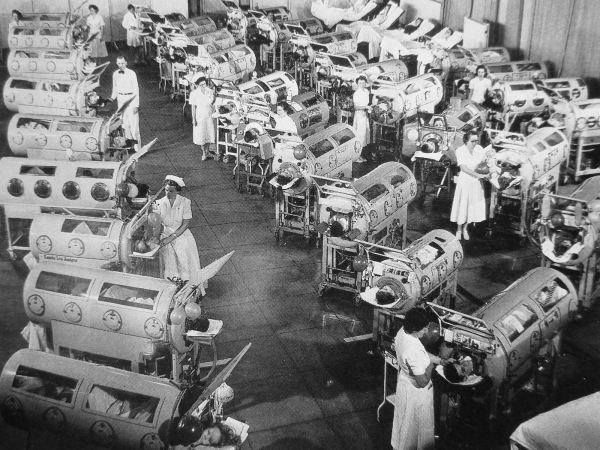
Prior to 1952, parents had little choice when it came to polio. Before that it was smallpox. If a child came down with either, parents had little choice but to watch their child suffer and hope for some miracle cure. My own grandmother came down with polio in the 1930’s. When the doctors told her she would never walk again, she gritted her teeth and said, “I don’t have a choice, I have 5 young children. I will have to walk again”. She was one tough lady. She did in fact walk again, but with a very noticeable limp. Her left leg was twisted sideways. Her youngest child contract the disease, yet was one of the lucky ones, she has no noticeable side effects. Far too many children and adults were not so lucky. There was no choice in the matter, you got it or you didn’t. Thankfully now, there is a vaccine for polio. We are privileged to have it. Now we don’t have to worry about another polio epidemic breaking out and causing mass suffering. Or do we?

Because there are some people who now think everything is a choice, including inoculating their children against childhood diseases, we may see epidemics again. Here lies the irony; because we have not seen a childhood disease epidemic in over 60 years, many people have forgotten what it is like, and because of this, we may have another one soon.

To vaccinate or not to vaccinate should not be a question. It should not be treated like a consumer choice. Years ago, as a society we already made that choice for you. We chose not to watch our children suffer, die or become disfigured by childhood diseases. We were privileged to have a government who agreed and used tax dollars to fund cures of childhood diseases. We are now privileged to live in a world free of childhood diseases.

There are many choices we now get to make in our modern world. Deciding to expose us to more outbreaks is not one of them. There is a difference between choice and privilege. And the sooner you learn this, the better off society will be.

Are we changing our brain? Part 1

brain-computer

Last Sunday, The Guardian ran an article that grabbed my attention. It’s been on my mind all week. The article “Why the modern world is bad for brain”, by Daniel Levitin discusses a topic that I’ve thought about for several years. I try not to be that proverbial chicken crying “the sky is falling”, but, it seems to me technology is changing us, even if it turns out to beonly our behavior.

The article discusses the effects multitasking has on the brain and how quickly we are becoming addicted to instant gratification and the stress this leads to, all thanks to modern technology.

Imagine that you are a prehistoric hunter. You spot a lion in the grass. Your brain is hardwired to focus on the grass and find patterns as part of the survival instinct. Once you correctly spot the lion your brain responds with “fight or flight”. Noting you are close to camp you run towards it, hoping to make it to safety before the lion takes chase. But wait. Is that Jane with a new pelt? You stop to admire the pelt and ask her how she got it to fit so tightly. This, sadly, is the last thing you do, as by now the lion has caught up and decided you are what’s for dinner.

Thankfully we no longer have to watch for predators in the grass, but we do have to admit, in some cases multitasking can get us killed. Texting and driving in the United States has led to enough deaths that the practice is now outlawed in many states. We think we can multitask but the truth is, we are not hardwired to do so. As we learned from the story above, focusing on one task at a time was a survival trait passed down from generation to generation. Those who lacked this trait usually did not live long enough to procreate.

In preparation for this article I read several studies concerning multitasking in the modern world. I cannot say I understand them all, and would defer to my science friends to help for help, but it does seem that studies suggest we are changing the hard-wire of our frontal cortex. We may be damaging our Executive functions.

Our Executive functions consist of advanced mental skills that help the brain organize and act on information. These skills allow people to plan, organize, prioritize, pay attention and get started on tasks. They also assist us with past information and experiences to solve current problems. If there is one area of the brain we don’t want to damage, this is it.

As Levitin points out in his article:

Our smartphones have become Swiss army knife–like appliances that include a dictionary, calculator, web browser, email, Game Boy, appointment calendar, voice recorder, guitar tuner, weather forecaster, GPS, texter, tweeter, Facebook updater, and flashlight. They’re more powerful and do more things than the most advanced computer at IBM corporate headquarters 30 years ago. And we use them all the time, part of a 21st-century mania for cramming everything we do into every single spare moment of downtime. We text while we’re walking across the street, catch up on email while standing in a queue – and while having lunch with friends, we surreptitiously check to see what our other friends are doing. At the kitchen counter, cosy and secure in our domicile, we write our shopping lists on smartphones while we are listening to that wonderfully informative podcast on urban beekeeping.

And, may I point out, it’s not just our smartphone that causes all this multitasking mania. How many are willing to admit that right now there are several tabs open on the computer? On an average day I have three. Not bad considering I know people who have more than one homepage, so that when they fire up their laptop 10 pages queue up automatically. We jump back and forth between Twitter, Facebook, Reddit, etc. all while watching TV or listening to music. Our ability to stay focused on one thing, one subject, drains away as we delude ourselves into thinking this type of behavior has no effect on our brain.

Levitin cites a study done by Glenn Wilson, a professor of psychology. His research found that being in a situation where you are trying to concentrate on a task, and an email is sitting unread in your inbox, can reduce your effective IQ by 10 points. I don’t know if I can afford to lose 10 points. What this study suggests, is just knowing we have e-mail causes us to break our concentration. We think we are not multitasking, yet just knowing we have information at our finger tips leads to stress. Do I open the e-mail? What if it is important? How should I prioritize my time? If this stresses us out, imagine what we are subconsciously doing to ourselves knowing we have access to all kinds of instant gratification and information? How many times have you switched back and forth from Twitter to Facebook because you want to make sure you haven’t missed anything?

Yesterday was National Readathon Day. Thanks to Random House, January 25 was a good excuse to unplug and read a book. With The Guardian article in mind, this is what I did. Oh, I will admit Sunday morning I caught up on my blog reading, but that was it. No Facebook, no Twitter, no Huffington Post, just me and a good Carl Sagan book.

It was easier than I thought it would be. In fact, by choosing to stay off the computer, my need to connect to others, to see what was going on in the world vanished. My mind was focused on my book and nothing else. I wasn’t distracted by a Twitter argument over whether the terms dialect and language are interchangeable. I wasn’t distracted by the need to know what my friends were doing at any given moment. My brain was focused on one task, and one task only. It was relaxing, and I found that the day seemed to go by slower. I didn’t look up from a computer screen a suddenly realize it was 5pm. I enjoyed the day for what it was. Quiet, calming, and thankfully, no lions, as I probably wouldn’t have noticed.

So here is an experiment I’m going to do on myself. I am going to focus on one aspect of the Internet at a time. It started with this article. Unlike my usual habit of web surfing pre-article writing, I ignored my e-mail. Ignored all social media and instead, opened up pages for citing purposes only. Once done, I will focus on one site at a time. No more multi-open pages, no more going back and forth and certainly no more TV and Internet. For one week it will be one or another. I want to see if there is any difference in my stress level or ability to really focus on what is in front of me. At work I will not look at and try not to think about my e-mail while reading contracts. I will instead turn off the notification bell and dedicate certain hours for my e-mail correspondence. We will have to see how well this goes over with my co-workers. Which leads nicely to part 2.

In part 2, I’ll go over some of our social norms that modern technology is changing and how this too is leading to everyday stress and anxiety.

Amazing Waste

Repurposing Food and Reducing Waste

measurestillformeasure

Shakespeare, Classics, Theatre, Thoughts

Nerd Cactus

Quirky Intellect for the Discerning Nerd

Sillyverse

Stories of magic and mystery

Commonplace Fun Facts

Mind-Blowing Facts You Didn’t Know

Fictionophile

Fiction reviews, Bookblogger, Fiction book reviews, books, crime fiction, author interviews, mystery series, cover, love, bookish thoughts...

Patrick W. Marsh

monsters, monsters, everywhere

Shakespeare for Kids Books

Opening the door for kids to love Shakespeare and the classics

desperatelyseekingcymbeline

The 10-year Shakespeare New Year Resolution

Katzenworld

Welcome to the world of cats!

booksandopinions.com

The Book Reviews You Can Trust!

The Book Review Directory

For Readers and Writers

thelitcritguy

screams from the void

Author Adrienne Morris

Step Into the Past—Lose Yourself in the Story.

crafty theatre

ideas inspired by crafty characters

Critical Dispatches

Reports from my somewhat unusual life

The Nerd Nebula

The Nucleus of the Universe for all Nerd Hacks!