When is a Shakespeare play not Shakespeare?

Getting ready for the play
This backdrop is supposed to tell us where we are. Can you figure it out?


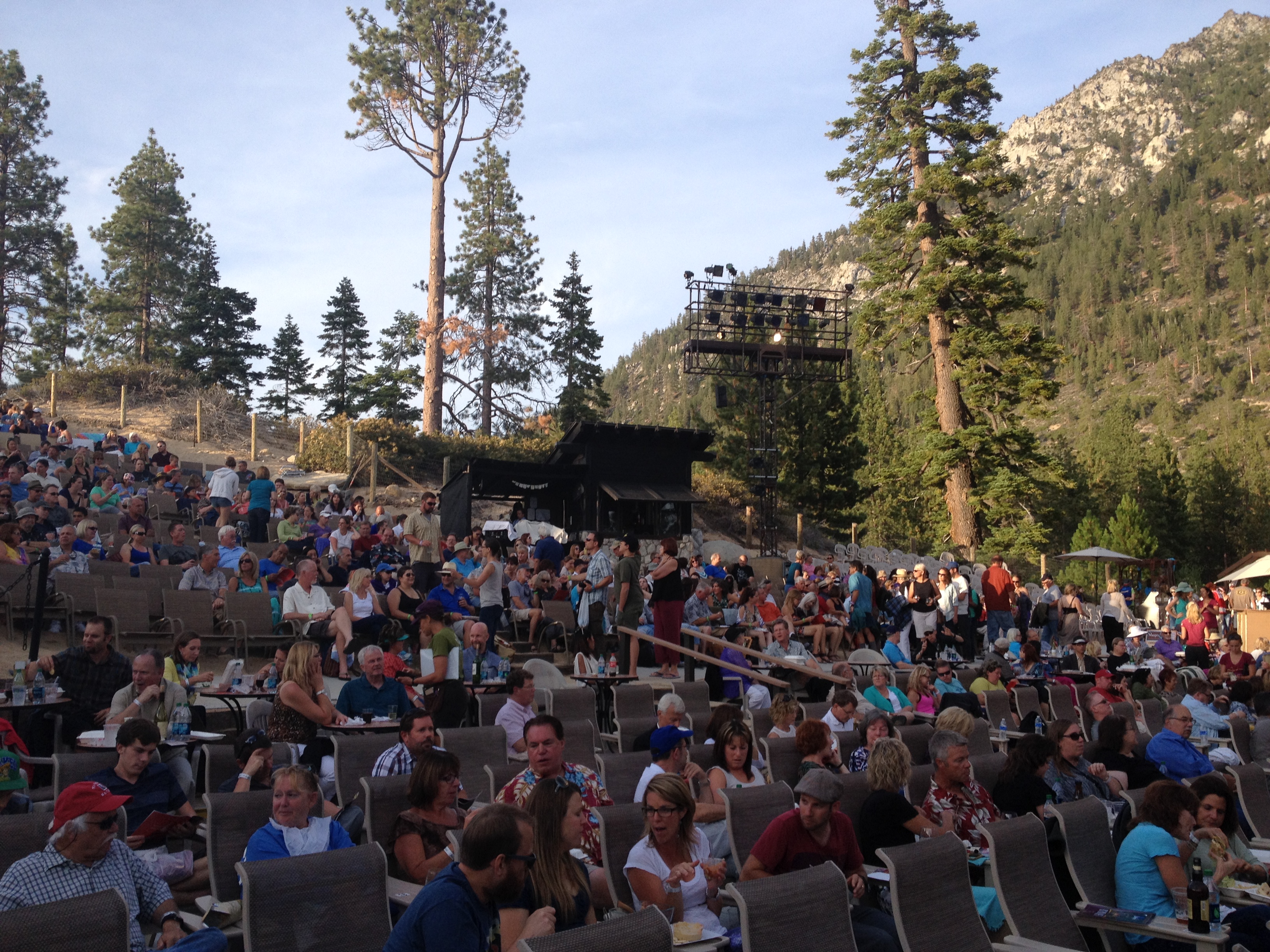
There was a large crowd for the August 2 production of Lake Tahoe’s Shakespeare festival. As you can see a nice  crowed had gathered for a night of cultural entertainment. How can you go wrong with one of Shakespeare’s best well written plays? Some of Shakespeare’s best lines are found in this play. From the well known, “All the world’s a stage” speech to Touchtone’s witty comebacks, what the play lacks in plot more than makes up for it with very witty writing. One would have to try very hard to screw this up. Yet, as much as I enjoyed the performance of the actors, a question came to mind as I watched. When is a Shakespeare play not Shakespeare?

I’m well aware that most modern productions of Shakespeare discard Elizabethan settings and dress in order to connect with their 21 century audience. Last year I saw a Midsummer’s night dream set in the 60’s; a time of free love and hippie spiritualism. It worked because the idea of woodland spirits and capricious love are found in both the play in the era of the Beatles. There was a lot of forcing of the action to fit the setting. But this year it was hard to imagine the connection between the era of the railroad barons and setting Shakespeare intended.

In the opening scene we see what appears to be railroad workers, both labors and timekeepers enter and exit the stage, for now apparent reason other than to illustrate the setting. Then Orlando, dressed as a lowly worker, appears with his servant Adam. Orlando, now changing his dirty cloths for clean cloths complains about his lot in life.

As I remember, Adam, it was upon this fashion
bequeathed me by will but poor a thousand crowns,
and, as thou sayest, charg’d my brother, on his
blessing, to breed me well: and there begins my
sadness. My brother Jaques he keeps at school, and
report speaks goldenly of his profit: for my part,
he keeps me rustically at home, or, to speak more
properly, stays me here at home unkept; for call you
that keeping for a gentleman of my birth, that
 differs not from the stalling of an ox?

This speech indicates that instead of being allowed to become a well-bred man (educated) he is stuck at home with nothing to do. This is Shakespeare 101. The wordplay, on “unkept” means that his brother’s lack of attention is not in keeping with his father’s wishes. Yet on stage we see a dirty unkempt youth, washing grime from his face. It would seem his brother has given him something to do (work on the railroad lines we have to assume) and not kept him at home like an Ox in a stall.

The lines and the action on the stage do not match. We are not introduced to a youth so bored he decides to risk his life in a wrestling match. If he wins, he will be rewarded with money. Money that will allow him to leave his brother’s home and seek his own fortune. By showing him as a workingman, we are left to wonder why he doesn’t save his wages and become his own man?

Touchstone, the wise and saucy fool has some of the best lines of the play.

The more the pity that fools may not speak wisely when wise men do foolishly”.

When asked how he likes his new life as a shepherd, he says:

Truly, shepherd, in respect of itself, it is a good life; but in respect that it is a shepherd’s life, it is naught. In respect that it is solitary, I like it very well; but in respect that it is private, it is a very vile life. Now in respect it is in the fields, it pleaseth me well; but in respect it is not in the court, it is tedious.

These lines alone are enough to make us laugh. The audience is smart enough to get the humor, yet in this production Touchstone is a buffoon. His physical mannerisms and cartoonish facial features detract from the words. Saturday night’s audience did not laugh at the lines; they laughed at the shtick that accompanied them. His lines were lost, hidden behind the clownish mask.

Were it not better,
because that I am more than common tall,
That I did suit me all points like a man?


When Rosalind and Celia decide to flee the court, the two talk of disguises. Rosalind makes the observation that being tall for a woman she should dress as a man so the two can safely make their way to the Forest of Arden. But in this, Shakespeare made a mistake (or the writers of the first folio made it). In the beginning of the play it’s established that Rosalind is the smaller of the two. Yet in the course of the play she is described as tall. Folger fixed this problem years ago by changing the first reference. Rosalind is said to be the taller of the two. Thus, eliminating the confusion and making the disguise make sense. The point of the manly disguise is to fool would be robbers into thinking twice about messing with a tall man. And later, Rosalind will give advice to several characters. Yet this director of As you like it, chose to make her short and petite. When Rosalind as Ganymede steps on the stage the audience is confronted with a youth who looks 15. The audience is left wondering why anyone would take orders from or find wisdom in a teen.

These are just three examples of how this adaptation fell flat. I heard someone behind me ask, “What is this, Shakespeare the musical?” when we were faced with a third vaudevillian song and dance number. He wasn’t the only one to show his displeasure. Some people left during intermission never to return. When it was over, the crowed applauded (the actors had done a fine job) but did not rise and show overwhelming gratitude for what they had just paid to see.

So when is a Shakespeare play not Shakespeare? When the director tries to conform the play to what he thinks his audience will understand. In this case, changing the play’s setting, action and physical characteristics. All this accomplished was a conflict between the action and the lines.

Why would one American railroad baron ask another, “So how goes it in court?” Why was Touchstone doing a soft-shoe number while reciting some of his best lines? Did the director think his audience to dense to get the original humor?

The first objective of a director of Shakespeare is to make sure the true spirit of the play comes through. Any changes should be done in order to make sure the first objective is met. Failing this, the play is not Shakespeare.

Let’s hope next year’s Tahoe Shakespeare Festival returns to the true spirit of Shakespeare.

Saying goodbye to books

My culled collection

For a moment I was elated. I felt the rush of a mountain climber reaching the summit of Mount Everest. I sat back on my heels looking at my now empty bookshelf with a sense of accomplishment. After culling through my Intending to Read pile, I’d managed to restack both my fiction and nonfiction reads into one shelf! I had a whole shelf sitting empty! I sighed and leaned back, basking in the glow of self-satisfaction; a momentary triumph over my book hoarding. But seconds later it was gone. I’d hit something as I leaned away and turned to see what it was. Damn it! I had forgotten that I started piling the keepers up to my left. Somehow, as I moved about, the pile was to my back. Oh well, it was a nice feeling while it lasted.

Today I finished book sorting. I started with my text and reference books and ended with my personal Grendel, the foe I never thought I would defeat, the dreaded Intending to read shelves. Over the course of a few hours I learned a few things about myself and book collections.

Textbooks – One piece of paper will do

I know, I know, most normal people sell their used textbooks back to the university bookstore after each semester. I’ve kept all of mine. It became a habit. The year I decided to go back to school the university tried an experiment. Instead of buying expensive rarely opened tomes, the university decided that most text would be offered as downloads or as PDFs to be read on computer screens. This was supposed to save students money. Personally, I think the school was at war with the bookstore and we students were the collateral damage. Because of all the color pictures, charts and graphs found on almost every page, it ended up costing us almost as much in paper, ink and binders as it was to buy them! I actually burned out a small printer by the end of the spring semester.

At the end of each semester instead of tossing the multiple binders I amassed, I instead shelved them high in my office closet. So, after switching back to textbooks, it was a habit to keep my books. A few times I found myself pulling out an older text when doing research on a paper. Once my son was in high school, my old text came handy for his research. My habit of keeping texts was cemented by their usefulness.

This morning I pulled out every textbook I owned and scattered them on the floor in front of me. I thumbed through each with one question in mind, “am I really ever going to use this again? “Out went sociology, psychology, gender studies, math (for someone who hates math, I own a lot of math books) and an old history book that I’ve kept since 1983. I’m keeping my German language and literature books, philosophy, art, science, (well okay, I got rid of two. Who needs three natural science textbooks?), western literature and post-modern humanism. The one’s I’ve kept are ones that I have and still use as reference books. All the others sat as a testament to my academic endeavors. I found I no longer needed to remind myself that I finished college. Isn’t that what the piece of paper hanging on my wall is for?

Eastern Philosophy- the heavy boat

Culling through my textbooks was easier than I had imaged. Maybe because I went at it with a single minded approach or maybe because it was a chore to be done. Either way, the ease at which the task was accomplished gave me the courage to plop myself down in front of my Eastern Religion bookshelf. Coming face to face with these books I wondered if I could do it. Could I even pull one book from this sacred space?

As I sat staring at the books, an old Buddhist story came to mind. A student was eager to learn more and more about Buddhism. He wanted to be a great Buddhist master. His teacher told him that ,Buddhism was like a boat. The boat can only get you across a river. After that, you have a choice; you can either tie up the boat and continue on foot, or you can drag the boat with you everywhere you go. At some point your education must come to and end. At some point the Buddhist principles are a part of you. There is no more reason to try to grasp at Buddhism as you travel through life. The same holds true for the books I had in front of me. They served their purpose. Back when I was in California living a completely different life, these books helped me become a better person. They taught me compassion, patience, and self- acceptance. As a collection they’ve been an important part of my life. I took them with me on two big moves. But now, pulling them out and examining them, I realized it was time to moor the boat. It was time to pass them on to someone else who might need to cross the river.

Intending to Read- when is someday?

Feeling a little empty and a little relived, I moved on to the last set of shelves; the physical manifestation of my reading habit delusions. The dreaded, Intending to Read shelves!

I pulled them all off the shelves, then after dusting the whole bookshelf, I picked each one up and asked myself a question, “If I had time, would I sit down and read this right now?” If the answer was “no” (and in this I had to be brutally honest) the book went in one pile, all “yes” went into another. Here is the weird thing; it only took me about 10 minutes to go through these because of these two questions. I now have a nice small collection of books I’m looking forward to reading soon.

I’m not sure how I feel about these boxes of books I now have in my office. I wish I could tell you I feel a huge burden has been taken off my shoulders, or a sense of relief, knowing I was able to let go. But I can’t. I feel a little numb. I don’t know if I feel as if I’ve lost a limb and am in shock or if I’ve had a tumor removed and the anesthesia hasn’t yet worn off. Only time will tell.

Next chore up- one hell of a garage sale!

Amazing Waste

Repurposing Food and Reducing Waste

measurestillformeasure

Shakespeare, Classics, Theatre, Thoughts

Nerd Cactus

Quirky Intellect for the Discerning Nerd

Sillyverse

Stories of magic and mystery

Commonplace Fun Facts

Mind-Blowing Facts You Didn’t Know

Fictionophile

Fiction reviews, Bookblogger, Fiction book reviews, books, crime fiction, author interviews, mystery series, cover, love, bookish thoughts...

Patrick W. Marsh

monsters, monsters, everywhere

Shakespeare for Kids Books

Opening the door for kids to love Shakespeare and the classics

desperatelyseekingcymbeline

The 10-year Shakespeare New Year Resolution

Katzenworld

Welcome to the world of cats!

booksandopinions.com

The Book Reviews You Can Trust!

The Book Review Directory

For Readers and Writers

thelitcritguy

screams from the void

Author Adrienne Morris

Step Into the Past—Lose Yourself in the Story.

crafty theatre

ideas inspired by crafty characters

Critical Dispatches

Reports from my somewhat unusual life

The Nerd Nebula

The Nucleus of the Universe for all Nerd Hacks!