New Rules For The Modern Detective

imagesAs a tribute to Sir Arthur Conan Doyle, born on this day in 1859, I thought I pulled this from the archive. Doyle did not invent the detective story (that would be Poe) but he did give us one of the first who had some serious issues. So just for fun, let’s talk about the flawed detective.

Why are today’s detective fiction protagonists so full of angst? Along with crime solving we are forced to watch as the well-educated Kay Scarpetta has a tragic affair with a married man. It’s fun to watch gritty John Rebus solve homicides in Scotland’s underbelly, but not so much to watch him battle his alcohol addiction. The Alex Deleware books were fun, until his personal life became the major plot points of Kellerman’s books. Yes, we do want fictional characters to have personalities and quirks so we can identify with them, but at some point we’d probably tell our best friends they needed help if they had the problems we see with today’s fictional detectives.

It wasn’t always like this. During the Golden Age of Detective Fiction, authors adhered to the Rules of Fair Play. These rules were put in place as a sort of pact with their readers. Detective fiction in the late 1920’s and 30’s assured readers that if proper attention was given to a book, they too could solve the crime right along with their favorite detective. This is why when Agatha Christy published “And then there were none” in 1939, both critics and readers were outraged as she purposely ignored the pact and guidelines. But even Christy would not dare over-humanize (yes, I just made that up) her characters.

This was the beauty of early detective fiction, there was less attention given to the characters so that the bulk of the story could center on the crime in question. Oh sure Holmes had his addiction, but Doyle did not make this a major plot point. Come to think of it, it would be kinda fun to read “Holmes and the Rehab Center”. Here Holmes could face his dependence while pointing out character flaws in the other patients. Many novelists today would do well to dial back the angst and instead focus on getting rid of plot holes or doing away with the surprise villain. Villains who come out of nowhere because the author was so busy attending to characterization that he or she forgot to figure out “who dun it”.

The rules of the game were codified in 1929 by Ronald Knox and agreed upon by the British authors Detective Club.  According to Knox, a detective story:

“Must have as its main interest the unraveling of a mystery; a mystery whose elements are clearly presented to the reader at an early stage in the proceedings, and whose nature is such as to arouse curiosity, a curiosity which is gratified at the end.”

Knox’s “Ten Commandments” are as follows:

  1. The criminal must be mentioned in the early part of the story, but must not be anyone whose thoughts the reader has been allowed to know.
  2. All supernatural or preternatural agencies are ruled out as a matter of course.
  3. Not more than one secret room or passage is allowable.
  4. No hitherto undiscovered poisons may be used, nor any appliance which will need a long scientific explanation at the end.
  5. No Chinaman must figure in the story. (No he wasn’t being a racist, perhaps just tired of the many Fu Manchu books being churned out. Okay, it still sounds racist)
  6. No accident must ever help the detective, nor must he ever have an unaccountable intuition which proves to be right.
  7. The detective himself must not commit the crime.
  8. The detective is bound to declare any clues which he may discover.
  9. The “sidekick” of the detective, the Watson, must not conceal from the reader any thoughts which pass through his mind: his intelligence must be slightly, but very slightly, below that of the average reader.
  10. Twin brothers, and doubles generally, must not appear unless we have been duly prepared for them

Historians now think Knox was being sarcastic, yet it is well documented that the British Detective Club took them rather seriously. They called Christy out and Sayers blatantly broke the rules with Gaudy Night.

We can laugh at these rules, but for almost 20 years they helped form the genre we now call “cozy mysteries”. Perhaps what we need is a new set of rules, even if they are taken as sarcasm.

  1. No detective can have more than one love interest at a time.
  2. Villains cannot appear out of then air. They have to be at least mentioned once prior to being named the culprit.
  3. Addictions cannot be made public. If fictional characters are to remain true to life, then any addiction must be hidden from the public, this includes the reading public
  4. Twists cannot be so convoluted as to make the writers of Mission Impossible spit out their coffee and yell, “no body would believe that shit”! (I’m looking at you Dan Brown)
  5. If you insist on writing a historical crime novel do some research. And no, watching the entire Downton Abbey and Brother Cadfael series does not count. I for one do not want to read another medieval mystery in which one character turns to another and says, “See you next weekend”. Medieval life was nasty, brutish and short. And they sure as hell didn’t get the weekends off.

Okay, so I started the list. What do you think? What would you add to it?

Discworld…what it means to be human

TP

Terry Pratchett is one of my favorite authors. His Discworld series is a satirical reflection of current and historical events and explores social norms, often lampooning other authors and sacred institutions. No one is safe from his wit, and through him we society as it really is. Silly and sometimes rather pointless. Like Shakespeare, Pratchett shows us what it means to be human and how our folly is the cause of many of our problems. The genius of Pratchett is that the mirror he holds in front of us is a fun-house mirror in which distorted truths lead to enlightening insight. To honor his birthday, April 28th, I thought I’d share a few examples of his genius. By looking closely at his world we can learn a lot about ourselves.

Setting

discworld

The Discworld is a flat disc, with oceans that drop down on all sides in huge waterfalls. The disc held up by four giant elephants who in turn, stand on a turtle named Great A’Tuin,(“ world turtles” are common to many cosmologies) as it slowly swims through space. It is said Great A’Tuin swims through space looking for a mate, but it would be hard to image what it would do once it found one, given that is has four elephants on its back.

Here we see right away, Pratchett is making fun of the medieval idea of a flat earth that traveled too far will lead to certain death. Religion plays a major role in all of the books the idea of a great turtle is no exception. The silliness of a world floating through space with the aid of giant animals is no sillier than the stories we find in all religions.

map

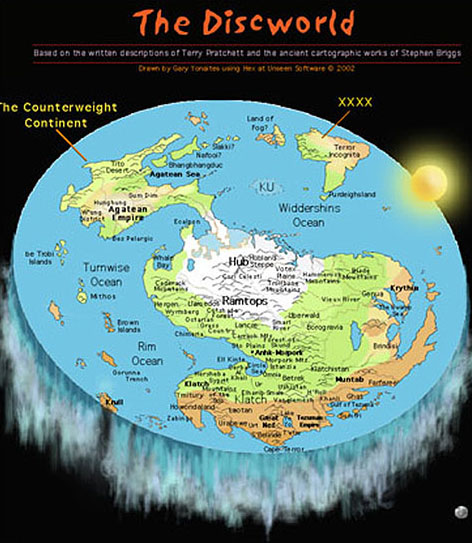
There are four main continents on the Disc .The majority of the Disc’s landmass is composed of a single supercontinent and a smaller Counterweight Continent connected by a narrow peninsula. The main unnamed supercontinent is where most of the novels are set (Think Europe) with the smaller continent being Klatch, (think Africa), The island continent of Fourecks (A.K.A. Terror Incognitia) is the smallest of the four (think Australia). On these continents a large number of countries, kingdoms, cities and towns can be found; the most widely mentioned in the books being Ankh-Morpork, Lancre, the Klatchian Empire and Überwald. It is in these settings that social commentary is front and center. There are wars between nations and in times of peace distrust is the motivating driver of several books.

Ankh-Morpork, the main setting for the series, resembles Victorian London complete with a river no one dares enter. The river is so polluted that it is often described as barely qualifying as a liquid. In Pratchett’s second Disc World book we get the best quote about the city. Ankh-Morpork! Pearl of cities! This is not a completely accurate description, of course — it was not round and shiny — but even its worst enemies would agree that if you had to liken Ankh-Morpork to anything, then it might as well be a piece of rubbish covered with the diseased secretions of a dying mollusk. The air is so polluted birds cough rather than sing. The streets are narrow and dirty. Houses are so close together it is sometimes difficult to know where one starts and another begins. As much as the people grumble about the conditions of Ankh-Morpork there is nowhere more exciting and more appealing. The city is crammed because it is a siren call to the inhabitants of the Disc World. Just like London the city is the cultural center of this small world.

Readers of Dickens would instantly recognize this city. It is where we see the worst of humanity (with its cut throats and bands of villains) and the best of humanity ( the City Watch is made up of characters who on one hand want to keep the citizens safe, but are more likely to walk away from a fight than engage in one). Pratchett gives us a place in which anything can happen and often does. It is here we see humanity struggle for survival while showing us just how important community is.

The times are a mix of medieval (complete with wizards, witches trolls, dwarves, and golems) and Victorian. In this world vampires clash with witches, trolls and dwarves make up the body of the police force. Zombies show up from time to time as do werewolves and dragons. Each of these characters are usually more human than the people they encounter or work with. Pratchett uses these characters as devices to illustrate our hidden prejudices and fear of “others”.

Characters

I cannot honestly think of a series that has more hilarious yet very human characters than Pratchett’s. Listing them all would require an additional post. I’ve picked my favorites, ones that illustrate what it means to be human.

Twoflower

From the BBC movie, The Color of Magic

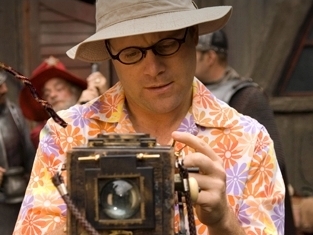
Twoflower first appears in The Colour of Magic .He is the Discworld’s first tourist. He strolls around the city of Ankh-Morpork looking for adventure and genuine native food, and taking pictures of everything with his iconograph. As one of the most naïve people on the disc, he truly thinks no harm can come to him. This is a man who wants to see everything but experience nothing. Because he does not become involved he avoids injury. He represents the western attitude that does not allow for real connections. His idea of engaging in the world is to photograph it, to capture it for later reflection. While some may view his non-involvement as a sort of Buddhist ideal of non-attachment, a deeper meaning can be found in his obsession with pictures. Even as he stands in the middle of the action, he doesn’t really see what is in front of him. His idea of the world and how it should be gives shape to his perception. He sees what he wants to see and ignores the rest.

lancrewitches2

Granny Weatherwax, head of the witches coven on Ramtop mountains, and one the wyrd sisters, is the grand old lady many of us wish we could be. Her no nonsense approach to the world is matched by her wit and wisdom, yet she does not necessarily like dealing with people.” Granny was an old-fashioned witch. She didn’t do good for people, she did right by them.” The fun of Granny and her coven of three is that like the witches of Macbeth, they manage to exact influence on those around them. One is never really sure if it is the witches advice and spells that compel people to act or if they are merely sounding boards to those who seek help and guidance. Granny doesn’t tell people what they want to hear, she tells them what they need to hear. When the wizard Ridcully comes to her asking for her help on an important matter, she replies “No. It’s just personal. Personal’s not the same as important. People just think it is.”

Reaper man

Death is the Discworld fan favorite. He is pictured as the Grim Reaper, yet there is nothing grim about this character. As the herald of death he desires to better understand the human condition and this makes him one of the most human figures in all of the series. His struggle to understand is our struggle. He marvels at the simplicity of our lives yet cannot comprehend why we make it so complicated. In the book Hogfather he muses, “Human beings make life so interesting. Do you know, that in a universe so full of wonders, they have managed to invent boredom?” (Death talks in all caps, and no I can’t explain why)

It has been suggested that if Death could cure world hunger, he wouldn’t do it by making social and economic changes he’d simply give everyone a hot meal.

Death is a favorite not only because we instantly connect with him, but because it is Pratchett’s satirical view on life that we hear through Death. Death is at once the straight man and comic relief. My favorite quote comes in a scene (for the life of me I cannot remember which book) that has a man up a tree as hungry wolves jump around him. The man fearing his life may soon be over looks up and sees Death sitting on a branch. The man asks, “Are you here to help me? Death answers, “YES, BUT NOT IN THE WAY YOU HAD HOPED”.

Many of the stories in the series center around a mystery. Something terrible has happened or is about to happen and it is up to Pratchett’s colorful characters to solve the crime. In other books Pratchett makes fun of current events by setting them in medieval or Victorian times. You never quite know what you will get when you pick up a Disworld novel. But isn’t this just like life?

Some of my favorite Discworld books

The Color of Magic

Reaper Man

Hogfathers

Small Gods

Moving Pictures

Feet of Clay

Going Postal

Wyrd Sisters

Carpe Jugulum

Amazing Waste

Repurposing Food and Reducing Waste

measurestillformeasure

Shakespeare, Classics, Theatre, Thoughts

Nerd Cactus

Quirky Intellect for the Discerning Nerd

Sillyverse

Stories of magic and mystery

Commonplace Fun Facts

Mind-Blowing Facts You Didn’t Know

Fictionophile

Fiction reviews, Bookblogger, Fiction book reviews, books, crime fiction, author interviews, mystery series, cover, love, bookish thoughts...

Patrick W. Marsh

monsters, monsters, everywhere

Shakespeare for Kids Books

Opening the door for kids to love Shakespeare and the classics

desperatelyseekingcymbeline

The 10-year Shakespeare New Year Resolution

Katzenworld

Welcome to the world of cats!

booksandopinions.com

The Book Reviews You Can Trust!

The Book Review Directory

For Readers and Writers

thelitcritguy

screams from the void

Author Adrienne Morris

Step Into the Past—Lose Yourself in the Story.

crafty theatre

ideas inspired by crafty characters

Critical Dispatches

Reports from my somewhat unusual life

The Nerd Nebula

The Nucleus of the Universe for all Nerd Hacks!