
One advantage to college is that it exposes you to subjects that you otherwise may not have touched. For me this is science. In high school I was encouraged to take agriculture as my science requirement because of my poor math skills. Since I lived on my grandparent’s farm during the summer months I laughed that I could take a class doing things I did on a daily basis. Needless to say I aced this “science” class, but my knowledge of general science was woefully lacking. During my early adult years I stayed away from science thinking I was not smart enough to get it. After taking a biology class three years ago, I found not only am I smart enough to get it, I love it and want to learn all I can. Most of my education has come from reading science books though I have taken three science classes since biology.
Early this summer I decided to learn more about evolution. Sure I had the basics down, but really not enough to hold a good debate with a creationist. Like most people what I “knew” came from what I had heard, not from what I read. One way to learn more about evolution was to read Darwin himself, but this turned out to be a very dry and boring read I am sorry to say. I looked for a modern guide to evolution; after all, we have learned so much since Darwin, surly there was someone out there who wrote about it in a way layman can understand. To my surprise it was Richard Dawkins who has written a book that I feel Darwin would have written if he had all the facts, terms and evidence we have now.
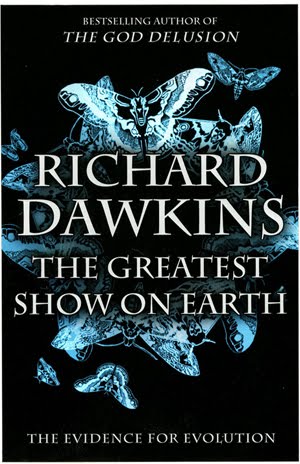
Like many of my readers I only knew Dawkins from The God Delusion and The Blind Watchmaker. I tried to read The God Delusion but was turned off by his attack on religion without giving it any credit for making people’s lives better. I did not know Dawkins is a biologist and a rather knowledgeable and engaging one at that. His latest book The Greatest Show on Earth, the evidence for evolution taught me and more importantly (at least in my mind) it got me asking questions. This is how I gauge if I am truly learning anything, when I ask follow up questions.
The book reads like a course in evolution. Dawkins starts with examples of evolution or mutation by artificial means. What we all take for granted we may not understand is a type of evolution. Over thousands of years man has taken the wolf from a village scavenger to the many breeds of dogs we see today. A scientist in Russia did the same with foxes in the 1950’s and within just a few short generations had tame foxes that started to look and act like dogs, from the floppy ears to loyal behavior. Dawkins points to plant breeding; from our early ancestors changing wild plants to the grains and cabbages we have today, to the award winning roses we all know and love. Dawkins starts here so the reader becomes comfortable with the idea of evolution and gene mutation.
The book then moves on to how genes mutate and how DNA really works. Those who may not have been exposed to these subjects beforehand can take heart that Dawkins explains this in layman’s terms. Those who have a firm grasp on the subjects can enjoy Dawkins examples of rapid evolution. There is a great story of a biologist who does an experiment on fish to determine how long it would take for them to change their spot patterns depending on if they had local predators. I won’t spoil it for you, but will say I have some good ammunition loaded with facts for the next round of discussions with my aunt.
I will admit the middle of the book dragged a little for me. Here Dawkins goes through the nine months of gestation. Even Dawkins admits this is a little digression, but he did have a point to make. I think he could have made the point in less time. This is my only negative thoughts on the book; at times Dawkins eloquently explains something but then spends another page or two explaining what he just said. Either Dawkins does not have confidence in his ability to get a point across or he does not have confidence his reader will fully understand some key points. I found myself skipping some parts because of this.
Over all I would highly recommend this book to anyone who wants a better understanding of evolution or science in general. The book is has some English humor and is easy to understand. I think we all should have a good grasp on science if only to make us better consumers. Many books and late night infomercials rely on our lack of science based knowledge in order to sell us cheesy ideas or products. Dawkins may not stop you from purchasing a glass plant watering globe that magically knows when your plants are dry, but I bet you never look at a dog or plant the same way again. And for a really great book on all things science I recommend Bill Bryson’s A short history of nearly everything.
If you dear readers have a favorite science book be sure to leave a comment. I am always on the lookout for a good science read.

 The View From Sari's World