
Do we have free will? This is one of mankind’s most loaded questions because the answer depends on the answerer’s worldview and how he perceive and react to circumstances beyond his control.
The question of free will can become a theological argument for those who seek to find meaning in tragedy or everyday disappointments. “Yes”, they may argue, “we have some free will but ultimately God is in control”. For others who do not ascribe to divine intervention, this argument is viewed as an exercise of rational philosophy (though first they argue over the term “free will”). Some feel that those who are not enslaved have absolute free will, while others feel agents of free will can only act upon their own will as long as circumstances allow; you may want to go outside but if a snow storm prevents it, then you cannot act upon your will. Of course no well-rounded debate over free will would be complete without the argument for moral constraints; and this too is a very loaded question and must remain in the shadows least this post becomes a ten page essay on ethics and free will. The point to all of this is simple; most arguments for and against free will come from a position of arguing over the role that outside forces have as impediments to absolute free will. But what about internal forces?
Psychologists might argue that there are some free agents who absolutely do not have free will (in fact we may not want to call them free agents); that the ability to act as they wish is hampered by the mind that drives their behavior. We would never say of the mentally ill that they will themselves into depression or delusions nor can we (or should never) say that they have the ability to will themselves well.
But what about those who are not mentally ill, but find themselves driven to certain behaviors through either the will of others or through their own inability to do little more than react to each moment without the much inner reflection? Do these people possess free will or is their internal hard wiring such that they cannot act on anything but impulse?
A classic example of someone who seems driven, not by will, but by impulse and external forces is Shakespeare’s Macbeth. Yes, all of the above rambling came to me as I re-read Macbeth last night as preparation for a viewing of Justin Kurzel’s adaption starting Michael Fassbender as the tragic king.
As I read the play it occurred to me that Macbeth was a man who never stopped to consider his actions and was continually pushed to action by either wild imagined impulse or the will of those around him. His own will or call to action stemmed from his fears of what may come next and this fear stemmed from what had just happened. His action can be seen as driven by thoughts of previous action and the idea of what is to come. This is not a man who spends much time contemplating how his bloody deeds are affecting his will. It is Macbeth’s imagination not his will that compels him to only consider the present moment and even then he is unsure how to act rationally. His thoughts are driven by his impulsive imagination.
For me, this was a new way to look at Macbeth and a good example of the many layers Shakespeare gave to each play. My earlier focus had been on Macbeth as a personification of the saying, “Absolute power corrupts absolutely”. Last night’s reading of the play was an opportunity to see that Shakespeare had more to say about the human condition and what drives our behavior. Shakespeare may have asked us to look at what happens when we don’t stop to analyze our behavior or take into consideration that as limited as it might feel, we do have free will and the consequences of not exercising it can have damaging effects on us and those around us.
This morning I looked to see if my ideas had merit. I was pleased to find that I was not the only one who noticed this. William Hazlitt, a noted 17th century Shakespeare scholar agrees:
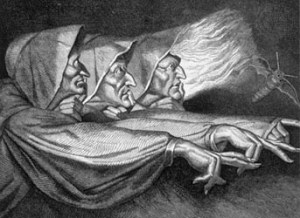
Macbeth himself appears driven along by the violence of his fate like a vessel drifting before a storm: he reels to and fro like a drunken man; he staggers under the weight of his own purposes and the suggestions of others; he stands at bay with his situation; and from the superstitious awe and breathless suspense into which the communications of the Weird Sisters throw him, is hurried on with daring impatience to verify their predictions, and with impious and bloody hand to tear aside the veil which hides the uncertainty of the future. He is not equal to the struggle with fate and conscience. He now “bends up each corporal instrument to the terrible feat.
As for the Fassbender adaptation I viewed last night? Skip it. I was prepared to watch for any clues that might have given my idea credence. I wanted to see an impulsive Macbeth, one who staggered under the weight of his own purpose as Hazlitt so aptly put it. I am sorry to report that what I saw was an entire film stagger under the weight of its purpose. As if Shakespeare was too much for any of the actors to bear. The movie’s atmosphere felt heavy; the grey tones and misty landscape seemed to drag the movie down. The setting could have worked if the actors had given us energy, but their lack of enthusiasm only enhanced the dreariness of the film. I kept waiting for the actors to fall asleep, as they seemed drugged by the fog that surrounded them. I would not have believed it possible but Kurzel managed to make Macbeth boring. About 45 minutes into the movie I exercised my free will and turned it off. Don’t believe me? This clip shows Fassbender at his most agitated state, and the only time Macbeth considers his actions.
Please, feel free to leave a comment below.
Works cited
Hazlitt, Macbeth AbsolutShakespeare.com
 The View From Sari's World
You must be logged in to post a comment.