If it wasn’t for Shakespeare…great quotes

Macbeth
Macbeth

From Disney to Star Trek, Shakespeare is quoted second only to the Bible. And even some who think they are quoting the Bible are actually quoting Shakespeare.

In Star Trek, the Undiscovered Country (the title is a quote) we hear 15 quotes. Disney has at least one quote or reference in almost every movie. Did you know The Sound of Music quotes Shakespeare? In the song, Something Good we find the famous line “Nothing comes from nothing”. This is taken right from from King Lear.

A Winter's Tale
A Winter’s Tale
Hamlet
Hamlet

Musicians, advertisers and authors make good use of Shakespeare’s words. Yet often these great lines go unnoticed, as most people don’t know what they are hearing is really Shakespeare. So, as we continue our Shakespeare birthday countdown, I give you:

If it wasn’t for Shakespeare, we wouldn’t have these famous quotes.

 Hamlet

To be or not to be, that is the question.

Love all, trust a few, do wrong to none.

Give every man thine ear, but few thy voice.

To thine own self be true.

God has given you one face, and you make yourself another.

Listen to many, speak to a few.

There is nothing either good or bad but thinking makes it so.

Neither a borrower nor a lender be.

Romeo & Juliet

What’s in a name? that which we call a rose, by any other name would smell as sweet.

Don’t waste your love on somebody, who doesn’t value it.”

Parting is such sweet sorrow that I shall say goodnight till it be morrow.


A Midsummer’s Night Dream

The course of true love never did run smooth.


 As You Like it

A fool thinks himself to be wise, but a wise man knows himself to be a fool.

All the world’s a stage, and all the men and women merely players: they have their exits and their entrances; and one man in his time plays many parts, his acts being seven ages.


Twelfth Night

Some are born great, some achieve greatness, and some have greatness thrust upon them.

If music be the food of love, play on.

Better a witty fool than a foolish wit.
Merchant of Venice

If you prick us do we not bleed? If you tickle us do we not laugh? If you poison us do we not die? And if you wrong us shall we not revenge?

It is a wise father that knows his own child.

All that glitters is not gold.

Julius Caesar

It is not in the stars to hold our destiny but in ourselves.

Cowards die many times before their deaths; the valiant never taste of death but once.

The evil that men do lives after them; the good is oft interred with their bones.

Et tu Brute?
The Merry Wives of Windsor

Better three hours too soon than a minute too late.

Henry VI

Suspicion always haunts the guilty mind.

Henry V

The empty vessel makes the loudest sound.

Macbeth

False face must hide what the false heart doth know.

Out damned spot. Out, I say!

What’s done cannot be undone.
Remember, the next time you are watching a movie or reading a book and think, “Hey that sounds like Shakespeare”, it probably is.

Reposted as part of our Get Ready for Shakespeare Week
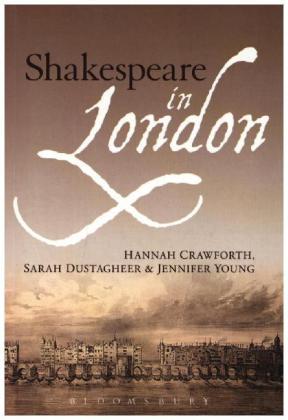
Shakespeare’s London A review

49712263Z

There’s been a growing trend of Shakespeare related books of late. Leading up his 450th birthday, authors scrambled to publish books in order to catch the wave of Bardolatry. We saw books about the man, his life, and his work. Some books were more successful than others. There was more interest in The Science of Shakespeare than there was for Shakespeare Star Wars, yet both tested critic’s views on what they were willing to accept.

The trend continues. It appears ever few months a new book is published that promises to shed new light on Shakespeare’s life or work. The authors of these books are convinced they know something others do not. While it is true, research in any field can offer new clues about a given subject, we have to be careful in assuming the connections we make between our chosen subject and what we have found are true. As I have said in past posts, it is a grave mistake to assume the connection(s) we find are evidence of some truth about Shakespeare. There is no shame in asking, “could it be?” but to say we KNOW is narcissistic speculation at best.

Tina Packer’s “Women of Will”, based a play of the same name, could have and should have been a delightful read. Packer is a director and actor who has dedicated the last 30 years to Shakespeare. Her knowledge of the theater alone would be reason enough to write a book. Yet she too falls into the “I know” trap as she talks about Shakespeare’s thoughts on women and why we wrote them as he did. Worse yet, she makes some rather bold claims about his life, as if her gut feeling is as good as factual knowledge. She claims to know who the Dark Lady is and her ‘relationship” to Shakespeare. Her claim that Shakespeare wrote Henry VI while still in school is laughable. Packer may be a brilliant director but it is fair to say that she has allowed herself to get too close to her subject. Make no mistake, Packer offers her readers insight into the world of acting, but an academic she is not.

This is why Shakespeare’s London is such a breath of fresh air. Hannah Crawforth, Sarah Dustagheer and Jennifer Young, three UK college lecturers, take us on a tour of Shakespeare’s world without a hint of “I know”. The authors point out events and social situations that might have been the inspiration for some of the plays. They make connections but never assumptions. Ironically, had they done so, I would’ve had to reassess my critical view on this sort of research. What they offer is compelling.

Each chapter is a specific view on London’s society. The first chapter is on violence, the last on economics. Every chapter opens our eyes to a new part of London society. They show us what Shakespeare would have seen and experienced. They offer tantalizing clues about Shakespeare’s world and how he may have mirrored it in his plays.

Chapter one talks about Tyburn, the city’s site for public execution. Travelers to London in Shakespeare’s day would have been greeted with the horrific sight of bodies left hanging. London’s citizens viewed public executions as part of everyday life. Hundreds stood and stared as criminals were hanged, drawn, and quartered.

These same people would think nothing of watching bear baiting and dog fighting. We don’t know if this type of spectacle was shocking to young Shakespeare but it is interesting to find out that in May of 1593 two Puritans were taken to Tyburn to be hanged. At the last minute they were reprieved, only to be taken back to prison, and hanged a week later. Shakespeare would write Titus Andronicus not long after this event. There is a scene in which it is noted that the hangman had taken someone down, “for the man must not be hanged till the next week”.

This is a very bloody play that suggests that nothing good comes from senseless violence. While we will never know why Shakespeare wrote this play, it is interesting to see how violence in the justice system and public sport could affect a writer. Learning about Tyburn and the city’s propensity to violence as a social norm was one of city’s many layers I uncovered while reading this book. To be sure this is a book about Shakespeare’s London, but it is the city, not that playwright that takes center stage.

One of the most compelling connections between Shakespeare’s work and his adopted city is the timing of The Merchant of Venice. The play was published in 1600. We don’t know how long Shakespeare took to write his plays, but even if we back it up to say, 1599, it comes close to a time in the Lord Chamberlain lives when they were struggling to find a permanent home. For a short while the players were forced to enter into an agreement with the owner of the Swan Theater, Francis Langley. He demanded the players stage no plays at any other venue; if they did they would be fined 100 pounds. Talk about demanding a pound of flesh! 100 pounds was a huge amount of money back then.

Now all of this is speculation of course, and the authors are quick to point out that while we don’t know exactly what inspired Shakespeare’s writings, we do know that we are all products of our environment. This tour of London offers readers the chance to see what kind of environment Shakespeare lived in. Take from it what you will.

Amazing Waste

Repurposing Food and Reducing Waste

measurestillformeasure

Shakespeare, Classics, Theatre, Thoughts

Nerd Cactus

Quirky Intellect for the Discerning Nerd

Sillyverse

Stories of magic and mystery

Commonplace Fun Facts

Mind-Blowing Facts You Didn’t Know

Fictionophile

Fiction reviews, Bookblogger, Fiction book reviews, books, crime fiction, author interviews, mystery series, cover, love, bookish thoughts...

Patrick W. Marsh

monsters, monsters, everywhere

Shakespeare for Kids Books

Opening the door for kids to love Shakespeare and the classics

desperatelyseekingcymbeline

The 10-year Shakespeare New Year Resolution

Katzenworld

Welcome to the world of cats!

booksandopinions.com

The Book Reviews You Can Trust!

The Book Review Directory

For Readers and Writers

thelitcritguy

screams from the void

Author Adrienne Morris

Step Into the Past—Lose Yourself in the Story.

crafty theatre

ideas inspired by crafty characters

Critical Dispatches

Reports from my somewhat unusual life

The Nerd Nebula

The Nucleus of the Universe for all Nerd Hacks!