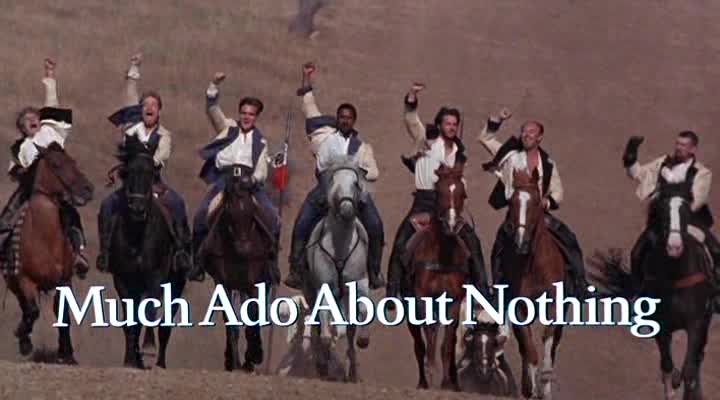
Can we still enjoy Much Ado About Nothing?

branagh-03

I haven’t watched Kenneth Branagh’s adaptation of Much Ado about Nothing since it’s 1993 release. I completely forgot how delightful the movie and the play truly are. This in part thanks to some modern scholars and theater directors.

I reread the play last month as part of a Future Learn class, but because I do not buy into the scholarly idea that this is a problem play, I didn’t get much out of the class. It seems to me modern scholars make much ado about nothing. Or at least, much ado about something we needed not think so hard on. When we chose to use our modern sensibilities as guides to inform us about a pre-modern plays with there will always be problems. But if we bother to look at this play from an Elizabethan audience perspective we find there is no problem.

My goal here is not to overly criticize modern scholars and directors as some of their points are valid; the role of women as objects is a worthy subject. But, when Shakespeare’s plays are placed under a microscope, scholars lose the big picture. Shakespeare understood the subject matter he addresses it in the play. Critics don’t like his solution and therefor tend to ignore it. This does a disservice to the play. Modern theater companies tend to make it darker than it need be. We need only to compare the Royal Shakespeare Theater’s 2013 production to the Branagh film to see how modern attitudes can affect the likability of the play.

In order to understand why Branagh’s film is a breath of fresh air and a film worthy of praise, we need to understand the subject matter Shakespeare addresses and his understated answer or his “moral of the story”, if you will. There is a lot to unpack but for discussion sake, I will keep it brief.

Here come the spoilers!

In a nutshell, Much Ado about Nothing is a play about two sets of lovers and the fragility of love and courtship. It is possibly the most socially realistic of his plays in its portrait of class difference and community life. The pain is contrasted and constraint by joy. As in all of Shakespeare’s comedies this play’s misunderstanding are sorted out and ends with a wedding scene.

Don Pedro (a prince of Aragon) accompanied by a band of soldiers, travels to the small town of Messina. It is mentioned that Pedro has an uncle in Messina but we never see him. It is the governor, Leonato, that Pedro decides to stay with. The soldier Claudio (a lord of Florence) instantly falls in love with Leonato’s daughter Hero. Hero’s cousin Beatrice and Benedick, another soldier, have an antagonistic relationship, one that was cemented before the soldiers return from an unnamed war. Upon Benedick’s return the two once begin trading barbs. It is obvious to all that that these two are in love, yet neither will admit it. It will take light-hearted subterfuge to get them together.

Claudio and Hero have no such problems confessing their love. When Claudio tells Pedro he wants to marry Hero, a quick (yet unnecessary) plot is hatched to woo and win her hand. The comedy turns dark when Pedro’s illegitimate brother, Don John, decides to interfere. His companion, Borachio (Italian for “drunkard”) devises a plan in which John convinces Claudio and Pedro to watch as “Hero” and Borachio have sex the night before the wedding. Claudio, enraged, publically shames Hero at the alter and throws her back at her father calling her a whore. Hero “dies” at the alter and is buried in a shroud of shame. When John’s devious plot is revealed, Claudio begs Leonato to punish him as he sees fit, believing he has killed the woman he loved. Leonato tells Claudio he must publicly admit his guilt and then marry his niece; a lady Claudio cannot meet or see until after he marries her. Claudio agrees to the terms. As it turns out, Leonato’s niece is really Hero, who has been in hiding waiting for the truth of her virtue to come out. That she agrees to marry the man who publicly shamed her is the modern scholars problem.

Elizabethans on the other hand, would have been very familiar with this plot. Shakespeare did not make it up out of whole cloth. Sexual slander was a theme sixteen-century theater audiences were quite familiar with. Aristo’s Orland Furiouso and Juan Martorell’s Tirant lo Blanco are two earlier works so similar to Shakespeare’s that we can safely assume he drew upon them. Seventeen-century playwrights would also use this theme as a way of satirizing English sensibilities. Cecil Sheridan’s A School for Scandal comes to mind.

That Hero agrees to marry Claudio may be disagreeable, but it shouldn’t shock us. In reality she has little choice in the matter, as it is her father that decides the wedding will take place. When the idea of her “death’ at the alter is voiced by the priest, it is her father, not Hero who agrees. It is her father who decides Claudio will marry her, even if it takes trickery to seal the deal. Hero has little to say about the matter as her voice is silenced by the pre-modern patriarchal society she lives in. This is the setting of the play, not modern England where woman are allowed to chose and reject their suitors.

Shakespeare knew fully well what he was writing. He could have easily kept the story a tragedy as it was in earlier plays. Instead, he couples it with humor by the pairing of Beatrice and Benedick. On the outset it seems these two couples are opposite but closer inspection shows us they are not. Beatrice and Benedick use words to hurt each other in order to avoid personal pain. They seem to be afraid of each other. It is only after overhearing conversations in which each thinks the other is in love, that they come together. Hero is easily wooed by Pedro’s words about Claudio yet Claudio, in his self-doubt, is easily blinded by John’s.

Shakespeare is telling us that in this time and place what people and society think are important (when isn’t it?). So important that Hero “dies” when she is called a whore, and resurrects when her honor is restored. Shakespeare knows Claudio is a flawed character and why he is flawed. His solution is to allows Claudio some redemption by way of punishment. Claudio must agree to marry a woman whose reputation and face is unknown. His station in life in part depends on whom he marries; yet he is willing submit to whatever fate has in store for him. He honors Leonato by his willingness to forgo social constraints. In doing so he finally achieves a measure of honor.

Many modern directors make Claudio so unlikable that there is little impact to this last scene. Audiences are so uncomfortable with the play’s progression that the unfortunate actor playing Claudio is painted into a corner. He can only hope his punishment fits the crime. I’ve seen one play that has the actor so vile that his acquiescence is little more than lip service. I pictured him dumping his veiled wife as soon as no one was looking. From all of this you might think this is one of Shakespeare’s least liked plays. It is not. This is one of the few plays that has never gone out of theatrical style.

Which brings us back to Branagh. As I reread and studied the play, it occurred to me that my memory of the movie in no way matched the ideas that were being presented to me as of late. I had to wonder if I had missed something in my introduction to the play? Is is possible to still enjoy the play?

This is a must see movie for so many reasons! One does not have to admire Shakespeare to fall in love with this adaptation. Between the setting and the acting there is much ado about this film.

Branagh sets his film in the lush hills of Tuscany. One can watch this a second time for the cinematography alone.

Branagh plays Benedick with the wonderful Emma Thompson as Beatrice. At the time, these two were in love and their passion for each other jumps off the screen. Some scholars suggest Beatrice and Benedick would end up having a doomed relationship, as their barbs would make it impossible for them to respect and love each other. Branagh and Thompson prove that it’s there hidden meaning, not the words alone that cement this marriage. It’s in thanks to Shakespeare that whenever modern fictionalized bickering male/female characters are first introduced we automatically know they will end up together. Branagh reminds us why we love this plot device.

Denzel Washington plays a very convincing Don Pedro. He range of mood: authoritative, compassionate, and contrition works. Keanu Reeves on the other hand only has one mood; that of a brooding malcontent. His character is so one-dimensional that it borders on the absurd. This is the only flaw I can find in the movie.

Michael Keaton more than makes up for Reeves’ wooden performance. Keaton is tasked with playing Dogberry, a beloved comical character who is not always easy to play. I’ve heard people complain that Keaton goes overboard with his representation but they forget he is introduced as the play switches from comedy to tragedy. Dogberry is inserted into the play as a reminder to the audience that this is still a comedy. Keaton’s Dogberry arrives on horseback in Monty Pythonesque style (that is, there is no horse). It is so out of left field that I laughed out loud, and for a moment forgot I was about to see the tragedy of Hero. Well played, sir, well played.

Robert Sean Leonard has the task of making us both like and dislike Claudio. I am not sure what his intent was but he managed to be dull, both as a potential lover and scorned groom. This actually worked in his favor, as Claudio is supposed to be malleable. Make him too likeable and his actions at the alter come across as false. Make him too distasteful and Hero’s affection for him, equal as false. Leonard comes across as a young man on the edge of manhood who is easily swayed by those around him.

The humor involves subtle slapstick. Watching Benedick as he tries to unfold a lawn chair while eavesdropping on a conversation reminds us just how funny Branagh can be.

Everyone is this film is a pleasure to watch. Branagh has a gift for surrounding himself with talented people, and is the kind of director who allows their talents to shine. The movie is just plain fun. It is a feel good movie that makes us realize why we still love Shakespeare.

If you’ve never watched a movie based on one of Shakespeare’s plays, start with this one. It may be one of the best.

I’d love to hear which is your favorite.
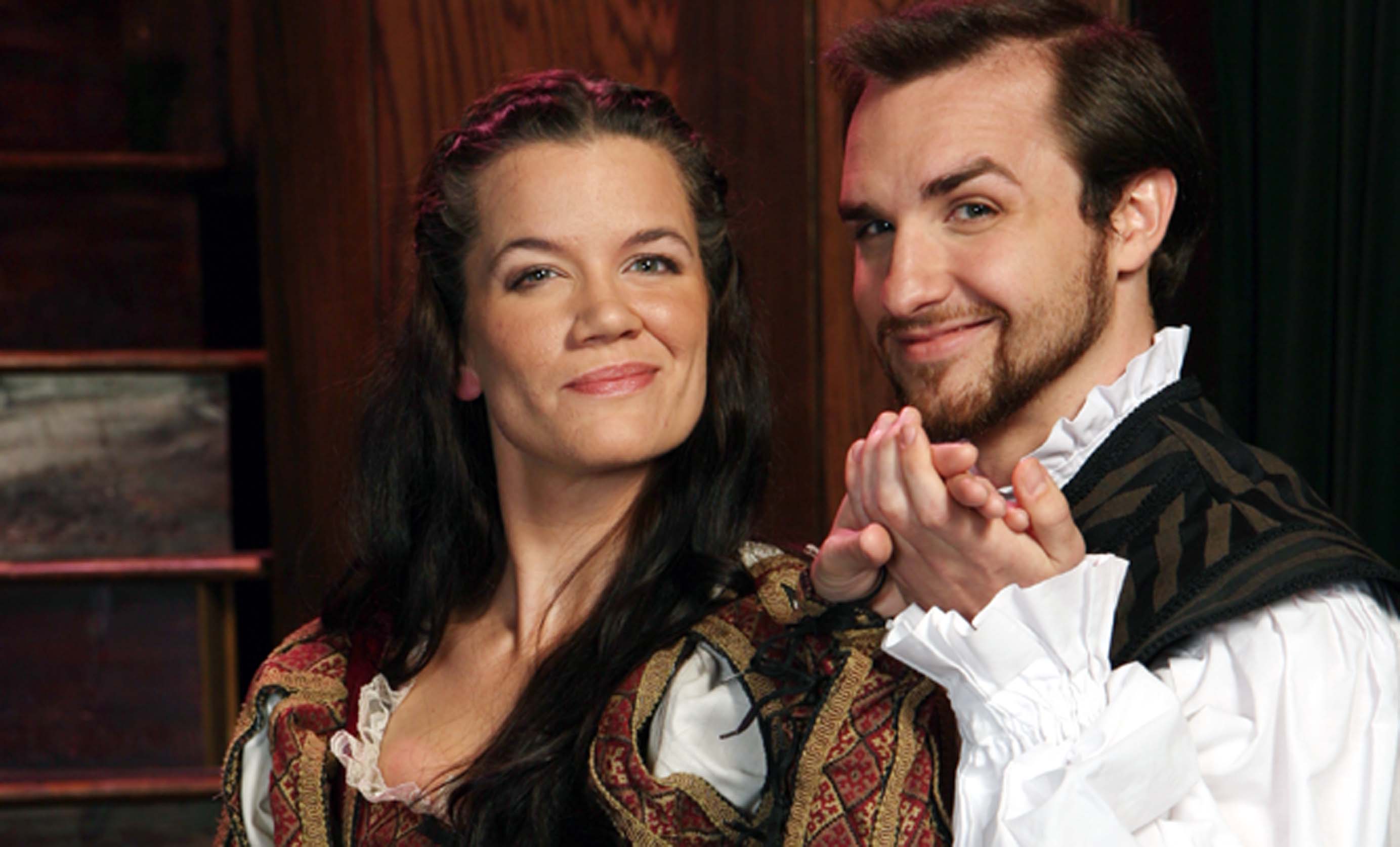
Taming of the Shrew – Does he or doesn’t he? Part 1

Shrew – Woman given to railing or scolding. Elizabethan definition. 

New American Shakespeare Theater Co.

Have you had a chance to view PBS’s second season of “Uncovering Shakespeare” yet? I binged watched it Sunday. It was an ideal way to pass a rainy afternoon. Morgan Freeman hosted the episode on “Taming of the Shrew”. While I thought it offered some wonderful insight, I don’t think it answered the question: Did Petruchio tame the shrew? This is a debate scholars just can’t seem to agree upon.

For those of you unfamiliar with the play, the plot is one of Shakespeare’s simplest.

Minola Baptista is a wealthy man living in the fictitious city of Padua. Babtista has two daughters: the older opinionated shrewish Katherine, and the lovely young Bianca.

Bianca has two suitors while Katherine has none. Baptista refuses to let anyone court Bianca until Katherine is married. It was not uncommon in the Elizabethan era to refuse a younger sister’s hand until the older one was married. Petruchio, a brash retired military man, arrives in town looking to marry a woman with a large dowry. Bianca’s suitors talk him into wooing Katherine so that Bianca is free to wed.

Though not keen on marrying anyone, Katherine is quickly taken in by Petruchio’s banter and unorthodox manner. The two wed, leaving Bianca to choose between her two suitors. The loser ends up marrying a wealthy widow. Everyone seems happy, or are they? This is the beginning of the debate.

The scholarly debate does not start with the events leading up to Katherine and Petruchio’s wedding. It’s the events right after, and leading up to the end of the play that encourages so much debate It’s the treatment of Katherine by her new husband that is hotly debated. It starts with Petruchio’s embarrassing speech at their reception, to his cruel treatment of her at home. It’s his “taming of the shrew” that bothers a lot of scholars.

Over the years I’ve sat on the fence, wondering if this play should be treated as a beloved screwball comedy or a misogynist view of marriage. It wasn’t until I started looking at the play backwards, did it dawn on me, that no, Petruchio did not tame the shrew. I propose that the “shrew” learned that love and marriage is the most important aspect of life. By marrying a man that matched her wit, she found true happiness.

Let’s start with the very last speech of the play, given to us by Katherine. She has shocked her friends and family by allowing Petruchio to toss her hat way because he does not like how it looked on her. Petruchio then instructs Katherine to explain to the horrified women the duty they owe their husbands. Katherine complies:

Fie, fie! unknit that threatening unkind brow,
And dart not scornful glances from those eyes
To wound thy lord, thy king, thy governor.
It blots thy beauty as frosts do bite the meads,
Confounds thy fame as whirlwinds shake fair buds,
And in no sense is meet or amiable.
A woman mov’d is like a fountain troubled-
Muddy, ill-seeming, thick, bereft of beauty;
And while it is so, none so dry or thirsty
Will deign to sip or touch one drop of it.
Thy husband is thy lord, thy life, thy keeper,
Thy head, thy sovereign; one that cares for thee,
And for thy maintenance commits his body
To painful labour both by sea and land,
To watch the night in storms, the day in cold,
Whilst thou liest warm at home, secure and safe;
And craves no other tribute at thy hands
But love, fair looks, and true obedience-
Too little payment for so great a debt.
Such duty as the subject owes the prince,
Even such a woman oweth to her husband;
And when she is froward, peevish, sullen, sour,
And not obedient to his honest will,
What is she but a foul contending rebel
And graceless traitor to her loving lord?
I am asham’d that women are so simple
To offer war where they should kneel for peace;
Or seek for rule, supremacy, and sway,
When they are bound to serve, love, and obey.
Why are our bodies soft and weak and smooth,
Unapt to toil and trouble in the world,
But that our soft conditions and our hearts
Should well agree with our external parts?
Come, come, you forward and unable worms!
My mind hath been as big as one of yours,
My heart as great, my reason haply more,
To bandy word for word and frown for frown;
But now I see our lances are but straws,
Our strength as weak, our weakness past compare,
That seeming to be most which we indeed least are.
Then vail your stomachs, for it is no boot,
And place your hands below your husband’s foot;
In token of which duty, if he please,
My hand is ready, may it do him ease

Yes, I know, the speech is long, so let me break it down for you. Katherine is reminding married women that while their husbands are out toiling in the fields or away at sea, the woman are warm and dry (admittedly she is talking to wealthy women). All that their husbands ask in return is to be loved and obeyed. Arguing with their husbands is pointless and only makes for an unhappy home. Husbands have the final say, so why not submit instead of committing acts of rebellion by “banding word for word, and frown for frown”? In other words, Katherine is reminding married women, it is their job to keep the peace.

Now, before I lose my female readers who may feel this is absolutely unacceptable, let’s bear a few things in mind.

Shakespeare has given Katherine the final say. In fact, Katherine has many of the best lines, the longest lines. And keeping in mind the word, “shrew” as it was used in Shakespeare’s day, refers to a highly opinionated woman. One who is not afraid to express herself. By allowing Katherine to express her views on marriage Shakespeare is keeping true to her “shrewish” nature. There does not seem anything tame about her speech. She scolds the woman much as she did men before she was married.

Let’s also keep in mind that the vow of obedience is still uttered today, though most modern women will say this is a vow that is more bark than bite. Our vows come to us not from our secular worldview, but from the Christian worldview. Looking at the vow from this lens we begin to understand the words Katherine chooses. She reminds the women that their husbands are their lords and should be obeyed as such. Christians, obey and love their Lord. If you reverse this, Christians obey their Lord because the love him. Katherine is telling women they should obey their husband because they love him. And we have to ask, what does she mean by obey?

Much of her speech is centered on arguing. She says, “But now I see our lances are but straws, Our strength as weak, our weakness past compare, That seeming to be most which we indeed least are”. Keep that last line in mind. Katherine is telling the women they are not weak, yet fighting will get them nowhere. The lance of argument is but straw. It will do no harm to men, and only make women feel weak. The stronger woman know when to pick her battles, and knows that arguing for argument makes her a “graceless traitor to her loving lord”.

How do we know this is what Katherine means? Let’s jump to the scene between the newlyweds in which Petruchio tries to goad Katherine into an argument. Why he does this depends on the actor’s point of view. If done right, it seems to suggest Petruchio is testing Katherine’s tameness, and once tested, suggests he is happy to be outwitted.

On their way back to Katherine’s father’s house, Petruchio points to the sun and notes how “shiny the moon is”. Katherine replies that it is the sun. Petruchio declares they are turning around and going home since she wants to argue with him. Katherine realizes the game his is playing, so agrees it is the moon, only to have Petruchio declare it is the sun. Katherine then says:

Then God be blest, it is the blessed sun,
But the sun it is not, when you say it is not;
And the moon changes even as your mind.
What you will have it nam’d, even that it is,
And so it shall be so for Katherine.

Petruchio is at a loss for words. If this scene is played out correctly, both smile. Katherine has picked her battle and Petruchio knows he has just lost because of it.

Let’s look at this from a modern perspective. You and your husband are sitting out on the veranda, sharing an intimate moment. Maybe you are sharing a bottle of wine and good conversation. Suddenly your husband points to Venus and says, “My, that star sure is bright tonight”. You could argue that it is a planet, not a star, getting out your phone sky app to prove it, or you could just smile and agree. After all, you are having such a good time, who cares what he calls it? You might think to yourself, “I married an idiot,” but you don’t say anything because he is your idiot, you love him. Guess what, you just picked your battle. Does this make you tame? No, this makes you strong. You know it is better to enjoy your evening and by agreeing with your husband on these little things, you will ensure a happy marriage. Why offer war, when you can kneel for peace? This, I think is what Katherine is doing. She realizes that by allowing Petruchio to think he is right, she has the upper hand. She gets what she wants. They continue to her father’s house in good spirits. Petruchio knows his wife is not stupid and will speak her mind, but will not engage in an argument for argument sake. They are content with each other.

Next time we will look at the two scenes that bother scholars the most: Petruchio’s “rude” reception speech and his “cruel” treatment of Katherine once he gets her home. We will look at what John Wayne has in common with Petruchio.

Katherine’s speeches

Women’s Monologues in Shakespeare’s

The Taming of the Shrew

  http://www.shakespeare-monologues.org/plays/7?g=2

Amazing Waste

Repurposing Food and Reducing Waste

measurestillformeasure

Shakespeare, Classics, Theatre, Thoughts

Nerd Cactus

Quirky Intellect for the Discerning Nerd

Sillyverse

Stories of magic and mystery

Commonplace Fun Facts

Mind-Blowing Facts You Didn’t Know

Fictionophile

Fiction reviews, Bookblogger, Fiction book reviews, books, crime fiction, author interviews, mystery series, cover, love, bookish thoughts...

Patrick W. Marsh

monsters, monsters, everywhere

Shakespeare for Kids Books

Opening the door for kids to love Shakespeare and the classics

desperatelyseekingcymbeline

The 10-year Shakespeare New Year Resolution

Katzenworld

Welcome to the world of cats!

booksandopinions.com

The Book Reviews You Can Trust!

The Book Review Directory

For Readers and Writers

thelitcritguy

screams from the void

Author Adrienne Morris

Step Into the Past—Lose Yourself in the Story.

crafty theatre

ideas inspired by crafty characters

Critical Dispatches

Reports from my somewhat unusual life

The Nerd Nebula

The Nucleus of the Universe for all Nerd Hacks!