12 Higher brain insults

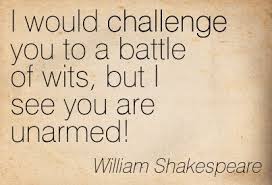
Shakespeare insult

We’ve all done it. At some point a hammer has missed its mark, a box has landed on a foot or a head has been knocked by an open cabinet or car door. And then, oh then, without thought an obscenity flies out! Maybe just one word or two, but the word(s) are spoken with venom and spite. Though if one is unaccustomed to using coarse language the object of one’s wrath may be merely dammed. Whatever the word(s) we feel better by cursing.

Experiments have shown that test subjects are able to keep their hands in freezing water longer when they repeat a swearword. Scientists believe that swearwords occupy a different part of our brain than does polite language. Most speech is a “higher brain” function while swearwords are stored in the “lower brain” the Limbic system, which is responsible for our emotions and autonomic nervous system. Swearwords may activate endorphins, which in turn interact with the opiate receptors in the brain to reduce our perception of pain. This would be all well and good if we only used swearwords as automatic pain reducers but we do not. Over the centuries we have directed curses, oaths and obscenities to our fellow man, and we are not the better for it. It has become the lazy vocabulary of our culture. When we cannot come up with something clever to say, we resort to ignorant language.

The reason I bring this all up is because I’m reading Melissa Mohr’s book, Holy Sh*t. A brief history of swearing. In it she reminds us that linguistically, a swearword is one that” kidnaps our attention and forces us to consider its unpleasant connotations”. The connotation gives the word its emotional punch. The connotation of f*cking, could mean really, really bad or working hard at something, depending on its use. The word itself is only taboo because of its connotation.

We use swearwords for a variety of reasons but no matter the reason or connotation we want to get across, we are engaging our lower brain when we do so. The idea that we sometimes allow our Limbic system to take over when telling someone off leads to questions. Does the act of telling someone off itself activate our lower brain or is it the language that we use? Do we do a double stoop by not only resorting to course language but also by wanting to? These are the kinds of questions that keep me in the shower longer than I should or reading further into Mohr’s book. I started making some notes because I wanted to know if there was a better way to tell someone off, or describe a horrible person while still using our higher brain? Of course we could just stop saying bad things to and about people, but sometimes there is no better option. Sometimes people need to be told off and described in harsh honesty.

Luckily I came up with an answer, one that allows us to use our higher brain and stops us from using lazy and ignorant language. Of course the answer is Shakespeare! Our Will was a master of insults and barbs. Many of his plays would not work as well without them. Of course he threw in an Elizabethan swearword or two to get his point across, but overall he showed us that a witty turn of a phrase was just as effective. So the next time you are forced to mentally dual with someone, yell at a teammate for a bad play or have the last word, I give you

 12 Shakespeare insults.

Each one was picked for how quickly it can be memorized and how seamlessly it fits into today’s language.  *Modern spelling is an option.

 As you like it

Let’s meet as little as we can

I do desire we may be better strangers

In civility thou seem’st so empty

All’s well that ends well

You show yourself highly fed and lowly taught

Henry VI part 2

That is too much presumption on thy part

The Tempest

Hell is empty and the devils are all here

You freckled whelp hag-born

Look, he is winding up the watch of his wit: by and by it will strike

You are living drollery

King Leer

I have seen drunkards do more than this in sport

Love’s Labour Lost

Come, come, you talk greasily: your lips grow foul

O! thou monster Ignorance, how deform’d dost thou look
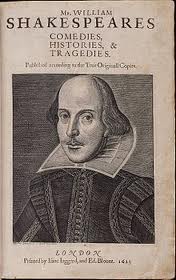
So, you think you’re smarter than Shakespeare?

images-2

My long time followers know two things about me. I love listening to podcasts and am in the middle of earing my master’s in humanities, ever hopeful to teach my favorite subject Shakespeare. So when one of my favorite podcasts Strange Frequencies Radio (SFR) decided to do a show about the Shakespeare authorship debate I eagerly joined in the live chat room.

For those of you who are unfamiliar with the Shakespeare authorship debate let me explain.  Critics of Shakespeare as an author believe that William Shakespeare the actor did not write the plays and poems attributed to him. This idea is not widely held by most scholars, but those who do are rather vocal about their views. This was shown to be true during the live broadcast of SFR Sunday afternoon. Wow the Oxfordians in the chat room were almost shouting! FYI they call themselves Oxfordians because they believe the 17th Earl of Oxford, Edward De Vere, is the true author. The “evidence” for this is comprehensive, ranging from De Vere’s aristocratic knowledge of the upper classes through to his education and the similarities between his poetry and Shakespeare’s (there isn’t any). As regards to the authorship of Shakespeare’s plays and sonnets, it is believed by the Oxfordians that Edward wrote these under the pseudonym of Shakespeare, both to avoid breaking a voluntary convention against aristocrats publishing poetry (there wasn’t one) and plays and to escape the consequences of the subject matter he was writing about.  It is suggested that the character of Polonius bears a striking resemblance to De Vere’s father-in-law. Anyone who has either read the play or watched it probably thinks Polonius bears a striking resemblance his or her father-in-law or at least we all have that one uncle…

Professor and humanities skeptic (I want that title!)Eve Siebert was SFR’s guest. She was on to debunk the arguments for someone else as being the author of the works of Shakespeare. No sooner had she started talking when someone in the chat room rudely typed “Wrong!” over and over again. He then rudely suggested the hosts “get a real scholar” on the show. Not only was this extremely rude and disrespectful it was obvious he could not handle his beliefs being debunked and wanted to only hear from someone whose believes were the same as his. I have to hand it to Bobby, one of the hosts of SFR, for he not only called out those in the chat room who were typing rude remarks, he dared them to call in after Professor Siebert was finished so they could tell their side. And to the doubters credit a “real Oxfordian scholar “did call in. As expected his arguments were weak; he talked about the relationship between De Vere and his father-in-law. As he rambled on his voice became angry not because anyone was arguing with him, but because the two hosts were asking follow up questions.

This post is not a case for Shakespeare, though in the future if you want I will talk about the various claims made by the Oxfordians, yet I feel compelled to talk about one. The one that all doubters of Shakespeare point to; that an uneducated actor could not have possibly written such great works. This, to me, is a disrespectful and ugly argument. It has always bothered me when those without degrees are looked upon as some how not as smart as those with degrees.

But before I do I want to share a couple of thoughts I had during the show.

  1. It is no secret that those who shout or become rude during a conversation debate always have the weaker argument and they know it. We see this all the time when listening to conspiracy theorists. What happened Sunday afternoon was no different from other conspiracy debates.
  2. There are those who feel the need to make themselves seem superior to their fellow men. In this case there are those who feel that if they could prove Shakespeare was not a great writer they would not only be intellectually superior to mainstream Shakespeare scholars, they would prove that only someone with a college education could have written the works of Shakespeare. In a way they would be proving that they are smarter than William Shakespeare. Which leads me to my intended post. Using myself as an example I’m going to show you just how easy it is for an “uneducated” person to come up with an idea and then run with it.

For years I felt inadequate because I lacked a college degree. I made up for it by being well read. I collected and read books on a wide range of subjects. I felt by reading I was making up for what I lacked in an education. Perhaps Shakespeare felt the same way. After all many playwrights of his day were college educated. Perhaps Shakespeare was also well read. After all, books come in real handy when doing any kind of research, as I am about to prove.

This last spring I wrote a paper titled What happens in the woods stays in the woods. It was a critical look at the play A midsummer night’s dream. In the paper I compared Greek mythology to the characters found in the play. I wasn’t sure what my hook would be until I did some research on centaurs. I wanted to see if I could figure out why the character of Bottom was depicted as having an ass’s head/ male body instead of the usual horse body/male head. My research paid off. I found out that Chiron, the wisest of the centaurs, is described as “having thoughts too great for man”. Does this sound familiar? It should if you have seen or read the play.

After Bottom is once again transformed into a man he declares ““I have had a dream past the wit of man to say what it was”. “ The eye of man hath not heard, the ear of man that not seen, the hand of man is not able to taste, his tongue to conceive, nor his heart what my dream was”. It would seem Bottom also had thoughts too great for man. Bottom couldn’t even explain them with any clarity (he was an ass not an centaur after all).

It was clear the playwright had Chiron’s wisdom in mind when he created the character of Bottom. In fact the majority of the action in the play requires that all of the characters believe they are acting wisely thought the opposite is true. I found my hook within 15 minutes of doing research and did so using books I collected before I earned a degree.

So what does this have to do with Shakespeare? Well, let’s say instead of writing a paper I decided to write a play and said play was to be based in ancient Athens because I just happened to love Greek mythology having studied it in grammar school. How would I go about it? Perhaps I would pick up Arthur Golding’s 1567 translation of Ovid’s The Metamorphoses and look for inspiration and find it in section Six titled, The Less Important Myths. Why this book? Because it was widely regarded during Shakespeare’s day and because this is where I found the mention of Chiron and his being wiser than men. It took my only 15 minutes, but perhaps Shakespeare had this in mind the whole time when he sat down to write. Maybe it didn’t even take him 15 minutes. The idea may have been planted in childhood.

It would not have taken a college education to write this play, just a natural talent for writing, love of Greek mythology and memories of being taught about them in grammar school.

References

D L Johanyak, Shakespeare’s World

Ovid, The Metamorphoses

George Puttenham ,The Arte of English Poesie

William Shakespeare, A midsummer night’s dream

If you don’t believe William Shakespeare was a writer, go ahead, give it your best shot. Show me your proof. But remember, I have reference books and am not afraid to use them!

Amazing Waste

Repurposing Food and Reducing Waste

measurestillformeasure

Shakespeare, Classics, Theatre, Thoughts

Nerd Cactus

Quirky Intellect for the Discerning Nerd

Sillyverse

Stories of magic and mystery

Commonplace Fun Facts

Mind-Blowing Facts You Didn’t Know

Fictionophile

Fiction reviews, Bookblogger, Fiction book reviews, books, crime fiction, author interviews, mystery series, cover, love, bookish thoughts...

Patrick W. Marsh

monsters, monsters, everywhere

Shakespeare for Kids Books

Opening the door for kids to love Shakespeare and the classics

desperatelyseekingcymbeline

The 10-year Shakespeare New Year Resolution

Katzenworld

Welcome to the world of cats!

booksandopinions.com

The Book Reviews You Can Trust!

The Book Review Directory

For Readers and Writers

thelitcritguy

screams from the void

Author Adrienne Morris

Step Into the Past—Lose Yourself in the Story.

crafty theatre

ideas inspired by crafty characters

Critical Dispatches

Reports from my somewhat unusual life

The Nerd Nebula

The Nucleus of the Universe for all Nerd Hacks!