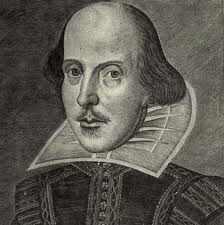
Shakespeare Day! Words! Words! Words!

images-1


Today we celebrate Shakespeare’s birthday. We do this even though historians are not quite sure this is his date of birth. What we do know is that he was baptized on April 26, 1564. Normally newborns were baptized three days after being born. He died on April 23, 1616, so April 23 is dedicated to the Bard.  And what better way to celebrate his work than with lists? Polonius asked Hamlet, “What do you read, my lord? Hamlet replies “Words, words, words. You my dear readers are going to read lists lists lists!

Harold Bloom, the great philosopher and Shakespearean critic, once said, “Shakespeare invented the human”. I would not go so far, but I would say Shakespeare invented how the West looks at the human condition. His characters are mirrors in which we can all look into and see a part of ourselves. Here is a quick list of some of his more famous humans:

Hamlet:

Hamlet has been called the man who could not make up his mind. He is tasked to avenge his father’s death, yet, while having no qualms about killing his traitorous friends, and lashing out with a sword in a murderous rage, he hesitates when it comes to killing Claudius. Hamlet doubts his own existence, and wonders what’s the use of it all? He is hesitant when it comes to suicide. He cannot decide whether this is a good idea; anymore than he can decide if killing Claudius is the right thing to do.

In the end all of his doubts just give Claudius time to plan Hamlet’s death. Every major character dies because Hamlet cannot make up his mind. We may never contemplate such drastic deeds, but how often have opportunities past us by because we cannot make up our minds? Sometimes we feel we have no control over our lives, but it may be that like Hamlet, we hesitate and allow fate to dictate what happens to us.

Lady Macbeth:

Lady Macbeth wants more out of life than a mere drafty castle in a Scottish outpost. She and her husband plot to kill King Duncan and take the crown by force. After the deed is done she quickly regrets her actions. The horror of what they have done seeps into her conscious like the king’s blood seeps onto the floor. “Yet who would have thought the old man to have had so much blood in him”. She begins to sleep walk and tries in vain to wash the blood from her hands. “Out damn spot, out!” She cannot live with what they have done and takes her life. I first read about Lady Macbeth in high school and the two lessons I took from her were:

Be careful of what I wish for. I am not be able to handle it.

Never do anything that will leave a stain on my soul.

Henry V

Henry V is a man of action, but it is his words that we hear (we never see the battle of Agincourt) that compel others to war and love. He talks his troops into war and he talks the French princess into falling in love with him. He is a reminder that words are just as powerful as action and that we should be wary of men with silver tongues. 

images-3

Words Shakespeare gave us.

Shakespeare invented 1700 words.. Shakespeare has been credited for inventing single words that normally would have taken several to mean the same thing. I won’t list them all, but here is partial list of words we use today:

  • auspicious
  • baseless
  • bloody
  • castigate
  • clangor
  • control (noun)
  • countless
  • courtship
  • critic
  • critical
  • dishearten
  • dislocate
  • dwindle
  • eventful
  • exposure
  • fitful
  • frugal
  • generous
  • gloomy
  • gnarled
  • hurry
  • impartial
  • lapse
  • laughable
  • misplaced
  • monumental
  • multitudinous
  • obscene

Some of my favorite Shakespeare quotes:

Brevity is the soul of wit

To thine own self be true

The devil can cite Scripture for his purpose

All the world ‘s a stage, and all the men and women merely players. They have their exits and their entrances; And one man in his time plays many parts

Et tu, Brute
images-2

My personal favorite books on Shakespeare:

Shakespeare, the invention of the Human by Harold Bloom

Shakespeare’s World by DL Johanhak

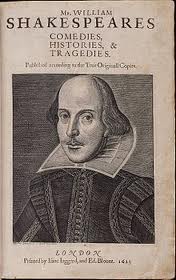
The Book of William, How Shakespeare’s First Folio Conquered the World by Paul Collins

Shakespeare, the world as a stage, by Bill Bryson

Shakespeare by Michael Woods

A Readers guide to Shakespeare, by Joseph Rosenblum (I have ben lucky enough to learn at this man’s feet. He is a master when it comes to understanding Shakespeare).

And thanks to No Sweat Shakespeare we can end on a list of fun Shakespeare facts:

Shakespeare is the second most quoted writer in the English language – after the various writers of the Bible.

Shakespeare is always referred to as an Elizabethan playwright, but as most of his most popular plays were written after Elizabeth’s death he was actually more of a Jacobean writer. His later plays also show the distinct characteristics of Jacobean drama.

Almost four hundred years after Shakespeare’s death there are 157 million pages referring to him on Google. There are 132 million for God, 2.7 million for Elvis Presley, and coming up on Shakespeare’s heels, George W Bush with 14.7 million.

There are only two Shakespeare plays written entirely in verse: they are Richard II and King John. Many of the plays have half of the text in prose.

Shakespeare’s shortest play, The Comedy of Errors is only a third of the length of his longest, Hamlet, which takes four hours to perform.

All Uranus’ satellites are named after Shakespearean characters.

Among the 80 languages Shakespeare’s works have been translated into, the most obscure must be the constructed language of Star Trek’s Klingon. Hamlet and Much Ado about Nothing have both been translated as part of the Klingon Shakespeare Restoration Project by the Klingon Language Institute.

Happy Shakespeare Day!



Happy Earth Day! My interview with a soil scientist

images

For Earth Day I decided to do something different. Instead of writing a story about the history Earth Day or a review of a good book on natural history, I decided to share a school assignment, tied to the idea of sharing what state forest departments do. Many people do not know what I do to pay the bills. Until writing articles allows me to stay home full time, I am one of two administrative assistants for the Nevada State Fire Warden. But let me start with what we don’t do, and why some days it doesn’t pay to get out of bed.

Caller: “Would you please come over to my house, pick up the dead quail in my front yard and tell me why it died”.

Me: No, ma’am, we do not offer that service. I suggest calling Fish and Game or your local animal control office”.

Caller: “But you work in the forest, why won’t you come get this dead bird?”

Caller: “I see smoke and flames on the road to Tahoe”

Me: Please hang up and call 911.

Caller: But I don’t know if it is an emergency!”

Me” If you see smoke and fire where none should be, it is an emergency”.

Caller: “You are no help!”

It might surprise people to know that even though we work in the woods we don’t deal with animals, dead or alive. Yes we do help put out fires, but we are never the first you should call if you see one. We respond after local authorities ask for our help. Our focus is wildfire prevention and improving our state’s natural resources. My school assignment was to interview a scientist, hopefully one whose work complements climate change mitigation. Luckily for me David Howlett, one of my co-workers is such a scientist.

I hope you enjoy the interview: Happy Earth Day!

I reached out to David Howlett, a soils scientist. David received his Ph.D. in Soil Science at the University of Colorado. I just happen to work with David at the Nevada Division of Forestry. David has been with our agency for about 6 months and already has established quite the reputation as a climate scientist within Nevada. David I sat down for lunch last Wednesday, and ended talking for two hours on everything from why climate change is hard for many to accept, to why Neil de Grass Tyson is such a hero to the science community. We disagreed on the subject of the lack of the general public education as it pertains to climate change, but over all I learned a lot about David and what government agencies are doing to mitigate the effects of carbon pollution.

David grew up in Las Vegas, where trees are rare. He did not grow up thinking much about the natural world and our place in it. It took a stint in the Peace Corp to bring the scientist out of him. He originally wanted to teach philosophy to bright-eyed college students. During his time in the peace core David learned about carbon in the soil and the damaging effects that deforestation has on carbon release. David learned that deforestation is releasing carbon into the atmosphere at an alarming rate. The general public equates industrialization with carbon pollution but it is actually the tilling of millions of acres that is doing the most damage. This has a double effect on the earth, as the soil is losing carbon which is a vital nutrient for Earth’s plants and trees. Not only are we taking trees down, we are weakening those that are left standing.  David and other soil scientists are on a mission to figure out how to capture air borne carbon and put it back into the soil.

Soil science owes its paradigm shift to Johan Six and his model for calculating carbon release. Here is a wonderful video of Six explaining agricultural air pollution http://vimeo.com/24628895. Before Six came out with his model of carbon release, science assumed carbon release was a natural by-product of plants. Most of us were taught that trees are the lungs of the Earth, and carbon release is a natural ‘exhale’ by plants. Six proved that agriculture and deforestation is responsible for most carbon escape into the air. Here is a wonderful article written to help the California agriculture communities mitigate pollution based on Six’s work http://ucanr.org/sites/ct/files/44381.pdf.

David explained that each year air quality tests are done in Hawaii. Hawaii’s air is seen by scientists as the perfect example of universal ambient air mixture. These tests show that CO2 pollution is on the rise. The ideal number is around 350 parts per million (ppm), right now we are at around 387ppm. His job is to figure out how to decrease the numbers.

So what does David do? Well, David is excited to once again be out in the field doing hands on work. He had worked in research, and considered working with Johan Six at the University of California in Davis. But as he put it, research is not very rewarding. You do the research, prove a hypothesis (or not) then move on. David wanted to see science in action, which is why he took a job with the Division of Forestry. David is working on two big projects;  developing grant funding on tree planting for county use and working with one of our resource managers on developing carbon mulch for commercial use.

David is encouraging urban tree planting, as plants capture more carbon than they expire. He is also going around Nevada accessing statewide tree health. The more we understand the effects agriculture and mining has on our soil the better our understanding is of our use of “natural resources”. The carbon mulch is made by burning wood (from wildfire mitigation work- that could have been another interview) without oxygen, thus keeping the carbon from being released into the air. Think of it as a slow burn in a airless oven. The result is small clumps of carbon that will be turned into deep soil mulch. The Nevada Division of Forestry will be using this mulch in conjunction with our urban tree-planting project.  Over the next few years David will be monitoring the growth of the trees and testing the soil. The goal is to find out if man is able to capture carbon and put it back in the soil. This would help both man and our plant life. How cool is that?

Amazing Waste

Repurposing Food and Reducing Waste

measurestillformeasure

Shakespeare, Classics, Theatre, Thoughts

Nerd Cactus

Quirky Intellect for the Discerning Nerd

Sillyverse

Stories of magic and mystery

Commonplace Fun Facts

Mind-Blowing Facts You Didn’t Know

Fictionophile

Fiction reviews, Bookblogger, Fiction book reviews, books, crime fiction, author interviews, mystery series, cover, love, bookish thoughts...

Patrick W. Marsh

monsters, monsters, everywhere

Shakespeare for Kids Books

Opening the door for kids to love Shakespeare and the classics

desperatelyseekingcymbeline

The 10-year Shakespeare New Year Resolution

Katzenworld

Welcome to the world of cats!

booksandopinions.com

The Book Reviews You Can Trust!

The Book Review Directory

For Readers and Writers

thelitcritguy

screams from the void

Author Adrienne Morris

Step Into the Past—Lose Yourself in the Story.

crafty theatre

ideas inspired by crafty characters

Critical Dispatches

Reports from my somewhat unusual life

The Nerd Nebula

The Nucleus of the Universe for all Nerd Hacks!