Depending on where you live, Halloween is right around the corner. As always, many of us are making last minute costumes or trying to assess just how much trick or treat candy we will need this year. I know I keep eyeing the large bag I have, wondering if it will be enough or if by the end of the night, I’ll be sneaking handfuls of candy into burned out neighborhood pumpkins just to get rid of the chocolate temptations. This is about the extent of my Halloween tricks, though it is fun to watch the guy across the street gingerly pick up his pumpkin in awe and then in horror as he realizes there is more damn candy for his boys!
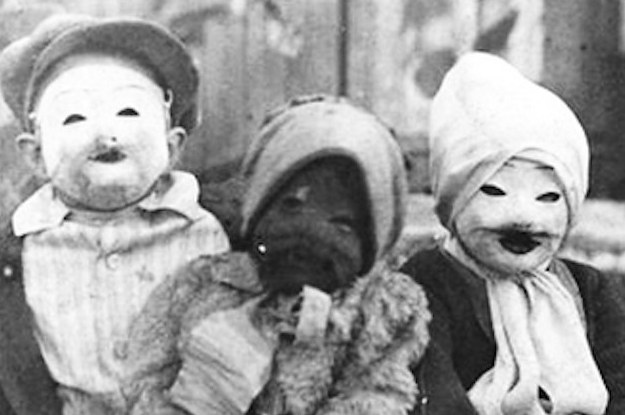
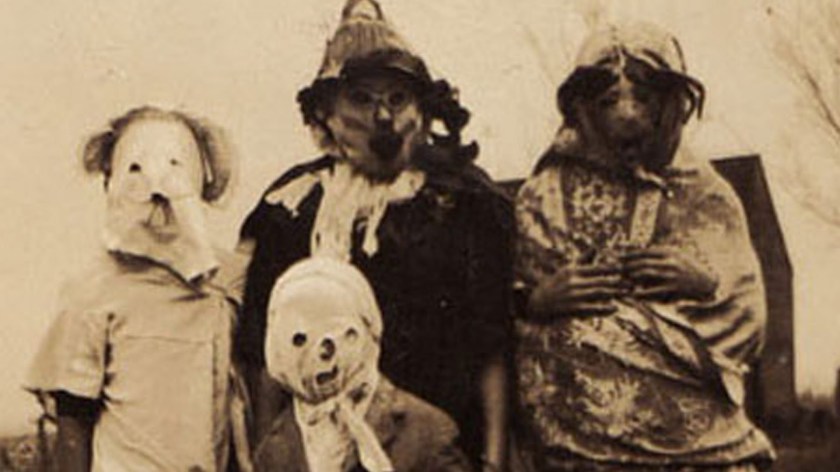
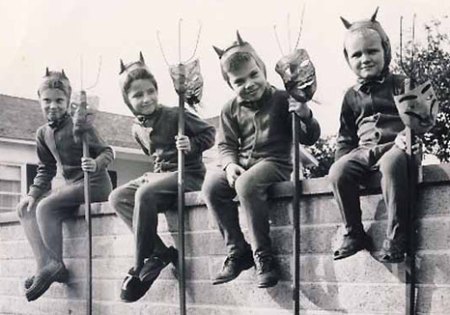
Halloween is one of my favorite holidays; it’s a wonderful excuse to dress up and pretend to be someone else. When I am not dressing up for a party I do enjoy the army of children that stop by. There is always one or two homemade costumes that brings to mind Halloween of old, when stores did not sell ready made masks and flimsy outfits.
I realize a lot of my readers are not aware that store bought costumes are fairly modern or that the first ones, designed in the late 1930, were made out of paper. These paper costumes did not go over too well with the public as they were extremely flammable. So leery was the public that store bought costumes did not really catch on until the 60’s and even then, you were more likely to see homemade costumes on children.
Did you also know that the phrase, “Trick or treat” started out as a veiled threat? I won’t go into the history of the term, you can find a great article on in here, thanks to the History channel but in brief, the term was used to remind folks that chaos would ensue if treats were not freely given.
As I thought about the phrase “Trick or treat” and vintage costumes, it occurred to me that we could really shake things up by going, old, old school this year. Why not bring back creepy homemade costumes and instead of crying “trick or treat”, why not quote Shakespeare? I mean, really, if you want better treats than “fun size” chocolate bars, shouldn’t you put some work into your costume and demands? Let’s see some effort kids! To help you out, I give you seven Shakespeare quotes you can use.
Hamlet
That one may smile, and smile, and be a villain.
Pity me not, but lend thy serious hearing To what I shall unfold.
Do not forget. This visitation Is but to whet thy almost blunted purpose.
Henry IV
Art thou not horribly afraid? doth not thy blood thrill at it?
The Tempest
Hell is empty, and all the devils are here!
Macbeth
Fair is foul, and foul is fair Hover through the fog and filthy air
And my very favorite:
By the pricking of my thumbs,
Something wicked this way comes.
The last time I wrote about Shakespeare and ghosts, I asked if you believed in ghosts. This time, I am asking, what is a ghost? We talked briefly about the modern idea of the nature of ghosts, but not of the religious nature of ghosts. The answer to the question may hinge upon your religious beliefs. Would you believe me if I told you that in the 16th century the answer could have gotten you killed?
Between the years 1534 and 1633, England experienced religious turmoil as each new monarchy ordered new religious followings; some more extreme than others. The country went from deeply Catholic to forced Protestant and back again, and then, back again! Henry VIII ordered all large monasteries to be dismantled. Under Mary Tudor, nearly 300 Protestants were burned at the stake. Under her sister Elizabeth I, Catholicism was tolerated up to a point. Only after a Catholic led assassination plot was uncovered did Elizabeth turn a suspicious eye to the faith. And so it went, as one royal died the next reversed religious course, right up to the civil war led by Charles I over religion and his ideas about kingly authority.
William Shakespeare was born at a time when Catholicism was giving way to Protestantism. Publicly this meant many citizens went to Protestant led church services, but privately kept to the old rituals and tenets. We cannot say for certain that Shakespeare grew up in a duel religious home, but evidence does seem to support this. When the Stratford townsmen, which included Shakespeare’s father, were ordered to white wash the Church walls and remove religious icons they lightly painted over the religious scenes, hid the icons and kept the stained-glass windows intact. There are events in John Shakespeare’s life that suggests he paid fines for not attending Protestant church services and a document titled “The Testament of the Soul”, once disputed but now deemed authentic, shows that John Shakespeare was willing to sign his name as a Catholic, at least in private. Jump to Shakespeare’s daughter, Susanna, who in 1606 was listed as a Papist after failing to appear at a Protestant Easter service in Stratford. We would not be too far off to say Shakespeare was at least exposed to both religious worlds as was his family.
So what does this all have to do with ghosts? Well, one of the biggest differences between Catholics and Protestants is the answer the question I posed at the beginning of this blog. And had I asked you that in 1564, the answer would have given your true religious beliefs away.
Protestants do not believe in Purgatory, nor do they believe a soul has the capability of returning from the dead. Catholics on the other hand do believe in Purgatory (not to be confused with Limbo, in which no soul is ever allowed to leave). Protestants (at least during pre-modern era) believed that if a ghost was to appear it was either an angel or demon; depending on the circumstance. The “ghostly” apparition would either be a sign of mercy or a sign of damnation. Contact with a ghost was strictly forbidden in the Protestant religion, as one was never sure if the visitor was a force for good or evil; best just leave that for the clergy to deal with.
We all know scholars love to look to Shakespeare’s work as proof of his personal life and never so much as been written as what has been written about his religious beliefs. There is a big debate on which side of the religious fence he sat on; was he a secret Papist, or did he outgrow the old religion and embrace the new religious tide swept in with Elizabeth’s reign?
Scholars on the side of Catholicism point to one of literature’s most icon ghosts for proof of their argument. Hamlet’s father’s ghost is one we all know and one that is forefront in the minds of many scholars looking to answer the question of Shakespeare’s religion. They point to his monologue, which seems to answer the questions, “what is a ghost?”
I am thy father’s spirit, Doomed for a certain term to walk the night, And for the day confined to fast in fires, Till the foul crimes done in my days of nature Are burnt and purged away. But that I am forbid To tell the secrets of my prison house, I could a tale unfold whose lightest word Would harrow up thy soul, freeze thy young blood, Make thy two eyes like stars start from their spheres, Thy knotted and combinèd locks to part, And each particular hair to stand an end Like quills upon the fretful porpentine. But this eternal blazon must not be To ears of flesh and blood. List, list, O, list! If thou didst ever thy dear father love, Revenge his foul and most unnatural murder.
As you can see, the ghost is claiming to be a spirit, or soul who is doomed for a time to suffer fire and take nightly walks around his own castle. This is his fate he says because
Of life, of crown, of queen at once dispatched, Cut off even in the blossoms of my sin, Unhouseled, disappointed, unaneled, No reck’ning made, but sent to my account With all my imperfections on my head. O, horrible! O, horrible! most horrible!
The spirit was dispatched (murdered) before he could make a confession of his sins. He was not allowed last rites, so he must suffer the flames of damnation until his soul is cleansed. This is a classic explanation of Purgatory and why so many scholars point to this as proof of Shakespeare’s Catholic leanings. To be fair, they also point to Shakespeare’s warm dealings with the clergy in several of his plays; most notably Friar Lawrence in Romeo and Juliet, and Friar Frances in Much ado about Nothing, but for our purposes, we will concentrate on Hamlet and how Shakespeare supposedly answers the question, “what is a ghost?”, in this play.
Shakespeare’s ghost is important to literature. Forgive me if I am wrong, but from what I can come up with, this is the first ghost in dramatic history that offers an explanation of his plight since Seneca’s Agamemnon and let’s face it, Shakespeare borrow a lot from Seneca, including his ghost. But for all of the borrowing that Shakespeare engages in, he is the first to offer a look at the supernatural life of a ghost; he is the first to tie a ghost to Purgatory. But for all of this, we still cannot say Shakespeare answered our question as a Catholic, because as much as the ghost wants Hamlet to believe him, his son is not quite buying it. I may have said this before, but the reason Hamlet cannot make up his mind about anything begins with his hesitation at answering our question. And now that you understand the different answers, the motivations and actions of the characters take on a new meaning. Take the example the reaction of Hamlet when he first sees the ghost
Angels and ministers of grace defend us! Be thou a spirit of health or goblin damn’d Bring with thee airs from heaven or blasts from hell, Be thy intents wicked or charitable, Thou comest in such a questionable shape
Hamlet is unsure if this is an angle or demon and what its intentions are. Hamlet’s ideas about the specter fall into line with the Protestant view of ghosts. Horatio has strong Protestant views on talking to the ghost as well, as he warns Hamlet not to follow it.
What if it tempt you toward the flood, my lord, Or to the dreadful summit of the cliff That beetles o’er his base into the sea, And there assume some other horrible form, Which might deprive your sovereignty of reason And draw you into madness? think of it: The very place puts toys of desperation.
Horatio is afraid that the ghost is a demon bent on destroying Hamlet. He seems to believe that the ghost is a demon and the best form of action is no action, just leave it alone. But as we all know, Hamlet is too grief stricken to listen and he willingly follows the ghost because he cannot let his father go.
Yet for all of his grief , Hamlet cannot decide whether this “ghost” is a Catholic soul trapped in Purgatory asking for revenge or if it’s a Protestant demon conning him into committing murder. It is not until Hamlet stages his play that he finally finds his answer. It seems to him that his uncle is guilty of murder, therefore the ghost must be telling the truth. But then again, what if some demon just happened to know how Hamlet senior died and uses this information for his own purposes?
Scholars look to Hamlet’s ghost for their own answers in part because Shakespeare has given us such much in this character. Shakespeare had written ghosts in a few of his plays before Hamlet, yet this is the first time we see a ghost tell his story and direct the plot of the play. Hamlet’s ghost demands attention and action, something not seen before, but copied over and over again in modern literature.
There is a lot to analyze about the relationship between Hamlet and his father. Is there a connection between this father and son and Shakespeare’s own relationship with his father? Is Shakespeare torn between his family’s past religious beliefs and the country’s new beliefs? Or did Shakespeare simply use religious tension as a dramatic plot device in order to give us one of the world’s best plays? I’m betting on the latter.
We will never really know the answer to these question just as we will never know Shakespeare’s true ideas about religion because he answers our original question with both answers. Just remember, how you answer the question may tell us more about you than it will about ghosts.



 And my very favorite:

 The View From Sari's World
You must be logged in to post a comment.