Shakespeare’s Prop Room- a review

9781476663364
McFarland & Company 2016


“Shakespeare’s Prop Room an Inventory” is hard to pin down. While at times it offers insight into Elizabethan theater life and may prove useful to theater groups, its arguments tend to be self-serving and a little questionable. If you are wondering why a book about props would propose arguments at all, let me assure you, this book offers more than a scholarly look at props; at times is reads as if the authors believe the plays to be some missing Christian gospels, which left me with a feeling of unease.

I blame Ralph Alan Cohen for setting me up. I was so eager to dive into the book after reading his foreword. In it he writes in part:

Crass considerations can get us deeper into the plays…What might a show look like? What was on stage? What were they holding? What objects are we dealing with?”

“And that is the question that Shakespeare’s props asks so well, questions that unlocks so much…It is a book that points but does not push the reader towards answers. …it is material to an understanding of the plays and matters to the production of a performance”.

I am not convinced Cohen read the entire book before he wrote the foreword. The first two chapters “Bring out your dead”, and “Off with his head” are highly enjoyable and as promised, offer some understanding of the plays; I can see both chapters as valuable material to any modern theater group looking for a deeper understanding of the norms and customs of Shakespeare’s day. But starting with chapter 3, Exit pursued by a bear” ,the book shifts focus and uses biblical passages to make the argument that Shakespeare relied heavily on the Bible for his imagery and made good use of his plays as arguments for Christianity. This is an odd argument to make, given that scholars know he used Ovid and older plays as his primary source material. The chapter is brief, (and possibly unnecessary as there are few animals in the plays) but somehow manages to talk about everything from Macbeth’s hounds of hell, to that of man taming his own inner beast, and then jumps to Caliban-is he man or fish-which somehow turns to Jonah and the whale. The author even finds the time to remind us on page 46 that, “God assures us we are made in his image, in his likeness, and like Prospero, have dominion over the fish of the sea…”

This short rambling chapter seemed so widely out of place that I had to read it twice to find any connection to the book it sits in. I am still not sure what any of this has to do with Shakespeare’s prop room.

In chapter 9, Welcome to our table”, the authors state “Behind every dinner lurked the last supper”. So much for Cohen’s claim that the authors points but does not push the reader towards answers. As part of their biblical argument the authors cite Jan Kott, a critic known to have interpreted the plays in light of existentialism, and his own personal experiences. The choice of Kott seems a little odd until one realizes he is used to bolster the authors’ Shakespeare/Christian argument.

A few chapters later we return to talking of props and their use with no mention of Christian leanings. As I read these later chapters, it dawned on me that the two authors may not have collaborated much. Perhaps each took a few chapter subjects and wrote separately. If this were true it would go a long way to explain why some chapters tend towards the utilitarian use of props while others towards the Bible as a metaphorical prop in Shakespeare’s plays.

If you sift through the biblical references and table some of the arguments for later, you may enjoy the book as a theater prop guide. Be warned, it is not the book Ralph Alan Cohen read, which is too bad because that book sounds amazing.

I received this book from Librarything’s Early Reader program in exchange for a fair and honest review.
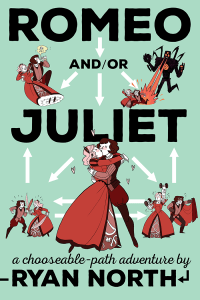
Romeo and/or Juliet by Ryan North The dumbing down of Shakespeare

Ryan North Riverhead Books Penguin Random House 2016
Ryan North
Riverhead Books
Penguin Random House
2016

“You are Sari! Right now you are standing in a library looking at the books in the “New Arrival” rack, wondering if “Romeo and/or Juliet a chooseable-path adventure” would smell just as sweet as the original story. You hesitantly reach out to pick it up.

If you pick it up continue to paragraph 2.

If you laugh and think, “oh hell no”, stop reading this post.

You pick it up wondering if this is truly something that would encourage your average teen to become engaged with Shakespeare. You flip to a random page out of curiosity. With mild trepidation you read a paragraph. The first thing you notice is the simplistic writing style. The author uses short, concise sentences. You wonder if he does this out of fear that his audience has a short attention span. As you read on, you wonder if the author has a short attention span. As you flip to the next page to read more, you wonder if the author is 10 years old. You begin to regret your current life choices, beginning when you read the title of the book you now hold in your hand.

It’s occurred to me that with the plethora of books we’ve seen published in the last 24 months with “Shakespeare” in their titles that my best course of action would be to smother my keyboard with tuna and allow my cat license to stomp around my computer for a few hours and then submit the mess to a publisher under the title “A Feline’s Guide to Shakespeare”. My luck it would hit the bestseller’s list and my cat would become the academic hero of the family. When will publishers say, “Enough is enough”!

Oh sure this book by Ryan North is full of words, words, words, but as an intro to Shakespeare it is useless. The library has classified the book as suitable for ages 8 to 16. Did the publisher suggest this? I’m not sure a book that makes use of several sexual references is suitable for 8 year olds and the writing is far too simplistic for 16 year olds.

In this adventure you start out as Juliet but quickly become Romeo who can choose to fall in love with Juliet or fall in love with a dude (North’s word, not mine), making it very un-Shakespeare like and more of a modern “politically correct” book. So much for Shakespeare.

There is very little in the way of Shakespeare’s work in this book. Most of it consists of Ryan’s self-indulging humor(I could almost hear him laughing at his own jokes). He starts off on the wrong foot when he says it’s Juliet’s 17th birthday (she’s actually 14) and quickly goes off the rails from there.

You have things to do too, Juliet. You tear through some quick stomach crunches (three reps of ten) and some pec blasts (four reps of eight), and your ready to start your day. So! Your well muscled and your family’s rich. What’s for breakfast? (page 4)

This is modern Shakespeare?

How are we to take this book? Surly this cannot be taken as a serious effort to get teens into classical literature. And if this is indicative of modern teen books, it shouldn’t surprise us that fewer and fewer teens are choosing to read as a leisurely pursuit.

It appears Mr. North does have an audience. His first choose an adventure book, Hamlet, was funded by Kickstarter. That book turned out to be the most funded publishing project for the company to date. This must have emboldened Mr. North to try again with Random House behind the project. I just wish I understood his aim (besides monetary gain). Did he really believe he this would bring teens closer to Shakespeare or did he also notice that anything with Shakespeare in its title would be easy to publish?

Personally I don’t think dumbing down Shakespeare or turning his work into adventure stories is doing our culture any favors. I see this type of art as part of the problem we are now facing. The government’s emphasis on more science-based education is pushing the Humanities to the outer edges. Colleges are bemoaning the fact that students are not receiving a well-rounded education because of this. Books like North’s do little in the way of helping the situation, as his simplistic approach to “Shakespeare” is little more than an adventure into the land of pop-fiction. And lousy pop-fiction at that.

I’d recommend skipping this adventure.

Amazing Waste

Repurposing Food and Reducing Waste

measurestillformeasure

Shakespeare, Classics, Theatre, Thoughts

Nerd Cactus

Quirky Intellect for the Discerning Nerd

Sillyverse

Stories of magic and mystery

Commonplace Fun Facts

Mind-Blowing Facts You Didn’t Know

Fictionophile

Fiction reviews, Bookblogger, Fiction book reviews, books, crime fiction, author interviews, mystery series, cover, love, bookish thoughts...

Patrick W. Marsh

monsters, monsters, everywhere

Shakespeare for Kids Books

Opening the door for kids to love Shakespeare and the classics

desperatelyseekingcymbeline

The 10-year Shakespeare New Year Resolution

Katzenworld

Welcome to the world of cats!

booksandopinions.com

The Book Reviews You Can Trust!

The Book Review Directory

For Readers and Writers

thelitcritguy

screams from the void

Author Adrienne Morris

Step Into the Past—Lose Yourself in the Story.

crafty theatre

ideas inspired by crafty characters

Critical Dispatches

Reports from my somewhat unusual life

The Nerd Nebula

The Nucleus of the Universe for all Nerd Hacks!