Shakespeare’s Kings or how to understand the war of roses over a hollow crown

The War of the Roses

If you live in the U.K. I bet you are well aware that the award winning series “The Hollow Crown” part 2 The War of the Roses” is being telecast right about now. If you are not aware this may help explain why all of the young girls are giggling and staying home; Benedict Cumberbatch is playing Ricard III.

This production is a series of some of Shakespeare’s English history plays. In chronological order of setting, these are: Richard II, Henry IV Parts I and II, Henry V, Henry VI Parts I, II and III, Richard III. But if we look at the order of when they were written we see that Shakespeare may not have had a series in mind.

Henry VI part II 1590

Henry VI part III 1590

Henry VI part I   1591

Richard III          1592

Richard II           1595

Henry IV part I  1597

Henry IV part II 1597

Henry V               1598

Looking at the order above, we may wonder just what it was Shakespeare had in mind. But if we keep in mind that his primary focus was the stage, not history, we can guess that for Shakespeare the story was thing. Knowing that Henry VI part II was written first it seems to me (and this is just an educated guess) that Shakespeare wrote the plays in response to current events or in order that he found the subject matter fascinating, maybe a little of both.

Thankfully for modern audiences the plays are presented in chronological order. I say thankfully because at times they can be hard to follow, especially the Henry VI plays. I cannot imagine trying to piece the narrative together if I had to watch them in order that they were written. But to be completely honest for many Americans Shakespeare’s history plays are hard to follow no matter the order. Here’s the rub; as much as we may adore Shakespeare’s work, his history is not our history. We don’t study English history unless we seek it out in college or become armchair historians. Many of the characters and events depicted in the history plays are all we have to go on. For many these plays represent our first window view into medieval England. But the window is cloudy and at times we are unsure of what we are seeing.

I was an armchair historian before I went back to school. I fell in love with the medieval Europe and as an undergrad studied the period in which the Catholic Church became the center of politics. Even so, I had questions the first time I saw Richard II. Why was he so hated? Why was it so easy for Henry Bolingbroke to take the crown? Who were all the players in the Henry VI series and more importantly, was Shakespeare true to history?

Now with renewed interest in the Hollow Crown series, I decided it was time to do some reading.

Touchstone Press  1990
Touchstone Press
1999

I’ve had John Julius Norwich’s book “Shakespeare’s Kings” on my bookshelf for about a year. I picked it up last week in the hopes that it would answer some of my questions and further my education on medieval kings. I wish I had read it earlier.

Norwich’s book could easily be a guide to the Hollow Crown series. Norwich begins his book not with Richard II but with Edward III, a play that some earlier scholars argued that Shakespeare helped write. Today’s scholars are slowly coming to the same conclusion, though I remain unconvinced. The prose seems sloppy and lacking in depth. Yet the inclusion of Edward assists Norwich as he attempts to paint on a broad canvass. Edward is the jumping off point to Richard’s reign as King and helps explain why it is Richard was such a disappointment.

Norwich is a fine narrator. His retelling of history is engaging and informative. As a historian he does not fall into the easy trap of extrapolating facts to fit his idea of history or seeks to understand it in modern context. I was sucked into the each King’s story and never once questioned Norwich’s conclusions (he has none) or questioned his motive. This is a clean narrative and a history book that is exactly what it claims to be; a historical look at some of Shakespeare’s kings. It is rare to find such a book now days.

Norwich lays out the historical events that shape each play, one by one. Each King is then subjected to Norwich’s summary of the play in question. He breaks them down act-by-act, pointing out inaccuracies and complete fabrication. Like he does with his narrative, Norwich does not judge Shakespeare or act as his chief apologist. Instead, Norwich reminds us that Shakespeare’s focus was on story telling, not lecturing his audience on historical facts. Along the way Norwich explains what source material Shakespeare probably used (I say probably because there was so little to choose from) and how the material shaped his view of Henry V and Richard III.

Reading Norwich’s account of Henry VI’s reign and how it led to the war of the Roses I began to understand why Shakespeare decided to pen three plays on this hapless King. But even so, I was a little disappointed on the liberties Shakespeare takes with historical fact. But then again, I had to remind myself that the more educated of his audience would have had a good understanding of history and would forgive him in order to be entertained. The less educated probably wouldn’t have cared.

Norwich begins with Edward III and ends with Richard III, which encompasses the years 1337 to 1485. This is a lot to take in, so I wouldn’t be at all surprised to find that the book requires a second reading or acts as a reference guide to specific plays. It certainly will remain in arms reach for me as I eagerly await the American premier of The War of the Roses.


Happy Towel Day & Thanks For All The Fish

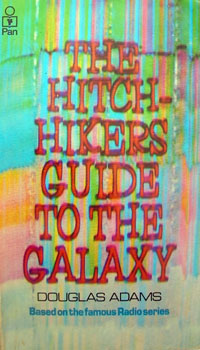
The original UK cover

Happy Towel Day! Here’s a look at my annual Towel Day post.

Towel Day is an annual celebration on the 25th of May, as a tribute to the late author Douglas Adams (1952-2001). On that day, fans around the universe proudly carry a towel in his honor. As part of the celebration, I offer you a few things you may not know about The Hitchhikers Guide to the Galaxy.

douglasadams

Who is Douglas Adams?

Douglas Adams was born on the 11th of March 1952 in Cambridge. He was an English writer and dramatist. While Adams was studying in Cambridge he hitchhiked from Europe to Istanbul, working various jobs to generate funds for it. After leaving school he tried his hand at comedic writing. Adams was “discovered” by Graham Chapman. They became friends, which led to Adams making a few brief appearances in the series ‘Monty Pythons Flying Circus’. But Adams writing style was not fit for the style of radio or television of that time which proved to be a hindrance in his success and led to bouts of low self-esteem and procrastination. Adams was never comfortable with fame and it took years for him to finish each book. In fact the first book ends abruptly due to the simple fact that because Adams was taking so long to adapt the radio series into book form the publishers called him asking that he simply finish the page he was writing.

The conception

The first episode aired on BBC Radio 4 on Wednesday, March 8, 1978, at 10:30 pm.

The Hitchhikers Guide was original a radio series idea. The initial idea for The Hitchhiker’s Guide to the Galaxy came to Douglas Adams while lying drunk in a field holding a copy of The Hitchhiker’s Guide to Europe, staring up at the night sky. The original concept was called The Ends of the Earth. The idea was that at the end of each show, the Earth would be destroyed in a new and interesting way. As Adams wrote he realized he needed a guide, one who could explain the various cultures that bring about the ends of the earth, so the character of Ford Prefect was born. Prefect was not the main character, that would be Arthur Dent, but he role was central to the stories. Adams needed a strong central figure because he did not outline his stories. Adams admitted he “made things up as he went along”, which is why so there are so many plot twists and turns. Adams had no idea what would happen next or where the stories were headed. Most of his most well known characters and plot devises stem from his “just winging it” writing style.

images

The Cosmic Cutie

If you live in America and are a fan of the series, this symbol is very familiar. It’s known as the Cosmic Cutie. But did you know Adams hated it? He asked to have it removed from the book jackets but the publishers refused. Why? Because Adams took so long between books it was designed by the publishers to visually connect the books. They were afraid readers wouldn’t know they were part of the same series.

Marvin__the_paranoid_android_by_Argial

Marvin the Paranoid Android

“I’d make a suggestion, but you wouldn’t listen. No one ever does.”

Marvin is a severely depressed robot. He’s so depressed that, when he gets bored and talks to other computers, they commit suicide. His depression is due to the “Genuine People Personality” he received while he was being manufactured. Originally Marvin was to be used in only one episode as comic relief, but proved to be very popular and so became a recurring character.

Babble Fish

Adams realized early on he had painted himself in a corner. How was Arthur to understand the man aliens he encountered? Having Prefect translate would use up limited air time so Adams had to come up with way to save time. According to the first book, The Babel fish is small, yellow, leech-like, and probably the oddest thing in the Universe. It feeds on brainwave energy received not from its own carrier, but from those around it. It absorbs all unconscious mental frequencies from this brainwave energy to nourish itself with”.

Infinite Improbability

Making stuff up as he went along created problems for Adams. How do you get your characters out of tight situations? Infinite Improbability, the most favorite of all the technology in the series, was created to get Adams out of a corner he’d written himself into. Adams came up with the idea after writing an episode that ended with Ford and Arthur being shot in open space without spacesuits; Adams no idea how to save them. It was absurdly improbable that any spaceship would come along and rescue them in time, so Adams created the Infinite Improbability Drive to make it plausible. This allowed Adams to create a universe in which anything could and usually did happen.

Answer to the Ultimate Question of Life, The Universe, and Everything- 42.

“The Answer to the Great Question… Of Life, the Universe and Everything… Is… Forty-two,’ said Deep Thought, with infinite majesty and calm.”

Books have been written about Adams answer to life’s most pressing question. Scholars, mathematicians and philosophers have all weighed in on what Adams meant by the number 42. It is ironic that humans are so obsessed with this question that many see value in Adams nonsensical answer. To him the answer is obvious; life is random and meaningless. When asked about his answer, Adams said: “The answer to this is very simple,” “It was a joke. It had to be a number, an ordinary, smallish number, and I chose that one.

The Towel

When traveling great distances it is always a good idea to pack smartly. Of all the things you must have, which is the most useful? For Adams it starts with a towel.

According to the guide, “a towel is about the most massively useful thing an interstellar hitchhiker can have. Partly it has great practical value. You can wrap it around you for warmth as you bound across the cold moons of Jaglan Beta; you can lie on it on the brilliant marble-sanded beaches of Santraginus V, inhaling the heady sea vapors; you can sleep under it beneath the stars which shine so redly on the desert world of Kakrafoon; use it to sail a miniraft down the slow heavy River Moth; wet it for use in hand-to-hand-combat; wrap it round your head to ward off noxious fumes or avoid the gaze of the Ravenous Bugblatter Beast of Traal (such a mind-boggingly stupid animal, it assumes that if you can’t see it, it can’t see you); you can wave your towel in emergencies as a distress signal, and of course dry yourself off with it if it still seems to be clean enough.”

Quotes

“Would it save you a lot of time if I just gave up and went mad now?”

“He felt that his whole life was some kind of dream and he sometimes wondered whose it was and whether they were enjoying it.”

“For a moment, nothing happened. Then, after a second or so, nothing continued to happen.”

“So long, and thanks for all the fish”.

Amazing Waste

Repurposing Food and Reducing Waste

measurestillformeasure

Shakespeare, Classics, Theatre, Thoughts

Nerd Cactus

Quirky Intellect for the Discerning Nerd

Sillyverse

Stories of magic and mystery

Commonplace Fun Facts

Mind-Blowing Facts You Didn’t Know

Fictionophile

Fiction reviews, Bookblogger, Fiction book reviews, books, crime fiction, author interviews, mystery series, cover, love, bookish thoughts...

Patrick W. Marsh

monsters, monsters, everywhere

Shakespeare for Kids Books

Opening the door for kids to love Shakespeare and the classics

desperatelyseekingcymbeline

The 10-year Shakespeare New Year Resolution

Katzenworld

Welcome to the world of cats!

booksandopinions.com

The Book Reviews You Can Trust!

The Book Review Directory

For Readers and Writers

thelitcritguy

screams from the void

Author Adrienne Morris

Step Into the Past—Lose Yourself in the Story.

crafty theatre

ideas inspired by crafty characters

Critical Dispatches

Reports from my somewhat unusual life

The Nerd Nebula

The Nucleus of the Universe for all Nerd Hacks!