
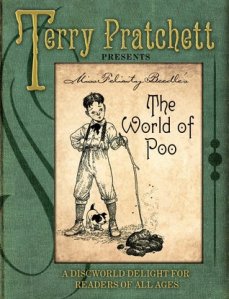
Doubleday
“Vimes looked at the cover. The Title was The World of Poo. Apparently it was by the author of Wee and if Young Sam had one vote for the best book ever written, then it would go to Wee. His enthusiasm was perhaps fanned all the more because a rare imp of mischief in Vimes led him to do all the necessary straining noises.” (T. Pratchett, Snuff)
Have you ever been tricked by a novel? Or should I say, by an author? I am not talking about the kind of trick that we call a twist, or unreliable narrator (I’m sure this has happened to us all) but actually believing something you read in a work of fiction? No? Lucky you. I have, and I am almost ashamed to admit it.
Years ago, right before the invention of the internet, I read William Goldman’s The Princess Bride and was completely bamboozled by the author. If you’ve had the pleasure of reading the book, you probable know where I am going with this, if not, warning, spoiler ahead!
The book is told from an omnipresent narrator who not only knows what is going on everywhere in the book, he (or it, if we want to be politically correct) breaks the fourth wall by talking to the reader. The narrator does this by talking to the reader and admitting this story is an adaptation of S. Morgenstern’s Classic Tale of Love and High Adventure, a French tale in which Goldman abridges “all the good stuff”. Throughout the book the narrator refers to this tale and remarks where he omitted a chapter or scene. My favorite is a lost chapter devoted to Buttercup and her hats. Goldman does such a fine job of outlining this silly chapter that I was disappointed he did not just include it. Oh how I wanted to read the original story. And this, my friends, is where he got me. There is no original story other than Goldman’s.
At the time, I did not know anyone who read the novel so I couldn’t ask about the original. I tried the library and even a rare book dealer, who it turns out, had no idea what I was talking about. He obviously hadn’t read the book or he would have clued me in. It wasn’t until the early days of the Internet did I find out what a fool I’d been. This was when the Internet consisted mostly of chat rooms. Remember those? I found myself in a book chat room one afternoon, talking about old books and I brought up the subject of the original Princess Bride story. I’m positive everyone in the room who had read the book started laughing in unison. I have to say, I felt really small and gullible when I found out I’d been had.
Now days when a book title is mentioned in a novel, I assume it is a fictional piece (unless of course, I’ve read it). I refuse to be fooled again! So imagine my surprise the other day to find a book at my local library that Terry Pratchett refers to in his novel, Snuff. The book is titled, Miss Felicity Beedle’s The Wonderful World of Poo. I laughed out loud and of course, because it was a Terry Pratchett book, checked it out. Though it’s a children’s book, I encourage everyone to read it.
I wasn’t sure what I was getting myself into, not being a fan of poo, but curious to read Pratchett’s take on the subject. Was this a book designed to explain our least talked about body function, or was it a silly take on what we do behind closed doors? To the first, not really, to the second, a little bit, but oh, so much more.
Have you ever longed for the days when as a child you viewed the world with wonder and awe? Even more so when you found yourself enthralled with collecting? For me it was rocks. I loved rock hunting, even if it meant just going out behind the house to look for treasures buried between the railroad tracks that ran through our town. I felt so proud when the grownups around me shared my enthusiasm and fussed over me when I showed them the newest “gem” gathered for my rock museum. Yes, I used our garden shed as my museum. Sadly, as much as I was encouraged to collect rocks, only one person was kind enough to buy a ticket. As much as I enjoy hiking in the woods now, and stopping to admire the beauty of nature, I will never recapture the feeling of my younger days when every day was an adventure.
Yet, for the brief amount of time I spent with this book, the memories of those days came flooding back even though our young protagonist, Geoffrey becomes obsessed with collecting poo.
In this book we meet several of Pratchett’s famous characters again, including the King of Gold Sir Harry, a gargoyle, Sybil, and a baby dragon that poops coal.
Grandma said, “I think there might be cake for tea. But first, tell me, what have you been doing today?”
“Well, I’ve stared a collection”. He said breathlessly, “and plain Old Humphrey said I could use his old shed for a museum, and he gave me a bucket and spade and a trowel for collecting. And I took Widdler (the dog) to the park, but I forgot my bucket and we met a boy called Louis”.
Geoffrey is visiting his grandmother in the city for the summer and spends his days meeting interesting people and animals, in the hopes of acquiring the greatest collection of poo to be housed in his museum. It sounds like a messy and smelly way to write about a young boy, but Pratchett manages to capture the feeling of awe and wonder that all children feel when given the chance to explore. This is the heart of the book and why it was such a pleasure to read. It is less about what is being collected and more about that short span of time we call childhood innocence. As I read I had to wonder if Pratchett, knowing he did not have much time left, wanted to recapture his youth and poor those feelings into Geoffrey. It was almost heartbreaking to think of this young boy growing up and losing his sense of wonder. In this book we find yet another gift from the great writer; he allows us to be children once again.
The book seems timely, given that our politicians are acting like caged monkeys who spend their days slinging poo at each other. It’s refreshing to read that given the right circumstances, collecting poo can be fun. Leave it to Pratchett to make us care about poo.



 The View From Sari's World
You must be logged in to post a comment.