
Rebecca Schuman, Slates’ educational columnist, just published a piece titled, The end of the college essay. It’s an indictment against required essays and those who write them. It is a surprising view, coming from someone who most likely acquired and sharpen her writing skills thanks to college essays.
She sets the blame squarely on the students in her opening paragraph:
Everybody in college hates papers. Students hate writing them so much that they buy, borrow, or steal them instead. Plagiarism is now so commonplace that if we flunked every kid who did it, we’d have a worse attrition rate than a MOOC. And on those rare occasions undergrads do deign to compose their own essays, said exegetic masterpieces usually take them all of half an hour at 4 a.m. to write, and consist accordingly of “arguments” that are at best tangentially related to the coursework, font-manipulated to meet the minimum required page-count.
I don’t know about you, but I know burnout when I see it. Schuman may want to reconsider her chosen profession. Did she really mean to make such a generalized statement or is she just loath to read one more of her student’s papers? Can you imagine the pressure her students must feel after reading these words? I graduated summa cum laude, and yet, I’d be shaking and sweating, knowing my work would be judged this harshly. I’d pick up a bottle of merlot for her and tape the paper to it. It couldn’t hurt, right?
She goes on to rant, say:
Most students enter college barely able to string three sentences together—and they leave it that way, too. With protracted effort and a rhapsodically engaged instructor, some may learn to craft a clunky but competent essay somewhere along the way.
Here I have to agree with Schuman. Most students enter college barely able to string three sentences together, never mind a well thought out essay. It was a nightmare when we students were asked to read and then “grade” our fellow classmate’s work. I remember one student, a senior in college, changed tense mid-sentence. Sadly, many of these same skill sets can be found in first time writers. As an editor I have on many occasion, found myself banging my head against the wall, once again being asked by a publishing house to “clean up a novel”. Burn it maybe, but clean it up? Impossible.
I’ll never forget this passage:
Wilson offered Smith a cup of water. Smith refused it………………. Wilson gave Smith his second cup of water. Wait, what? Whose second cup? Wilson’s or Smith’s? How could Smith have a second cup of water if he refused the first? Obviously (?) the writer meant Wilson offered Smith a second cup, but to this day I have to wonder if Wilson drank the first cup and then offered another to Wilson.
But yet, unlike Schuman, I don’t blame students as much as I blame the college professors who allow poor sentence structure and grammar skills to go unchecked. I don’t know many professors who take the time to articulate and impress upon their students the importance of the well-written word. I have an idea Professor Schuman, how about making Writing 101 a required course? Make it the first course.
When I went back to school, I was one of those students the good professor seems to detest. I was well aware of my lack of writing skills and assumed my first course, “How to do research,” would help improve them. Sadly, this was not to be. It was incumbent upon me to learn how to write something worth reading. This I did by reading articles not unlike Schuaman’s. Starting a blog was a good way for me to strengthen my skills. I look back at some of those first posts with horror and embarrassment. Yet, I can count on one hand, how many professors corrected my work.
Schuman argues that college essay writing should be replaced with tests and oral exams, for this would be the only way to ensure students do not cheat for pay for essays. Maybe this will ensure the first class doesn’t cheat, but I guarantee you, the next class will know what’s on the test and what they will be expected to say. I know, because high school students engage in type of cheating. I remember my high school economics teacher was amazed by our ability to pick out which stocks were doing well that morning. He didn’t know, but as we went in, the exiting class passed on this valuable information.
Schuman suggests that good writing skills are no longer important for today’s job seekers. This may be true for those who aspire to work full time in low paying jobs, but for everyone else writing matters. My day job involves writing contracts and e-mails to those who don’t understand legal jargon. If I couldn’t express myself in legal and layman’s terms, I’d be out of a job.
Yes, students hate writing essays, but this has more to do with the type of essays they are asked to churn out. Maybe, instead of asking for a 10-page paper on the history of Christianity, (yes, this happened and by page six I knew I was in trouble, since I was still on the 3rd century) how about focusing on one aspect of the history? I would’ve given anything to write a 10 paper on the Medieval Christian world. At the time that was my passion and why I enrolled in the course. I had no idea I would be asked to condense a 4-inch book into 10 pages. How is that even possible? What professor would do that to themselves? No wonder Schuman appears to be on a ledge.
I was once instructed to write a 1600 word essay including 5 scholarly quotes. The subject was Faust. I enjoyed the subject, but found myself writing an essay based on the scholarly quotes I found on JSTOR. I had a lot to say about Goethe and mental illness, but yet felt most of what ended up on the essay was more about what scholars thought of his state of mind. I tried to balance my thoughts with theirs but my hard work didn’t pay off. I ended up with a B because I wrote 1605 words and used the same source twice. Never mind that this source was relevant to the topic.
Students are asked to write in the style of scholars. For the average student this is an exercise in futility as no one bothers to teach them how. Not all students aspire to be scholars, so why demand this of them?
In one of my earliest science classes we were told to write in our own voice. Our professor offered us the chance to write in the style we found most comfortable. He too complained about reading essays (but in a more jovial manner) and wanted us to focus on the subject, rather than the writing. I took a chance with one of my Power Point presentations. I knew Marc was a big fan of Monty Python. He would quote from Monty Python and the Holy Grail whenever he could. We had talked about the opening credits so I knew this was something he liked. As part of my Power Point narrative, I used the pythonesque gag of inserting something silly, and then apologizing for it. I knew I was taking an academic risk, but seriously, how many Power Point presentations about the Amazon River can one professor read without wanting to drown himself?
My jokes paid off. Not only did Marc like it, he called me at home to tell me so. He laughed so hard he had to stop grading for a while. Looking back, I feel a little bad for the remaining presentations. Sorry guys, I’m the reason why you probably disappointed him.
After that he insisted I include at least one gag in each of my papers. Our running joke was that I would place at least one outrages “fact” in my paper (including cite, it was college after all) and he would have to spot it.
It may make some of my professor friends cringe, but this paid of. I enjoyed writing science papers and in turn, fell in love with science. Not that the jokes got me off the hook mind you. I was judged by how well I communicated what I had learned. Marc had no problem kicking back poor writing and offering opinions on how I could do better.
Instead of bitching about students and their essays, how about finding a way to make the job more enjoyable for both? We should do away with 1600 word essays that do little but illustrate the ability to organize research. May I suggest, shorter, focused essays? Essays that allow students to write in their own voice, and explore what a given subject means to them. Trust me, the students who want to learn how to write well crafted essays will find a way. But this doesn’t mean professors should allow poor writing to go unchecked. Writing matters, whether it is in joke form or a well-crafted scholarly argument. Students and editors alike will thank you for it.

 It’s May 4th, or as we nerds say. it’s Star Wars Day! I thought I’d celebrate by brushing off a review I did a couple of years ago.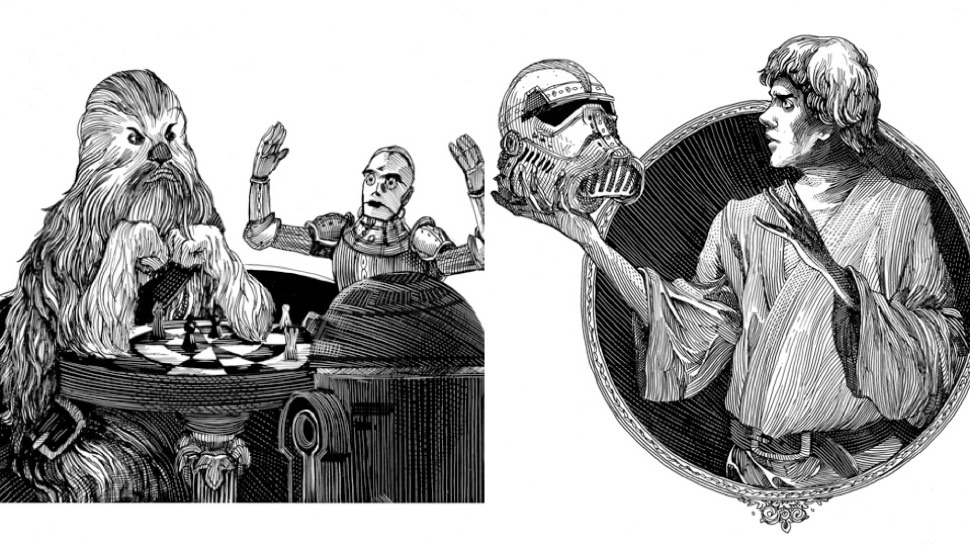

 The View From Sari's World
You must be logged in to post a comment.