The difference between choice and privilege

rashes_princ_6l7247_measles_424x302

As a modern western society we are blessed with the privilege of choice. We get to decide where we live, what professional path to follow, who to marry, and how many children to have (if any). Hell, we even get to choose what type of dietary lifestyle we want to follow and what brand of water to drink. We live in an age of unabashed consumerism. Yet, how many of us stop to consider that what we call “choice” is in fact, privilege? We are privileged to live the way we do. Not everyone is so lucky. Not that long ago, neither were we. Here in lies the problem; we have forgotten that not that long ago, we had little choice over our lives.

Think about how lucky we are that we can wander the supermarket aisle, making choices about what food we want, what brand we want and how much we want. A 100 years ago this would have been unthinkable. Oh sure there were small mercantile shops in which one could find much needed supplies, but the norm was to produce most of what one needed at home. Now we have aisles of laundry soap to choose from, but our great-grandmothers made their own soap. People had little choice when it came to consumer goods and services. Today, we can order just about everything we need online.

Our choices do not stop at consumer goods. We assume we have other choices as well. The age of consumerism has changed our perception of choice. Many people now think they have the right to choose what medical advice to follow, even if it means the chance of harming other people. Because they have grown up in a society of choice, they erroneously believe everything is a choice.
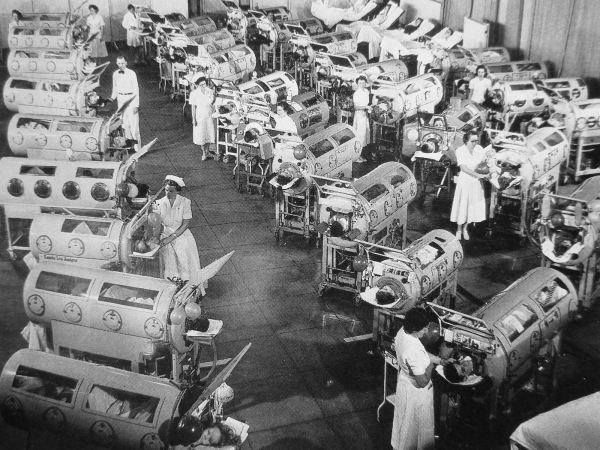
polio-patients

Prior to 1952, parents had little choice when it came to polio. Before that it was smallpox. If a child came down with either, parents had little choice but to watch their child suffer and hope for some miracle cure. My own grandmother came down with polio in the 1930’s. When the doctors told her she would never walk again, she gritted her teeth and said, “I don’t have a choice, I have 5 young children. I will have to walk again”. She was one tough lady. She did in fact walk again, but with a very noticeable limp. Her left leg was twisted sideways. Her youngest child contract the disease, yet was one of the lucky ones, she has no noticeable side effects. Far too many children and adults were not so lucky. There was no choice in the matter, you got it or you didn’t. Thankfully now, there is a vaccine for polio. We are privileged to have it. Now we don’t have to worry about another polio epidemic breaking out and causing mass suffering. Or do we?

Because there are some people who now think everything is a choice, including inoculating their children against childhood diseases, we may see epidemics again. Here lies the irony; because we have not seen a childhood disease epidemic in over 60 years, many people have forgotten what it is like, and because of this, we may have another one soon.

To vaccinate or not to vaccinate should not be a question. It should not be treated like a consumer choice. Years ago, as a society we already made that choice for you. We chose not to watch our children suffer, die or become disfigured by childhood diseases. We were privileged to have a government who agreed and used tax dollars to fund cures of childhood diseases. We are now privileged to live in a world free of childhood diseases.

There are many choices we now get to make in our modern world. Deciding to expose us to more outbreaks is not one of them. There is a difference between choice and privilege. And the sooner you learn this, the better off society will be.

Station Eleven and why I’m not on board.

09-15seleven_standard_600x400

Emily St. John Mandel’s Station Eleven is gaining widespread acclaim. It is a New York Time’s bestseller, and was a 2014 National Book Award finalist. For the life of me, I cannot understand way. While personally, 2014 wasn’t a stellar year for reads, this was by far the biggest disappointment.

To by far to Mandel, part of the disappointment can be can be laid at the feet of Random House. I was sent an e-mail by the publisher telling me of an exciting new book that told the tale of a troop of actors in a post-apocalyptic world struggling to keep culture alive by putting on plays by Shakespeare. The group was determined to bring light to another wise darkened world. Shakespeare, post-apocalyptic lit? My heart skipped a beat; why didn’t I think of this? My two favorite types of lit in on book. With a little envy for Mandel’s idea, yet excited to see how this would play out I pre-ordered the book. I could hardly wait to read it. This had to be good, right?

Post-apocalyptic literature, as you know, concentrates on survival. The struggle to survive, and what it means to survive is usually played out with characters coming face to face with situations they otherwise would never encounter. Authors push their characters into the darkness in order to see just how far someone can go and still retain their humanity. Robert Kirkman’s The Walking Dead is a good example of this. I cannot think of any post-apocalyptic book that shows the struggle to retain culture. The idea that survival depends on keeping culture alive is novel, yet very much needed. What is the purpose of rebuilding civilization if culture is dead? This question was one that was promised to be answered within the pages of Station Eleven. As it turned out, the promise was broken.

The plot is very convoluted, so bear with me as I try to unravel it. The story starts a few hours before the pandemic that will end up wiping out most of humanity hits New York. Famed actor Arthur Leander is on stage as Lear when he suffers a major heart attack and dies. A medic named Jeevan who is in the audience tries to save him. A child named Kirsten Raymonde is on stage when Arthur dies. She is very fond of Arthur who had just hours before had given her two comic books from a series titled Station Eleven. The comic tells the tale of a group of post-apocalyptic survivors traveling through space. Some of the survivors want to return to earth and see if humanity has survived, while others want to find a new planet in order to start fresh.

The first part of the book centers on Jeevan and his struggle to understand the horrors of a worldwide pandemic. It is compelling reading but unrelated to the central plot. Once his story is told, the book then jumps 15 years after the fall of civilization. It is here we meet our troop of “actors”, Kirsten Raymond is one of them.

Instead of meeting a group of people who have retained a civilized or cultured way of life, we are introduced to characters who seem to be suffering from post traumatic syndrome, which is odd given that Mandel tells us most are too young to remember life before the apocalypse or were born after the fall. The actors use the excuse of traveling in order to avoid settling somewhere. All the communities they encounter are dangerous or are wary of strangers. After a run in with one particularly cult- like community, Kirsten and a companion become separated from the troop and set out to find the fabled Severn City. This city turns out to be an airport full of survivors and their offspring. It is here where past and present collide. This is also the best part of the book. I would have been singing Mandel’s praises if she had written an entire book about these “airport” characters.

One of my biggest complaints is a problem that is shared with other post-apocalyptic novels. Why, if so many people survived, can no one figure out how to get the electricity back on? In this novel all the engineers, mechanics, and homegrown preppers must have died because no one has a clue how to do anything! Boy scouts know how to make batteries out of potatoes, yet there’s not a boy scout among the hundreds of survivors. Everyone we meet acts as if they’ve always lived in a third world country.

As I read the book, I could not help but think that Mandel was trying to tell too many stories for one book. The novel jumps back and forth in time. A large portion of the book tells of the decline of Arthur’s marriage to his second wife Miranda, the author of Station Eleven. Like Jeevan’s story, this had little to do with the plot and took a lot away from it. Mandel would have been better off, using these pages to make good on the promise of bringing light into a darkened world.

This is a novel about memories and how we hold on to them when our world is falling apart. This is the strength of the book and should have been the focus. It is when Mandel is writing about memories and what they mean to us that the book becomes alive. But sadly, because she offers so many characters and such a long time span, even this becomes stale. I am sure Mandel has a message but it was lost in all of her backstories. It’s hard to take a book about memories serious, if those we are supposed to remember won’t go away.

The novel ends so abruptly one has to wonder if there is a sequel coming or if Mandel became tired of writing. It was as if she realized in the last chapter she had nowhere to go with this story. I felt cheated. As much as I liked bits and pieces of the book, taken as a whole it just fell flat. It was a collection of short stories rather than one cohesive story.

For the life of me, I cannot figure out why this is the book everyone is talking about. I am hopping one of you has read it, and can give me a good reason as to why it is so highly praised. Hamlet sums up my feelings best.

How weary, stale, flat and unprofitable,
Seem to me all the uses of this world!


Amazing Waste

Repurposing Food and Reducing Waste

measurestillformeasure

Shakespeare, Classics, Theatre, Thoughts

Nerd Cactus

Quirky Intellect for the Discerning Nerd

Sillyverse

Stories of magic and mystery

Commonplace Fun Facts

Mind-Blowing Facts You Didn’t Know

Fictionophile

Fiction reviews, Bookblogger, Fiction book reviews, books, crime fiction, author interviews, mystery series, cover, love, bookish thoughts...

Patrick W. Marsh

monsters, monsters, everywhere

Shakespeare for Kids Books

Opening the door for kids to love Shakespeare and the classics

desperatelyseekingcymbeline

The 10-year Shakespeare New Year Resolution

Katzenworld

Welcome to the world of cats!

booksandopinions.com

The Book Reviews You Can Trust!

The Book Review Directory

For Readers and Writers

thelitcritguy

screams from the void

Author Adrienne Morris

Step Into the Past—Lose Yourself in the Story.

crafty theatre

ideas inspired by crafty characters

Critical Dispatches

Reports from my somewhat unusual life

The Nerd Nebula

The Nucleus of the Universe for all Nerd Hacks!