
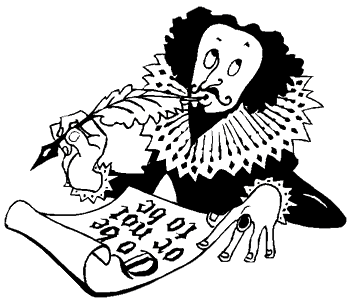
As I mentioned a couple of days ago, I am participating in Coursera’s “Shakespeare in Community”. It’s a course that allows students to express their thoughts and feelings about the Bard. A better title might be, “What Shakespeare Means To You”
We found ourselves discussing Carlo Carlei’s 2013, adaptation of Romeo and Juliet. I freely admit I haven’t seen the movie, and from what others have said, I don’t think I will.
Some argued that Carlei had every right to change the script; Juliet awakens right before Romeo kills himself. This was supposed to add to the drama and tragic ending. Carlei’s R&J is set in the modern world so naturally guns are the weapon of choice. Yet another change can be found in the dialog. Carlei uses Shakespeare’s most iconic lines while taking liberty with most of the lines. We have to ask, is this Shakespeare or is this based on Shakespeare?
Here are my thoughts, and please. Feel free to tell me yours.
West Side Story, Kiss Me Kate, The Lion King. These are movies based on Shakespeare. The directors unabashedly admit to adapting the plays and re-imagining them. Yet they stop short of calling their work, Shakespeare. Why? Because this allows them the ability to play loose and fast with his work. It allows them to explore ideas found in Shakespeare’s work without constraint. These directors want us to judge the work on their own merit, even if their work is not quite original. Then again, neither was Shakespeare’s.
We all know Shakespeare adapted earlier work to fit the needs of his audience. While the players could have just as easily been known as the group who performed classic works, they re-imagined them instead, and offered them in a way that their audience would accept and understand. Carlei may have felt he was doing the same. But there is a difference: Shakespeare re-wrote older literary works by changing the words, sometimes names and settings, and on several occasions re-wrote the ending. By doing this he took ownership of his work and called them his own. Like the directors mentioned above, Shakespeare did this so that his work would be judged on its merit.
Carlei’s movie is not Shakespeare, no matter what he wants us to think. His work is based on a play, just like Robert Wise’s West Side Story is not exactly Shakespeare. Carlei has been heavily criticized for his work and largely ignored by movie audiences. It is obvious Carlei is being judged, not on his merit, but on his use of someone else’s work. He doesn’t seem to understand the difference between adapting and basing.
Adapting someone else’s work usually involves a change of setting, or a re-ordering of scenes. Sometimes director remove or blend characters in order to save time and money. Yet these same directors will keep to the original dialog and endings. They want to be judged on how well they’ve used someone else’s work. Fair enough. I rather enjoyed Morgan Freeman’s Wild West version of The Taming of the Shrew. BBC did a remarkable job of placing an adaptation of Hamlet is the present day, so there video surveillance cameras in every room. This gave the play a dark, creepy feel as everyone, including the audience, felt spied upon. These two examples might not fit your definition of Shakespeare, but at least they didn’t omit the language and change the endings.
One of my classmates argued “tragedies can and should be altered”. “We don’t always require a sad ending”. Another classmate responded by asking if we always need comedies? His point was that by tweeking the content we no longer have the same play that we started with. John came up with a brilliant illustration to make his point. I give him full credit for coming up with the following idea. What if we to re-title some of Shakespeare’s comedies? Would they still be Shakespeare? You decide.
All’s Well that end’s Poorly
As you hate it
The grumpy wives of Windsor
Midsummer’s night’s nightmare
The unemployed of Venice
Twelve Long Nights
Much ado about nothing, nothing at all
The Shaming of the Shrew
 The View From Sari's World
You must be logged in to post a comment.