Contested Will or a look into why people deny Shakespeare

517jHQZPLjL._SY344_BO1,204,203,200_

By heaven, methinks it were an easy leap to pluck bright honor from the pale-faced moon, or dive into the bottom of the deep, where fathom-line could never touch the ground, and pluck up drowned honour by the locks. Henry IV Pt. I

If anyone is wiling to doubt on their authority, the history and existence of Christ, he must, in order to be consistent, be wiling to doubt on the same grounds, the history and existence of Shakespeare.

So begins a semi-satirical argument made in 1848 by Mosheim Schmucker in his book, Historical Doubts Respecting Shakespeare: Illustrating Infidel Objections Against the Bible (his publisher rejecting the shorter title of Oh Come on, seriously? because all great late 1800 book titles were required to be long and pretentious). Unfortunately for Schmucker, and to Shakespeare scholarship in general, his book was taken far too seriously.

The book was written as a response to another titled, The Life of Jesus, and the burgeoning “Higher Criticism” movement that inspired it. The phrase “Higher Criticism” described the study of the origins, date, composition, and transmission of the books of the Bible in order to separate fact from fiction. David Fredrick Strauss, one of the scholars who employed this method to the New Testament, came to the conclusion that there was no “supernatural, divine Christ, no miracles and no resurrection of the dead”. This did not sit well with the clergy (as one can easily imagine) and so Schumuker took it upon himself to write a response. The results were not what he had expected and sadly, we’ve been subjected to the 2011 movie Anonymous because of it.

To be Shakespeare or not to be Shakespeare. Allow me to take everything out of historical context while asking this question.

Schumuker, a historian and Lutheran pastor, decided to parody Strauss and his like by writing a book using the same arguments to determine if Shakespeare ever existed. Schumuker never doubted Shakespeare’s existence and assumed his readers would see the book for what it was intended to be; a satirical rebuttal to the argument that given the lack of historical data and contradictory stories surrounding Christ, we must conclude there was no Christ. He wanted his readers to see through Strauss’ argument using the “absence of evidence argument”. What ensued was not what he expected; it began the serious study of the authorship question that still rages today. Ironically, those seeking to question Shakespeare’s authorship used Schumuker’s book as their bible; using his arguments as talking points. Though the book is no longer regarded as the ultimate guide to the authorship questions, the arguments he presented are still in use today. Thanks to Schumuker and his obvious lack of satirical skills, the authorship question did not die a natural death. One could say he resurrected a question that was all but forgotten and gave it new life.

I found this story absolutely intriguing. It is one of several stories James Shapiro offer us in which we learn how and why the authorship question remains a topic of interest and debate. I learned that Mark Twain came to question Shakespeare as an author because in his later years he was convinced that all writing is consciously and subconsciously autobiographical. Twain was famous for his “truth” in fiction, but as he aged he began to believe that all writers expressed themselves in their works and that no one could write about things that they themselves had not experienced. I have to wonder if anyone pointed out to Twain that he was not a time traveler yet was able to write a lovely book on the subject.

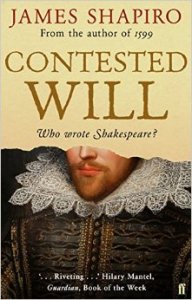
A better-suited title for the book, Contested Will Who wrote Shakespeare? would’ve been Contested Will Why people deny Shakespeare, as this is what Shapiro offers us. It is the history of doubt and what led other wise intelligent scholars, writers, and armchair historians to question whether there ever was a playwright named William Shakespeare. I read it in one day as I could not put this book down. It is one of my favorite books regarding the study of Shakespeare.

I have to commend Shapiro for his even-handed style in which he presented these people and their stories. It could have been so easy for him to scoff and make fun of them, but instead he presents their cases in a respectful and very well researched manner. Yes, once in awhile he does ask a question or makes a remark but this on ensures that the book is lightheaded tone, rather than a dry academic read or catty argument against the Anti-Stratfordians.

Make no mistake, this book is about the authorship questions but it is much more; it is a fascinating look into historical scholarship and offers modern readers the chance to see the other side of literary debate. Who knew this all really started with one woman’s frustration with not being taken as a serious scholar and took off when a pastor overestimated his comedic writing skills? Thank you Mr. Shapiro for enlightening us as to why people deny Shakespeare.

Works Cited/ Referenced

American Psychology Association The psychologies of Mark Twain

William Shakespeare Henry IV part 1

James Shapiro Contested Will Who Wrote Shakespeare?

William Shakespeare’s Star Wars: a new hope for fans

130316023938_shakespeare-3_4_r536_c534It’s May 4th, or as we nerds say. it’s Star Wars Day! I thought I’d celebrate by brushing off a review I did a couple of years ago.

May the 4th be with you!

I’m a part of the Star Wars generation. The original movie came out the summer I turned 12. Back in 1977 no one had ever seen a movie quite like this. Between the special effects (who can forget the Death Star explosion) and makeup, it was Hollywood magic at its finest. Even my mother, a jaded movie critic gasped when Obi-Wan and Luke entered the cantina. Everyone I knew wanted to see Star Wars, and for many of us kids, once was not enough. By summer’s end I’d watched it 12 times.

Even today it holds a special place in my heart. Maybe because it came out in the twilight of my innocence. That last summer between adolescence and teen angst. Or maybe because I just remember how much fun my friends and I had watching it, acting it out, (yes, we were at that age where that sort of behavior was acceptable) and arguing over key moments in the movie; we were also of the age that philosophical thought started to creep into our discussions. Was Luke destined to be a Jedi, or was it dumb luck that cast his fate?

Star Wars remains one of my favorite movies. But as the years past I moved on, finding new loves and new subjects of philosophical debate. Shakespeare is now the topic of many long discussions; though I do recall one in which Hamlet and Luke were subjected to comparison. Both at times, hesitated to do what was needed and both have some serious daddy issues!

k-bigpic

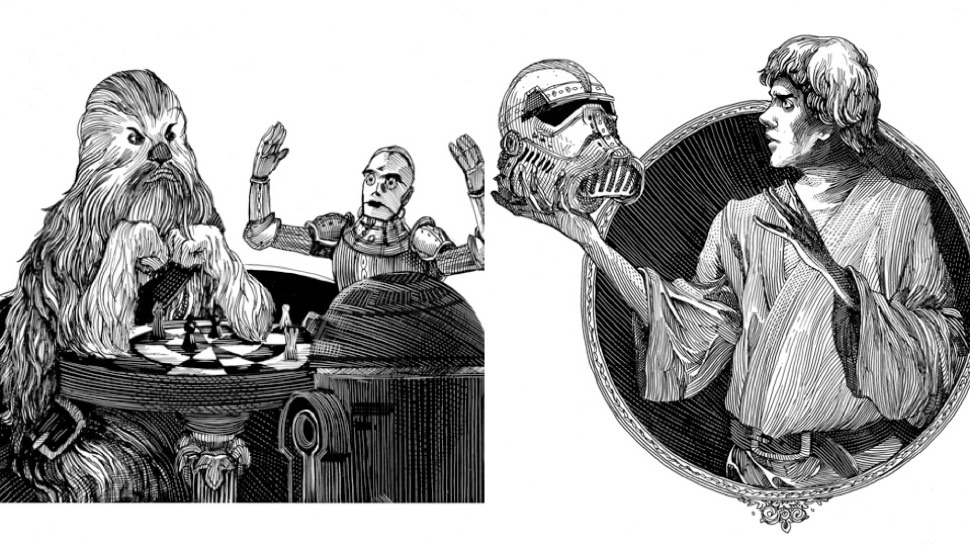
Why am I bringing this up? Well, a few weeks ago I was offered the chance to review Ian Doescher’s book William Shakespeare’s Star Wars. The nerd in me jumped at the chance to read this mash-up. What science nerd/Shakespeare geek wouldn’t?

Of course I wondered if it would be any good and if the Bard scholar in me would find fault on every page. So how did it do?

The book exceeded my expectations; although to be fair, my expectations were rather low. I hoped for a few hours of light entertainment. What I got was a few hours of pure delight. From the opening lines to the last I was hooked.

C-3PO- Now is the summer of our happiness

Made winter by this sudden, fierce attack!

Our ship is under siege, I know not how.

O hast thou heard? The main reactor fails!

We shall most surely be destroy’d by this.

I’ll warrant madness lies herein!


The adult Shakespeare lover in my admired Doescher’s ability to stick to some of Lucas’ original words while giving them a Shakespearean make-over. But the biggest surprise and delight came from Doescher’s novel idea to place Shakespeare-like asides and soliloquies in key moments. These monologs offers Star Wars fans new vantage points to view the characters and their motivations. Take Luke’s inner struggle after finding his aunt and uncle’s chard remains:

Adventure have I ask’d for in this life,

and now have I too much of my desire.

My soul within me weeps: my mind, it runs

unto a thousand varied paths.

My uncle Own and my aunt Beru,

have they been cruelly kill’d for what I want?

As the soliloquy goes on,we get the idea that Luke feels guilt and pressure over this tragedy. He vows to fight so that his family will be “honor’d in their grave”.

From R2D2 to Vader, these innermost thoughts add depth to the story, and dare I say it?  Make it a little better. Yep, I am telling you that Doescher’s retelling breaths new life into the Lucas’ world.

I wish this book had come out when the other mash-up were popular. I got my son to read and admire Jane Austin with Pride Prejudice and Zombies. If he had read Doescher’s book in high school he may have had an easier time with Shakespeare. William Shakespeare’s Star Wars is a wonderful introduction into Shakespearean verse. Getting students used to “Shakespeare “speak” can be a challenge. Doescher’s book may ease some of their fear of Shakespeare.

Are there mistakes? Yes, the biggest is that Doescher doesn’t modify speaking styles; the higher class should be speaking in verse, and the lower in prose, a style  Shakespeare used to show the difference in classes. Am I complaining? No, not really, I had too much fun reading this book and I hope you will to.

Anon. May the verse be with you!

Amazing Waste

Repurposing Food and Reducing Waste

measurestillformeasure

Shakespeare, Classics, Theatre, Thoughts

Nerd Cactus

Quirky Intellect for the Discerning Nerd

Sillyverse

Stories of magic and mystery

Commonplace Fun Facts

Mind-Blowing Facts You Didn’t Know

Fictionophile

Fiction reviews, Bookblogger, Fiction book reviews, books, crime fiction, author interviews, mystery series, cover, love, bookish thoughts...

Patrick W. Marsh

I write literary horror - poems, short stories, and books

Shakespeare for Kids Books

Opening the door for kids to love Shakespeare and the classics

desperatelyseekingcymbeline

The 10-year Shakespeare New Year Resolution

Katzenworld

Welcome to the world of cats!

booksandopinions.com

The Book Reviews You Can Trust!

The Book Review Directory

For Readers and Writers

thelitcritguy

screams from the void

Author Adrienne Morris

Step Into the Past—Lose Yourself in the Story.

crafty theatre

ideas inspired by crafty characters

Critical Dispatches

Reports from my somewhat unusual life

The Nerd Nebula

The Nucleus of the Universe for all Nerd Hacks!