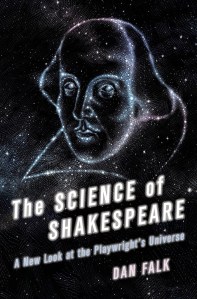
In 1996, during a meeting of the American Astronomical Society astronomer Peter Usher presented a usual paper titled “A new reading of Shakespeare’s Hamlet”. In the paper Usher argued that Hamlet was written as an allegory about competing cosmological models. It is always a little alarming whenever someone announces they’ve peered into Shakespeare’s mind and unlocked its secretes, but in this case Usher’s paper begged a very good question: what, if any influence did science have on Shakespeare’s work?
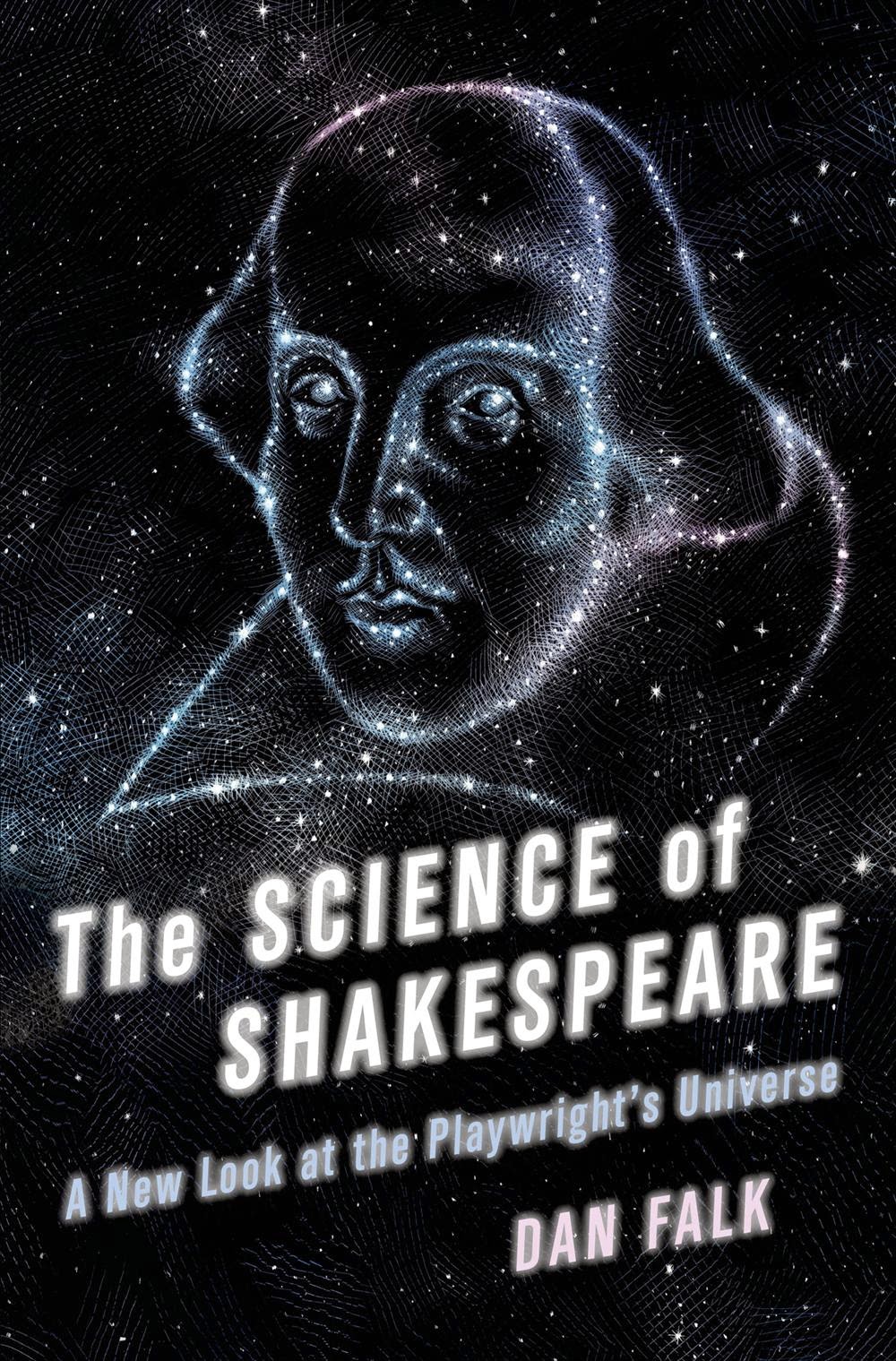
Dan Falk tries to answer this question in his tour de force, The science of Shakespeare. Falk reminds us that,“William Shakespeare lived at a remarkable time—a period we now recognize as the first phase of the Scientific Revolution. New ideas were transforming Western thought, the medieval was giving way to the modern, and the work of a few key figures hinted at the brave new world to come: The methodical and rational Galileo, the skeptical Montaigne”. The obvious question is, did any of this have an impact on Shakespeare’s writing? If so can we find hints of scientific ideas in Elizabethan pop culture?
From the very start Falk admits to be walking a thin line. It’s one thing to analyze Shakespeare’s work in order to form an opinion on what he might have thought; it is another to conjecture based on one’s own thoughts. That an astronomer thinks Hamlet is some sort of scientific thesis should gives us pause. Yet Falk is open to the idea that Shakespeare was indeed influenced by the events and people around him and that this influence is peppered through out the plays.
Does Falk present a convincing argument? I think so. First, we have to admit that it is not unusual for a writer to be influenced by current events and public figures. Shakespeare would not have such a lasting impact on us if he had not commented on society. Yet this idea of science in Shakespeare shows us that there is more going on than just simple acknowledgment of the changing times. Drawing on new ideas and discoveries, Shakespeare may be telling us how they affected society. After all, his audience would have to have some basic understanding of them in order to understand his words.
Falk makes his case by introducing us to some of history’s most compelling thinkers. Men like Thomas Digges, the publisher of the first English account of the “new astronomy” and who just happened to live in the same neighborhood as Shakespeare; Tycho Brahe, whose observatory-castle stood within sight of Elsinore and whose family crest happened to include the names “Rosencrans” and “Guildensteren (did you know that? I didn’t) and my favorite (I have to thank Falk for introducing him to me) Michel de Montaigne, a skeptical thinker whose motto Que sais-je? (What do I know), mirrors my own. Falk shows us how each of these men and others, in one way or another influenced Shakespeare’s work.
Take for instance, Montaigne. His essays on his thoughts on life and the universe clearly show up in Shakespeare’s The Tempest. Montaigne talks about a group of Tupinamba people who were brought to France by French explorers. He writes:
It’s a nation….that hath no kind of traffike, no knowledge of Letters, no intelligence of numbers, no name of magistrate nor politke superiorite; no use of service, or riches or of poverty…”
Now take Gonzalo’s view of a utopian society:
I’th’ commonwealth I would by contraries
Execute for all things, for no kind of traffic
Would I admit; no name of magistrate;
Letters should not be known; rich, poverty
And use of service none.
This does not prove Shakespeare argued for a utopian society, but it does show us that he was reading and thinking about recent publications and events. As I read this I wondered if The Tempest was indeed a critical allegory to colonization, and if so, was it Montaigne who planted the seed of doubt in Shakespeare’s mind?
Around 1610, Galileo’s book, The Starry Messenger was a hot topic in English intellectual society. The book sold out. Thomas Hobbes had a hard time getting his hands on a copy. Galileo’s observation of Jupiter’s four “satellites” showed that Copernicus’ model of a heliocentric universe just might be right after all.
This had to be big news and to ignore it would be to ignore the changing views of our place in the universe. Shakespeare could have written a play about this had it not been controversial and a little boring for two hour play, but instead seems to have planted the idea in a convoluted scene in Cymbeline. In the scene, Posthumus, finds himself jailed. In his cell Posthumus has a dream in which four ghosts visit him and move around him in a circle. They call upon the god Jupiter to help him. Humm.. four satellites and the god Jupiter? This is either an odd coincidence or Shakespeare’s way of introducing his audience to idea of this discovery.
Of course we will never know. Though the book is filled with more examples, some more convincing than others, Falk never makes the claim that these are proof that Shakespeare used science. We are left to form our own opinions. This is one of many reasons this is a compelling read. Falk explores many theories on Shakespeare and science, yet rarely comments on them. The one exception may be his agreement that Prospero may be based on Thomas Digges rather than John Dee. I do not agree, for the simple reason Dee was both a man of science and a magician who claimed to talk to the angel Uriel (just as Prospero talked to Ariel).
If nothing else this is a wonderful look at the history of science and the men who brought about the scientific revolution. It had me questioning some of the modern assumptions about Shakespeare’s work. It just might be my choice for best read of 2014.

 The Pierced Heart
 The View From Sari's World
You must be logged in to post a comment.