Things you may not know about urban dystopian literature.

Dystopian Endcap


A while ago when asked what subject I’d like to teach, I replied “Dystopian literature”. A blank stare was the response. I then went into a lengthy explanation as to why I picked this genre. Not as a topic of literary work, but as a vehicle in which we can explore and confront our basic human nature and ask hard questions of ourselves: Stripped of modern day luxuries would you break or would you be forced to start living? Could you, if need be, break from an oppressive society? Are you a sheep more comfortable with known rules and norms or are you a rebel, willing to risk it all for self identity? Again, a blank stare was the only response. I realized my companion had no idea what I was talking about.

” Distopeeann literature, what’s that”? Had this been an illiterate friend, I would have chalked his confusion up to too much TV, but this was a published friend. Someone I was sure would understand my enthusiasm for the topic. This was a good reminder not to take it for granted that everyone knows or enjoys what I do. So, if you are as confused as my published friend, this blog is for you. It is the first of two parts. The first deals with the urban side of dystopian literature. The second post will delve into my favorite, the post- apocalypse side.

 Things you may not know about urban dystopian literature.

What does dystopian even mean?

A dystopian setting is the opposite of a utopian setting. The very word dystopia comes from the Greeks, meaning bad place. So a dystopian setting is one in which the conditions are miserable. Usually dystopian literature is characterized by human misery, poverty, oppression, disease or pollution. Sometimes the plot involves the cause of society’s breakdown, most often than not, the cause is not as important as the effect. Dystopian societies are portrayed with different defining features. Included in this list but not limited to are: futuristic, allegorical, metaphorical, political, and religious. Though each novel and its setting is unique, they a share the idea that these societies resemble or try to resemble a utopian society but fail because of one fatal flaw. Other times the condition of the setting is so bleak (think post-apocalypse) that it in no way can be passed off as anything other than it is.

When did we start using this term?

The first use of the word in modern English may have come from John Stuart Mills in a 1868 speech before the British Parliament in which he was defending the poor; Mill said, “It is, perhaps, too complimentary to call them Utopians, they ought rather to be called dys-topians, or caco-topians. What is commonly called Utopian is something too good to be practicable; but what they appear to favor is too bad to be practicable “. Let it be noted, Mill’s was not describing the poor in this quote, rather those who would oppress them.

The first true dystopian work of literature

Many credit Aldous Huxley for writing the first dystopian novel with Brave new world, yet I say one of the very first is found in the Christian Bible. The Book of Revelation may be the oldest surviving story of a post-apocalypse world.

Key elements found in urban dystopian literature

Social Control: Someone or something is trying to gain social control usually in the guise of social order. Fahrenheit 451 and Atlas Shrugged are two examples of novels in which the plot center around social control.

Lack of social cohesion: Fanaticism is the more typical form of dystopian politics, sometimes an alternative version to social control is lack of social cohesion. A Clockwork Orange and Lord of the flies are prime examples of social order spinning out of control.

Absence of Civil Society: There are no social groups besides the state, and or such social groups are subdivisions of the state. 1984 and The Handmaid’s Tale are two extreme examples.

Political ideologies: Dystopian urban societies come in all forms of governments and political systems. Each with the goal of turning society into one predominate system usually by oppressing ideas and individual thought. Iron Heel and 1984 both exemplify the idea of a society in which censorship is key to political rule.

 How do these books end?

The hero’s purpose is either escape or destruction of society, yet the story is often unresolved.  Individuals in a dystopian society are discontented, and may rebel, but ultimately fail to change anything. Sometimes they themselves end up changed to conform to the society’s norms. Yeah, kinda of bleak, but we are talking about dystopian literature.

And now you know.

Sari’s Scariest Reads

51693111d834790f8a99dc50000f7b68

To be clear, I really dislike book lists. You’ve probably seen them. Lists with titles like, The 100 books you should read before you die (no pressure here), Books of the well-educated mind, (This is my least favorite. I often say, “It’s not what you read, but how you read that counts), The best novels of all time (according to who?) and The 100 books everyone should read (why?).

Yet each time I see a new list I am suckered into looking at it if for no other reason than to try to figure out why the author felt these are must reads and what makes him or her an expert. A about a week ago a list titled 10 novels that will scare the hell out of you appeared on The Huffington Post and then, the internet being the internet, made its round on Twitter. I love scary books, though it has been years since one scared the hell out me.  Ever since I sat in a hospital room waiting while surgeons performed open heart on my 2 ½ month old son, no written word has truly terrified me. But, still I hope.

I’ve read many of the books on this list, and while I agree The Shining is one scary book, the others are mere exercises in psychological thrills. While The Little Stranger by Sarah Water is well written, everyone I know who has read it saw the end coming.

I don’t think anyone one person can say what are the best or scariest books to read. It is up to the individual reader to determine that for his or her self. Oh sure book lists can be useful guides and are great for finding new authors, but no one should dictate what you read.

Yet, as I sat looking at the list of scary novels an idea emerged. What if we posted lists of reads we found scary? After all, Halloween is upon us. What if we shared our favorite scares? Not as personal propaganda ploys to get us to like what you like, but as a way of sharing our ideas on what scary means to us. I’ll start

I give you Sari’s scariest reads:

The Exorcist Peter Blatty

To be fair, I was way too young to read this. I think I was 11 or 12. As I mentioned in an earlier post about Dr. Sleep, my parents did not keep a lot of books in the house. This is one I sneaked into my room after my mom said, “This might not be a book you want to read”. If you know me, you will know her words made this the book I had to read.

The Exorcist scared me so badly, I slept with the light on for two full weeks! To this day I cannot watch the movie. It wasn’t so much as what happened, but to my immature mind, but that it could happen. That at any moment someone or something could take over my body and there wasn’t a damn thing anyone could about it. I bugged and bugged my mother to explain to me why she was so sure this would never happen. We had a theological debate of sorts for months after I read it. She ended up throwing the book in the fireplace as a type of exorcism.

Sybil Flora Rheta Schreiber

This is the book my mother should have burned after she read it. Bloody hell, this was a scary read. Once again I was far too young to read it and only did because my mother forbid me to do so.

For those of you who may be unfamiliar with this “true” story, it is about a woman who seeks therapy due to her constant loss of time (in some cases, years). What starts out as a story of a woman’s desperate attempt for help, quickly turns into a story of multiple personalities and pornographic child abuse. I can’t say what scared me more, Sybil’s mental instability or her mother’s psychotic personality.

I too experienced trauma as a child, though nothing on the scale of Sybil’s, and I wondered how much a person could take before their mind broke? I became scared that I would start missing time, or worse yet, have my friends look at me and say, “What’s wrong with you? You’re not yourself these days”.

Last year, after Sybil’s psychiatrist passed away, the truth came out. None of the story was true. Her mother did not sexually abuse her, and her various personalities were fabricated to please the doctor who was looking for someone to treat for split personalities.  Turns out Sybil was sick, but not in the way we all thought. Come to think of it, this is just as scary.

The Shining Stephen King

This is the first Stephen King I read. I think it is one of his best. It’s not the story that scared me, but King’s imagery. How King is able to take everyday objects and turn them into stuff of nightmares is a wonder to me. His use of topiaries as demonic guardians had me running in the house mentally screaming, “Redum, redum!” when my mother innocently mentioned we should trim the hedges. I’ve mentioned this before, but fire hoses still creep me out. Whenever I’m around our fire trucks I walk far from the hoses lest they get any ideas about attacking me.

It Stephen King

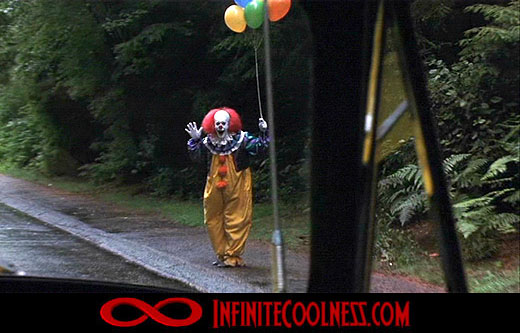
I loved this book! When I read it in the fall of 1987 I could not put it down. Luckily for me I worked as a desk clerk at a small motel. Once all 35 rooms were sold for the night, I had hours to kill. I loved the characters and the story was just creepy enough to keep me on the edge of my seat. But I had no idea just how creepy and scary Pennywise the clown was until I almost killed a man.

I was living in Sebastopol California, a place of long quite farm roads. At the time Sebastopol was known for growing apples, melons and squash. In the spring and fall the roads were dotted with small roadside stands selling the freshest produce possible. This particular fall one industrious man decided to open a large roadside stand selling pumpkins, apples and fall vegetables.  The man enlisted the help of his teen son, who was assigned the dubious task of encouraging drivers to stop.  The man wanted his son to dress as a scarecrow or goofy farmer. The son, not happy to spend his weekends flagging cars down, decided to dress like a clown, and not just any clown. Oh, no, he dressed as Pennywise.

So there I was, speeding down this country lane, when I noticed a clown holding balloons standing at the edge of a dirt driveway. At first I thought it was odd that there was a clown standing on the road, but as I got closer I noticed his blue jumper, white shirt and red hair. It was Pennywise! My first and only thought was “kill the clown!” and so I turned the car into the driveway. Thank god for the both of us, he jumped into the ditch and I slammed on my brakes. When we both caught our breath we couldn’t apologize enough; he for scaring me, and I for almost running him down. I try not to run clowns down anymore, but man do I hate them!

Twilight Stephanie Meyer

No, don’t role your eyes. Let me explain. Two things about Twilight scare me; that it is a best seller and that many young female readers don’t find Edward’s “affection” abusive.

It’s scary enough to hear young girls declare this dribble to be the best book ever! But I even have co-workers who think Meyer is a genius. My IQ drops just holding the book. And can someone tell me what’s sexy about having a man push you down the stairs and disable your car just so you don’t go into town and “hurt yourself”? Since when is this a turn on? Oh and did you know in one of the books, Edward and Jacob engage in a penis comparison? Apparently vampires got all the charm while werewolves got everything else. This may be one of the scariest books I have ever read.

The comment section of the Huffington Post.

Who knew there was so much anger and vitriol in modern society? Pick any article from the Huffington Post and scroll down to the comment section. I promise you will be scared witless! The Post brings out the worst in people. Between the snarky comments, horrid grammar, straw man arguments and wild accusations nothing is sacred, nothing is off limits. It’s high school on steroids. Under an article in which a disabled Girl Scout risks her life to save drowning kittens will be wild Obama claims and stories about how the Girl Scouts is nothing more than a Nazi like terrorist group bent on world domination one badge at a time. If this is how our society acts while engaging in public discourse then I am truly horrified.

These are my 7 scares. What are yours?

Pennywise-stephen-kings-it-28544961-520-333

Amazing Waste

Repurposing Food and Reducing Waste

measurestillformeasure

Shakespeare, Classics, Theatre, Thoughts

Nerd Cactus

Quirky Intellect for the Discerning Nerd

Sillyverse

Stories of magic and mystery

Commonplace Fun Facts

Mind-Blowing Facts You Didn’t Know

Fictionophile

Fiction reviews, Bookblogger, Fiction book reviews, books, crime fiction, author interviews, mystery series, cover, love, bookish thoughts...

Patrick W. Marsh

monsters, monsters, everywhere

Shakespeare for Kids Books

Opening the door for kids to love Shakespeare and the classics

desperatelyseekingcymbeline

The 10-year Shakespeare New Year Resolution

Katzenworld

Welcome to the world of cats!

booksandopinions.com

The Book Reviews You Can Trust!

The Book Review Directory

For Readers and Writers

thelitcritguy

screams from the void

Author Adrienne Morris

Step Into the Past—Lose Yourself in the Story.

crafty theatre

ideas inspired by crafty characters

Critical Dispatches

Reports from my somewhat unusual life

The Nerd Nebula

The Nucleus of the Universe for all Nerd Hacks!