All the world’s a stage: A brief history of Renaissance Faires

Queen Elizabeth holding court

Today’s American Renaissance Faires (yes it’s spelled faire) are becoming quite mainstream. It seems you can’t throw a juggler’s ball far without hitting one. Just about every state in the union has at least one yearly faire, some, like California host several. The faires are now popular family, and school events. Some faires even host special family and student days, with activities designed for educational purposes. Of course no American faire is complete without its many vendors selling everything from Elizabethan costumes to modern body scrub. Thousands of people attend these commercialized faires so it might come as surprise to learn that the original faires were presented as part of the 1960’s counterculture movement, specifically as playful ways of protesting American consumerism and uptight social norms.

In her 2012 book, Well Met: Renaissance Faires and the American Counterculture, author Rachel Lee Rubio tells us that the 1964 Pleasure Faire and May Market, featured “an authentically attired ‘monk in full beard and hooded robes’ hawking papal indulgences and calling to fairgoers, ‘Let me absolve you of the punishments and everlasting torments of commercialism!’” The faire, for the California radicals who first participated in it, was not just an entertainment but also a criticism of the establishment and all it stood for.

The first American Renaissance faire was the brainchild of Phyllis Patterson, a Los Angeles schoolteacher. In 1963, she held a very small Renaissance fair as a class activity, in the backyard of her Laurel Canyon home. It was so successful she and her husband Ron Patterson, held a weekend fundraiser for a local radio station. 8,ooo people showed up. This must have been a very successful fundraiser.

Two years later the Patterson’s staged the first Renaissance Pleasure Faire in Angora California. The first commercial vendors were artisans and food merchants who were required to demonstrate historical accuracy or plausibility for their wares. Groups of volunteers were organized into “guilds” to focus on specific reenactment duties (jugglers, singers, actors, blacksmiths etc.). It was hoped that by presenting the faire as a living history event the Renaissance period would be brought to life so that attendees would be reminded of an early age, before the world, or at least America, became immersed in modern technology. What the Patterson’s may have over looked was that the Renaissance period was also a time of growing technology and consumerism. The 17th century Romantic era was pushback to this, the original counterculture movement, if you will. It is a little ironic that the Renaissance era, not the Romantic period was the theme of choice.

The Pattersons wanted full participation from the attendees. According to Rubio, one did not pay to attend the faires, one paid to play.

[A]ttending the Renaissance faire was, during the 1960s and 1970s, a sort of statement of purpose: of belonging in some way to the counterculture, of resistance to consumerism, of side-stepping — albeit briefly — the external constraints of social convention. Through the faire, people could demonstrate public participation in, and affirmation of, a new type of community that was resolutely transnational, transhistorical, transcultural, and one of choice rather than birth.

I wish I would have known about the history of the American faires, for now I can make better sense of what I saw and participated in last Saturday. It turns out there was a hidden message that I completely missed. In a way, the faires are American experimental theaters designed in a way as to break the fourth wall and pull the audience into the action and not just respond to the players.

I’v been a fan of Renaissance faires ever since I attended the Black Point Pleasure Faire, held yearly in Marin County. The Pattersons also started this faire, and apparently during the late 1970s (when I first attended) was still part of the counterculture movement.

These years I attend the Valhalla Renaissance Faire, held annually in Lake Tahoe California. I even met a Guild Master Saturday who mentioned she knew Phyllis Patterson, but at the time the name meant nothing to me.

As my friend Karen and walked around we were invited to participate in games, street performances, (I ended up quoting Shakespeare near the front gate never guessing I had become part of the play) and was even invited to join the Fellowship Guild (be part of a guild? Sign me up!) I had no idea that we were being asked to join a community, even if only for a day, dedicated to the idea of breaking free from the modern establishment. There was a lot of bawdy talk being bantered about; this too was part of the antiestablishment movement. I thought the vendors were getting into the spirit of Shakespearian humor. I giggled but lightly participated. Leave it to an academic to view the experience through a narrow lens.

It’s not all my fault I saw the faire as a window in Shakespeare’s world. For you see, it was promised to be the weekend that the Bard would finally show his face! I had every intention of interviewing him. I asked and got permission. Wouldn’t that of made a good article? Sadly, he was called away. In fact none of the Lord’s Chamberlain’s men made an appearance. I was disappointed, yet amused that the man remains elusive, even to a time traveler.

Ah, see there’s the rub. I was under the impression I was there as a traveling tourist. Someone who didn’t quite fit in yet wanted a close and upfront view of an alien world. Now I know better. In October California is hosting yet another faire, this one outside of the state Capitol (see I told you they are everywhere). We are making plans to go only this time I will have a better understanding of what will be asked of me. I will pay to play in the spirit of the counterculture movement. I will shake the bonds of both academe and society and let the inner hippie wench out.
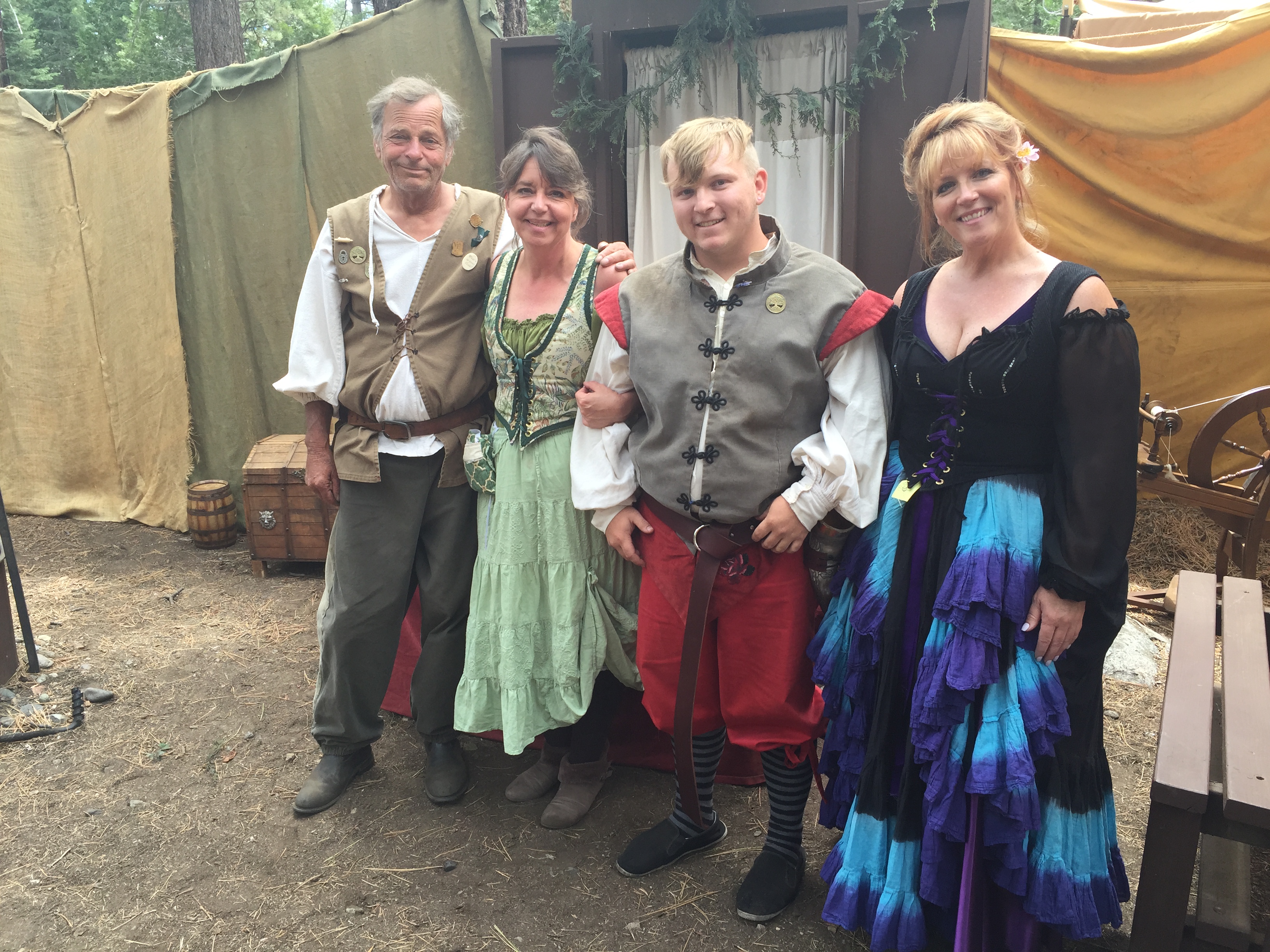
 

Meeting some of the Fellowship Guild members

If the history of Renaissance Faires is of interest, or you just like good biographies, I found this gem on Vimo. It’s a video for rent, titled, Faire: the American Renaissance. It was fun to watch some old home movies of the early days of the original faire.

Rubio’s book is another source for a fresh look at the counterculture movement.

Rubio, Rachel Lee. Well Met: Renaissance Faires and the American Counterculture. NY Press. 2012
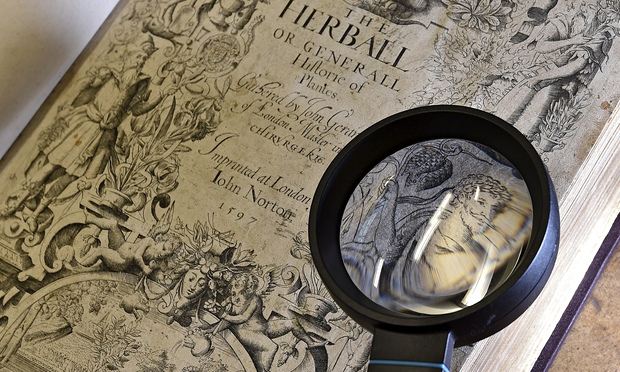
To be or not to be, Shakespeare?

Shakespeare portrait claimed in illustration John Gerard The Herball

George Sumner is an environmental impressionist painter, specializing in ocean scenes. 20 years ago you would have found his work in galleries across America including Hawaii. In fact, 20 years ago, you couldn’t have visited the island chain without tripping over a painting or lithograph of his. His popularity has waned over the years and now his work is limited to Northern California.

My mother fell in love with his work during the height of his popularity. She had a condo in Hawaii that was decorated with his lithographs. An art dealer, sensing a true patron, got her in touch with Somner’s ex-wife. The ex had a painting of his for sale. It was a painting that wasn’t cataloged as he had painted for his wife, now ex-wife. My mother jumped at the chance to own a one of a kind piece of work. A piece that was never reprinted for sale; very few people know it even exists. After my mother tired of it (it’s huge and doesn’t fit in her scaled down lifestyle) she sold it to another collector who was also happy to have a one of a kind piece.

Now, let’s say that collector keeps it in the family for several generations, and in, let’s say 100 years from now, Sumner is popular once again. Can you imagine the thrill the art world would feel if the owner of the piece comes forward with this unknown painting? The origin story makes the piece all that more interesting.

These things happen. Just recently there’s been a discovery of a previously unknown Van Gogh. A Rembrandt scholar thinks he has found 70 misidentified paintings. Who knows how many unknown or misidentified works of art are waiting to be found? How many are actually hidden in plain sight?

According to the latest edition of Country Magazine, a botanist found a book that contains a picture of Shakespeare hidden in plain sight. The article in Country Magazine makes the claim that what they have, reveals an astonishing new image of William Shakespeare, the first and only known demonstrably authentic portrait of the world’s greatest writer made in his lifetime.

The go to explain:

Botanist and historian Mark Griffiths reveals in this week’s issue of Country Life magazine, how he cracked a many-layered Tudor code and revealed the living face of Shakespeare for the first time, on the title page of The Herball by John Gerard, a 16th century book on plants, 400 years after it was first published.

Upon reading this my first thought was, “Oh great, another code cracker. Had Griffiths read one too many Dan Brown novels?” But of course I had to keep an open mind, so I spent a few hours reading the various takes on what Country Magazine calls “the find of the century”.

139af321-11aa-4fcb-9cb7-067289f6a50a-2060x1236

Griffiths claims that while studying the life of John Gerard, he started researching the title page of The Herball in order to determine who the four figures are that make up the edges of the page. He noticed some Latin under each of them and after doing some Robert Langdon style deciphering, came up with a theory that they are Gerard himself, the Flemish botanist Rembert Dodoens, Queen Elizabeth’s chief minister Lord Burghley, who was Gerard’s patron, and the man dressed in a Togo, William Shakespeare. “At first, I found it hard to believe that anyone so famous, so universally sought, could have hidden in plain sight for so long,” Griffiths said. But he is convinced that this is only reasonable explanation for this figure. I’m still trying to find a reasonable explanation for the code. Ready? Here is it as spelled out by Telegraph newspaper:

The number four + the letter ‘E’ – translating in Latin as ‘quater-e’, meaning ‘to shake’

The letters ‘OR’ – the heraldic term for gold, a reference to the Shakespeare family coat of arms

The code can also be read from left to right, top to bottom, as ‘quat-e-or’, a Renaissance spelling of ‘quatior’, meaning ‘I shake’

A rebus representing a spear – put together these say ‘shake-spear’

A letter ‘W’ to represent William

He goes on to suggest, the man in the portrait is holding an ear of sweetcorn, a fleur-de-lys and a fritillary (a flower of the lily family) in references to Titus Andronicus, Henry VI Part I and Venus and Adonis respectively.

Now that’s some code! No wonder no one else in 400 years has pointed to this as Shakespeare. It makes me wonder what Mr. Botanist smokes in his spare time. Just for fun I consulted a couple of my Latin dictionaries to see if indeed quatere translates into “to shake”. I found out that there are several Latin words that translate into shake, depending on the context, but only one that means “to shake”; Exhorresco. Quarter translates into 4. But my dictionaries could be wrong….

John Overholt, a Harvard scholar says, not so fast. This same “code” or device is nothing more than a printer’s mark. He has found the same code listed as a printer’s mark in the William and John Norton Compendium of Printer’s Stamps, published in 1749. Oxford Professor Edward Wilson, who backs up Griffiths’ claim, quipped back that the Nortons must have made an error in judgment in saying that this is a printer’s mark. Easy to say when the men in question have been dead for over 300 years and can’t defend themselves.

Many Shakespeare scholars think that what Griffiths has come up with is utter nonsense. Micheal Dobbs and Paul Edmonson both laugh at the idea. While I want to keep an open mind, I am on the side of scholars for a couple of reasons.

If this is a code, it’s a pretty far-reaching one. If this truly is supposed to be Shakespeare, why go to such lengths to hide it? Why not make it obvious for all to see?

Second, even if this is a depiction of Shakespeare, it isn’t self evident that this is a true to life likeness. For all we know it may be the artist’s interpretation of what he thinks the great poet is supposed to look like. It is a big leap to say this might be a nod to Shakespeare and a monumental leap to say this is the only known demonstrably authentic portrait of the world’s greatest writer made in his lifetime, as Country Life is claiming.

We aren’t exactly sure what Shakespeare looked like. The only known authentic likenesses of Shakespeare are found in the First Folio and on the effigy on his monument at Holy Trinity church in Stratford-upon-Avon. Both of these were commissioned posthumously. Ah, and there’s the rub. Is this to be or not to be a realistic picture of the young playwright? We may never know. But, I am betting against it, as Country Life has made a far greater claim, one that should have been the lead story. Next week they are going to present us with a newly discovered play penned by non-other than Shakespeare!

I smell a book deal in the works.


Country Life, Shakespeare His true likeness reveled at last

The Guardian Shakespeare: writer claims discovery of only portrait made during his lifetime

Charles Murry Latin to English Dictionary

John Stone, Latin for the illiterati

The Telegraph, William Shakespeare: Newly-discovered image revealed

Amazing Waste

Repurposing Food and Reducing Waste

measurestillformeasure

Shakespeare, Classics, Theatre, Thoughts

Nerd Cactus

Quirky Intellect for the Discerning Nerd

Sillyverse

Stories of magic and mystery

Commonplace Fun Facts

Mind-Blowing Facts You Didn’t Know

Fictionophile

Fiction reviews, Bookblogger, Fiction book reviews, books, crime fiction, author interviews, mystery series, cover, love, bookish thoughts...

Patrick W. Marsh

monsters, monsters, everywhere

Shakespeare for Kids Books

Opening the door for kids to love Shakespeare and the classics

desperatelyseekingcymbeline

The 10-year Shakespeare New Year Resolution

Katzenworld

Welcome to the world of cats!

booksandopinions.com

The Book Reviews You Can Trust!

The Book Review Directory

For Readers and Writers

thelitcritguy

screams from the void

Author Adrienne Morris

Step Into the Past—Lose Yourself in the Story.

crafty theatre

ideas inspired by crafty characters

Critical Dispatches

Reports from my somewhat unusual life

The Nerd Nebula

The Nucleus of the Universe for all Nerd Hacks!