Actions speak louder than words A lesson on civil disobedience

Last night’s Baltimore protest was a direct result of years of police brutality and the racist undertones we still face. The civil unrest and riot stemming from the protest, was long in the making. People can only be pushed so far; there are limits to what a oppressed group can take. 2015 has proven to be that limit.

While I in no way condone the violent riot we saw last night, I do understand the anger. I am angry every time an unarmed citizen is gunned down by an officer whose job is supposed to be to protect and to serve. I am angry that more often than not, this ugly abuse of power is justified as part of the job. I can’t get the image of 12- year Tamir Rice gunned down simply because he was holding a toy gun, out of my head. When I was ten my grandfather disabled a real shotgun so that we grandkids could play cops and robbers. I remember carrying it as I walked down the street to a friend’s house. It never occurred to my grandparents that the sight of a 10-year-old girl walking down the street with a gun would be threatening. Truth be told, I bought my 14-year an air-soft gun (one like Tamir Rice was holding) to target practice with his friends. I shudder to think that my son could have met the same fate. So yes, I am angry.

I know, I know, the statics say police brutality has gone down over the last few decades, and that what is reported in the news only serves to make us think differently. But this fact is meaningless to those who have lost family members. It should not matter that brutality has gone down. We should have zero tolerance for those who take lethal action when there are other ways. There is no justification for murdering an unarmed citizen when we have the technology and means to defuse a situation. Escalating the encounter to such drastic conclusions harms our society and only increases what is already a palatable tension between citizens and our men in uniform. In this day in age life should be more precious. We should know better.

Full disclosure, I work for state law-enforcement. I know all too well there are some scary people out there who don’t value life. Ask any cop who is willing to be honest, and you will hear that with the rise in gun ownership, everyone who is stopped poses a threat. Yet this too is not justification for violence.


The Salt March
The Salt March

Yet, historically meeting violence with violence has never worked for those looking for changes within society. Yes, it works when a group decides to overthrow a government, but this usually leads to war. Changes from within come from peaceful civil disobedience.

Not all government overthrows were accomplished with violence though. India was once under British rule. By the late 1920s the Indian people, viewed as second-class citizens in their own country, cried “Enough”! Led by Mohandas Gahndhi, the people engaged in satyagraha, a war without violence. The people did this by enacting civil disobedience. They refused to carry government-mandated papers. They ignored curfews and refused to ride in third class train cars among other things. The masses used these tactics as a large-scale nation-wide protest.

The original goal of wanting to be viewed as equals to those who ruled them, became a wish for “Home Rule”. Ten years of peaceful protest turned to simmering rage as thousands were jailed and beaten with no end in sight. Gandhi and his supporters decided to take a stand, but there would be no looting, no burning, no violence. This stand, as ridiculous as it may seem to us, was a symbolic gesture to show the government that the people had reached their limit.

In February of 1930, Gandhi and a band of twenty-eight followers marched to the sea to take something Indians were not allowed to freely take: salt. It was illegal for Indians to make their own salt. They had to buy it from British companies. Local villagers joined Gandhi and his followers as they marched to sea. By the time Gandhi reached the sea he had thousands of people at his side. Everyone took some salt and soon people were buying and selling it.

Though small, this simple gesture of civil disobedience turned the tide of opinion. Gandhi and others would be in and out of jail for the next few years, yet this was starting to become a thing to celebrate. As more and more were jailed, the more the jails became communities. Family members were often reunited in jail, causing much celebration. Jail was becoming the place to be. The world’s attention turned to India and soon the situation became a spectacle, rather than a lesson on how to treat a conquered nation. The British government felt the pressure, both from within and from without. Finally in August of 1947, India was free. Sadly the bitter irony is that the nation fractured into two: India and Pakistan. The animosity between these two young nations turned to bloodshed, with Gandhi caught in the middle. He was assassinated in 1948. Today the two countries have nuclear weapons pointed at each other. We humans sure seem bent on self-destruction.

Last night’s riot was viewed around the world. News coverage was non-stop. It reminded me of another time when TV viewers sat in horror as police used every means necessary to stop protests. Only that time, it was the police, not the protesters that were out of control. The world watched as police dogs and fire hoses were used on peaceful demonstrators whose only crime was wanting to be noticed.

hoses

The Birmingham Campaign was series of peaceful protests by black citizens who wanted nothing more than to be treated as equal citizens. Like India before them, they no longer wanted to be viewed as second-class citizens in their own country.

The campaign started in the spring of 1963. Over the next few months, the peaceful demonstrations would be met with violent attacks using high-pressure fire hoses and police dogs on men, women, and children alike. The world watched in horror as peaceful citizens were treated as animals. As more and more demonstrations resulted in police brutality, the nation had no choice but to question segregation. These violent images, beamed around the world, producing some of the most disturbing images of the Civil Rights Movement. Yet it wasn’t the violence that moved so many people, it was the pacifistic actions of those whose were attacked by the police. This said as much about them as the actions of the police said about them.

Those who want to argue that not much as changed, probably didn’t live through the Civil Rights movement. While things are still horribly unfair, and more often than not unequal, we are a better society. Social norms and attitudes have changed for the better, thanks to the peaceful actions of those who stood up and said, “Enough”.

To say things need to improve is an understatement. As a country we have a long way to go. Racism may never go away, it seems this is an ugly part of the human condition, but it should never be socially acceptable. As humans we have the capacity to grow and mentally evolve. This ugly feature of humanity should be something we strive to shed. Just as we should shed our idea that violence is a justifiable means to an end; whether you are a cop or an angry citizen. There are other answers. Remember, the world is watching. Your actions speak louder than words.


Eknath Easwaran, Gandhi the man Nilgiri Press

PBS, The Birmingham Campaign http://www.pbs.org/black-culture/explore/civil-rights-movement-birmingham-campaign/#.VUA2I2Z4i1l
What ifs about Shakespeare

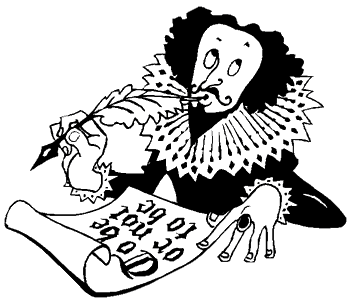
The Thinker, Shakespeare style

As some of you might know, I am working on notes for my own book about Shakespeare, an introduction to our beloved Bard and how to enjoy the plays. It’s a groundling’s guide to Shakespeare if you will. I do rather like that for a title.

As part of my research (and continuing education) I’m listening to various podcasts as well as reading books and academic papers. Of all of my research, I am finding the podcasts to be most informative. Sometimes I hear things mentioned, usually as an aside, that gets my imagination going. Unfortunately for me, this usually happens at work. I scribble myself a note for later use.

Some of the things I hear starts me down the path of speculation. Oh, if that is true, could this also be true? Of course, we know so little about the man we are left with a lot of holes to fill. Holes we should reserve for our own pleasure, our own entertainment value. Since we cannot prove anything, the path should be narrow and short so that we don’t venture into the wild weeds of conjecture.

I have to admit, musing on Shakespeare’s life is an entertaining intellectual exercise. When I start down the path, I find myself using my knowledge of history and Elizabethan social norms. Of course no intellectual exercise is complete without a little research. As I mentioned, the path is short, and I end up putting my thoughts aside for more useful endeavors. But I thought it would be fun to share some of my ideas as part of Shakespeare Week

I give you three What ifs about Shakespeare

I’ve taken many classes on Shakespeare and in each the subject of his relationship with his wife always comes up. Students, who hear about his gift of the second best bed in his will for the first time, assume this is a dig. They couple this with his move to London as proof that he did not love Anne. It is also assumed that Anne, being older and pregnant when they married, must have tricked him into it. This idea seems to be popular with male scholars too. In Shakespeare’s Wife, Germaine Greer argues that too many scholars paint Anne as a scheming woman who set a trap for poor young will as she is getting on in years (26 is old for women of her day). But what if it was the other way around? What if he talked her a relationship? What if it was Will, not Anne who pursued the relationship? What if he wrote this sonnet for her, as some scholars suggest?

Those lips that Love’s own hand did make,
Breathed forth the sound that said ‘I hate’,
To me that languished for her sake:
But when she saw my woeful state,
Straight in her heart did mercy come,
Chiding that tongue that ever sweet
Was used in giving gentle doom;
And taught it thus anew to greet;
‘I hate’ she altered with an end,
That followed it as gentle day,
Doth follow night, who like a fiend
From heaven to hell is flown away.
‘I hate’, from hate away she threw,
And saved my life, saying ‘not you’.

Scholars believe line’s 13 and 14 seem to be puns on Anne’s name. “hate away’ sounds very close to Hathaway, and “and saved my life” could be a play on “Anne saved my life”. If this were true, then we could say she did not like him at first, yet in the end, she “saved his life” by marrying him. This would offer us a new way of looking at their marriage.

Other scholars have pointed out that Sonnet writing would not come into fashion for another 9 years. This type of poetry was started by Phillip Sydney. But that doesn’t mean we should throw out the idea that Shakespeare wrote this for his wife. Who knows, maybe he wrote as an anniversary present?

Speaking of marriage, did you know young Elizabethan married men couldn’t be apprentices? I learned this from one of the many Shakespeare related podcasts I listen to. Sadly, I failed to note which one. It was an off-handed remark about Shakespeare’s early employment or lack of. I thought, wait a minute. This may tell us something; Shakespeare, having gotten married at 18 would have had difficulty in securing employment. What if this was the reason he left for London? Not because he wanted to get away, having just been through a shotgun wedding, but because his options were limited?

The Tudor “Poor Laws, enacted in 1536, says “male apprentice must be cared for until they reach the age of 21 or marry”. Okay, new path to follow, what if, at 18 Will either hated being an apprentice (he would have started at 14) or was finally being pushed to find employment with a master by his father, chose to get married instead? What would make a man leave his wife and children in the country for the big city? Fame, money? Possibly, or maybe he had no real prospects in the country. Or maybe he did want to get way from Anne….

He’s starting to sound like a jerk. Perhaps we should leave this path all together.

Speaking of sounding like a jerk…

One of the most talked about holes in Shakespeare’s life is the explanation for why he only left Anne the “second best bed” in his will. This has been debated ever since the will was found in 1747. Scholars, historians, and critics of Shakespeare have argued over the reason for this gift. Bonner Miller Cutting sifts through them all in his essay, Alas, Poor Anne: Shakespeare’s Second-Best Bed” in Historical Perspective. He argues that given what we know about Elizabethan wills and marriage laws, this was a deliberate dig by Shakespeare. He left his estates to his daughter Susanne and her husband John. Cuttings asks, “if Shakespeare wanted to ensure his wife was well cared for but not given the best of things, why not the second best house”? It is a fair question.

The question surrounding the “second best bed” has intrigued me for a long time. It is not something I think about a lot but once in while the question pops into my head. It wasn’t until I heard an episode of the History Extra podcast did I give it any serious thought.

The episode talked about the changes in childbirth; from medieval times to the present day. It was noted that during the Elizabethan era births were moved from the marriage bed to a birthing/sick bed. As houses became bigger, rooms were given over to the infirm. Women were advised to stay in bed for three day after giving birth in order to regain their health. What, if this second best bed was the birthing bed? What if, instead of being a dig at his wife, Shakespeare gave her the bed as a token of his appreciation for her as a wife and mother?

This is all speculation of course, but it does make our favorite playwright less of a jerk and more to our liking. And isn’t that the point? We speculate about Shakespeare’s life and fill in the holes as we see fit. We want him to be perfect, just as we view his work to be. But, in reality, he was human, and as such was complicated. What we really need to do is appreciate the work, and forgive his flaws.

Bonner Miller Cutting, “Alas poor Anne”

William Shakespeare, Sonnet 145

Joseph Tanner, “Tudor Constitutional Laws”

Amazing Waste

Repurposing Food and Reducing Waste

measurestillformeasure

Shakespeare, Classics, Theatre, Thoughts

Nerd Cactus

Quirky Intellect for the Discerning Nerd

Sillyverse

Stories of magic and mystery

Commonplace Fun Facts

Mind-Blowing Facts You Didn’t Know

Fictionophile

Fiction reviews, Bookblogger, Fiction book reviews, books, crime fiction, author interviews, mystery series, cover, love, bookish thoughts...

Patrick W. Marsh

monsters, monsters, everywhere

Shakespeare for Kids Books

Opening the door for kids to love Shakespeare and the classics

desperatelyseekingcymbeline

The 10-year Shakespeare New Year Resolution

Katzenworld

Welcome to the world of cats!

booksandopinions.com

The Book Reviews You Can Trust!

The Book Review Directory

For Readers and Writers

thelitcritguy

screams from the void

Author Adrienne Morris

Step Into the Past—Lose Yourself in the Story.

crafty theatre

ideas inspired by crafty characters

Critical Dispatches

Reports from my somewhat unusual life

The Nerd Nebula

The Nucleus of the Universe for all Nerd Hacks!