
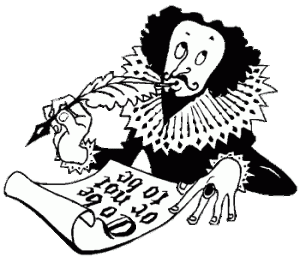
One of my favorite readers and someone I call friend, asked the questions “what are the best plays to use to introduce a neophyte to Shakespeare? Or someone turned off by bad experiences in high school or college?” It is a question I am asked a lot but one that I always struggle to answer. Literature, like all art is subjective. What speaks to me may turn you off. It’s hard to tell what will move someone else. Given that disclaimer, let’s go ahead and look at some of Shakespeare’s plays that may be the best way to introduce someone to his world.
Let’s start with reading. As I said yesterday, it’s okay to read Shakespeare and though you may not get a sense of how beautiful his words sound, you certainly will get a sense of how beautifully they flow. Whenever I recommend reading Shakespeare, I always suggest that the reader take a few passages and read them out loud. It’s something we learned to do in college; it helped the students get a sense of the poetry and word play that Shakespeare is so famous for.
Julius Caesar
Julius Caesar is one of the easiest plays to read. I read it (thought admittedly did not fully understand it) when I was 10. Antony’s “lend me your ears” speech moved my young soul and thrilled me to no end. I memorized the speech and was an annoyance to friends, family, and my teacher for months. I would stop and recite the speech at the drop of a hat. As I write this, a memory of me jumping on a playground bench comes to mind. I belted out the speech just to see if I could get the other kids to lend me their ears. But I am no actor. I am sure if they had tomatoes, I would have been human ketchup in no time.
JC is easy to follow as it has the simplest plot of all of the plays. A group of Roman senators are afraid the Caesar is becoming too powerful and will tip the balance of the Republic by becoming the ultimate authority over Rome. This plot allows the reader to contemplate the true meaning of justice and authority. While Shakespeare could have easily given us a play in terms of black and white/ good and bad, he instead offers us Brutes, one of the most conflicted characters of his cannon. Most of us live our lives trying to do the right thing, but with JC Shakespeare asks us to consider how we determine what the right thing is.
Macbeth
I’ve talked in the past about how Lady Macbeth’s hand washing led me to reconsider how I conducted myself in high school and beyond. As a young person who was unsure of who I wanted to be, her actions gave me pause; never would I do something that would stain my soul.
Reading Macbeth in high school reminded me that free will at times is an illusion. I think everyone in my English class instinctively understood that Shakespeare was showing us that absolute power corrupts absolutely. The language was a little daunting but nothing a young person couldn’t get through. Yes, when we first started reading it many students felt intimidated but by the time we were done I don’t remember anyone regretting having read it.
Hamlet
This is the first on my list that could be equally a great reading or viewing introduction. I included it here because I read it after I saw the play. Having watched Hamlet I still wondered what all of the fuss was about. It wasn’t my favorite of Shakespeare’s play until I read it. There are so many great lines, so many great moments that only a slow careful read gives us the full picture and you come to understand why this is Shakespeare’s masterpiece. But once you read it, seeing it performed is a must. It was chilling to hear Cumberbatch rebuke his former friend Guildenstern, as Hamlet realizes his “friend” is now Claudius’ spy.
Why, look you now, how unworthy a thing you make of me! You would play upon me. You would seem to know my stops. You would pluck out the heart of my mystery. You would sound me from my lowest note to the top of my compass. And there is much music, excellent voice, in this little organ, yet cannot you make it speak? ‘Sblood, do you think I am easier to be played on than a pipe? Call me what instrument you will, though you can fret me, yet you cannot play upon me.
Henry V
I first read Henry V as part of my master’s program. This happened to coincide with the BBC series “The Hollow Crown”, so we eagerly studied it in preparation of the show. It is very easy to understand, notes help with the historical facts behind the argument over Henry’s legitimacy but over all a wonderful introduction to Shakespeare. It has many over lapping messages and lessons. We looked at it as an allegory for the way in which politicians use the power of words as calls to action. We compared Henry’s speeches to modern leaders and found some things never change. Kennedy asked us to do more as if he was calling us to the breaches in order to get to the moon. Bush’s “you’re either with us or against us” speech could have been director to the governor of Harfleur. It’s the second play that I would suggest could also be used visually to introduce someone to Shakespeare. Though beware, most adaptations skip the awful scene of the dead boys killed by the French as they stayed in the camp. Any sympathy we may have had with the French King dies with the young men. Yes, Shakespeare tells us, war is hell.
Viewing Shakespeare can be a thrilling way to be introduced to his work, if and only if, the production is worthy of his words. A great actor can breathe life into Shakespeare’s poetry, bombast, and bawdy word play. Seeing Shakespeare for the first time is a thrilling event and can leave an audience member wanting more.
Much ado about nothing
This one is for the ladies. Any time a woman tells me she can’t get into Shakespeare a smirk appears up on my face. I ask her to watch Kenneth Branagh’s Much Ado About Nothing. Oh to see him and Emma Thompson fall in love despite their shared distain of such emotion is pure perfection. And then there is Michael Keaton as Dogberry. Is there anything left to say?
Hamlet
For all of the reasons I noted above, Hamlet is a must for any introduction to Shakespeare. If you can’t see it live, I suggest starting with Mel Gibson in the Zeffirelli film. I really wanted to like David Tennant as Hamlet, but I don’t think he was able to capture the agony and frustration as well as Gibson did. A really fun treat is to find Mystery Science Theater 3000’s riff on an old black and white German adaptation on Hamlet. But don’t let this be your introduction to Shakespeare.
As you like it
This is a very fun play and one that seems to be produced often enough that it should be easy to find locally. Rosalind is a strong female character and is arguably one of Shakespeare’s strongest characters. She takes charge of her circumstance as best she can while trying to navigate her way through the unknown. She is banished to the forest of Arden just as she is coming of age. College students can identify with her plight and marvel at her hesitation to fall for the first man who shows her some interest.
The play contains some of Shakespeare’s most well known quotes included the”7 ages of man” speech. Yes, all the world’s a stage, and in this play Shakespeare shows us how at times we all play different parts. It’s a feel good play that ends as we like it; with love and laughter.
A midsummer’s night dream
I’ve seen good productions and bad productions, but yet even the bad productions can be a life-changing event. This play like no other invites the audience to enter into a fantasy world in which fairies meddle in the affairs of men. Love and lust, we learn can and often overlap. We are forced to ask ourselves if we can really tell the difference between the two.
One of the best things about a live production of AMSND is the ending, when Puck makes the final speech
If we shadows have offended,
Think but this, and all is mended,
That you have but slumber’d here
While these visions did appear.
And this weak and idle theme,
No more yielding but a dream,
Gentles, do not reprehend:
if you pardon, we will mend:
And, as I am an honest Puck,
If we have unearned luck
Now to ‘scape the serpent’s tongue,
We will make amends ere long;
Else the Puck a liar call;
So, good night unto you all.
Give me your hands, if we be friends,
And Robin shall restore amends.
Works Cited
William Shakespeare Hamlet, Folger edition
William Shakespeare A Midsummer’s Night Dream Folger edition


 The View From Sari's World
You must be logged in to post a comment.