
Religion has been on my mind this last week. From Pope Francis’ view that humans, as God’s children are rejecting our parent, “When we exploit Creation we destroy the sign of God’s love for us”, to the Supreme Court’s ruling on marriage equality, and the Christian fundamentalist “the sky is falling” reaction to it, it would almost be impossible to think about anything else.
Perhaps this is why Eric Pyle’s book, “William Blake’s Illustrations for Dante’s Divine Comedy”, resonated with me. I picked it up as I have been meaning to read and review it for a few weeks now. McFarland Press, as part of Librarything’s Early Reviewer program, kindly sent it to me. I thank them both.
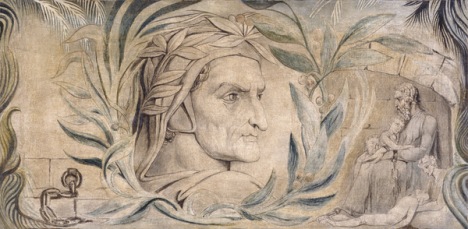
William Blake (1757-1827) was an early modern poet, artist, and theological philosopher. The last two years of his life was devoted to illustrating Dante’s epic poem. Blake’s works included watercolors and etchings. Sadly, he died before the work was complete, and tragically many of the finished products were either destroyed or edited after his death.
Pyle, a professor of Dante studies, collected copies of what remains of Blake’s work and his notes, and has produced a book that looks at both Blake’s criticism of Dante’s philosophy and his idea of the 9 circles of Hell. Blake lived during what we call the Romantic era, when artists and philosophers sought out social justice and fought against the idea of a cold soulless world. In many ways Blake’s drawings and accompanying notes updated Dante’s ideas of social injustice as seen through the Romantic point of view.
As I read the book and learned about Blake’s ideas, one thought stood out. It ties Blake to Dante and why the artist may have taken it upon himself to work on the project up to his dying day.
In one of his notes Blake writes about God and his handing the reins of good to his son and evil to Satan.
He (God) could have never have Builded Dante’s Hell nor the Hell of the Bible neither in the way our Parsons explain it. It must have been formed by the Devil himself. Whatever Book is for Vengeance for Sin and whatever Book is Against the Forgiveness of Sins is not of the Father but of Satan the Accuser and Father of Hell. (E.690)
Think about that for a second. What Blake is telling us is that evil, not love, created Hell and those who are unforgiving are part of this creation.
Pyle tells us that Blake “doesn’t think that a just God would send anyone to Hell for eternity.”(80) And, if I’m reading Pyle correctly, Blake believed that rather than creating an actual hell, humans construct hell out of their perception of good and evil. Unlike Dante, Blake believed not in a physical place but in an imagined Hell and that individuals condom themselves to it. But like Dante, Blake believed punishment reflects the evil actions. It gets a little deeper, but for brevity sake, let’s break it down to this, Blake believed that we create our own Hell, which can, depending on our perception of the world around us, show up as real and imagined social injustice while we are still living.
This self-styled Hell joins Dante’s lesson on self-responsibility and the type of punishment that follows when we “sin”. Yet it is the perceived social injustice this living Hell is what captured my attention. Let’s look at this a little more closely as it relates to the events of this last week.
It could be argued, by Blake’s ideas, that if you, as a fundamentalist Christian, truly believe that marriage equality will destroy your way of life, a personal Hell is forming in your mind. Your worldview becomes colored by the idea that there are threats or evil deeds going on all around you. As such, the way you perceive the world around you demands that you have locked yourself in a personal Hell; one that has you surrounded by “sinners”. This self-styled Hell is compounded upon by the intolerance, anger and hate you now feel. Let’s go back to Blake’s words; “Whatever Book is for Vengeance for Sin and whatever Book is Against the Forgiveness of Sins is not of the Father but of Satan the Accuser and Father of Hell”. By accusing others of sin, and acting to oppress the “sinners” are we not doing Satan’s work? Blake says yes and further more, by doing Satan’s work, we are creating a living Hell for ourselves, and society at large. It is when we find ourselves in such “dire” situations that we lash out and our personal hell bleeds out onto society. Perceived social injustice leads to actualized social injustice in the form of repressive laws and bigotry.
When we view the world as a scary place it manifests as a scary place, just as it becomes filled with wonder and awe when we are filled with love. Our perceptions become self-fulfilling; it is our choice to live in either Heaven or Hell. So instead of worrying about how others live, or trying to keep others down, wouldn’t it be better to look inward, to find some measure of peace so that we aren’t condemning ourselves to Hell?
Pyle, Eric. William Blake’s Illustrations for Dante’s Divine Comedy. Mc Farland Press 2015.

 The View From Sari's World
You must be logged in to post a comment.