Surprising poetry inspired by Shakespeare

We know that Shakespeare’s influence can be felt throughout the Western Cannon. We find his work in everything from novels, plays, movies, operas, and classical music pieces. Being England’s greatest poet, it can be of no surprise to find he inspired later poets, who often paid tribute to him in their works. Keats, Alexander Pope, and Wadsworth openly admitted their admiration in letters and poems.

As I read through Shakespeare in America, a collection of essays and poems written by American scholars and writers, two pieces stood out. Not so much for the content, but the authorship. One was written by a very American writer and the other, by a man forced to assimilate into the America culture. These two men stand in stark contrast yet are united by their admiration of Shakespeare.

Herman Melville wrote Moby Dick, one of the greatest American novels. His themes of man vs. nature, greed, obsession, and naïve belief in one’s own abilities against all odds are quintessentially early American values. The country was founded on these very ideas. Yet Melville lived during a time when the country was tearing itself apart due in large part because of these very ideas.
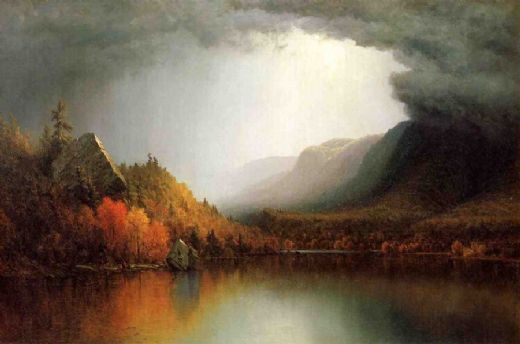
Sanford Robinson Gifford A Coming Storm

This picture “A coming Storm” was painted in 1863, right in the middle of the American Civil War. Herman Melville viewed it at the National Academy exhibition in Manhattan shortly after the assassination of President Lincoln. What struck Melville was the fact that the actor Edward Booth, brother to John, the very man who had murdered the President, owned the painting. Melville must have been in a very depressed mood and seemed to project his feelings onto Edward Booth. Melville’s poem suggests that Edward saw in the painting a kind of coming national storm, a tragedy in the making much like what was foreshadowed in Hamlet

Coming Storm

A Picture by S.R. Gifford, and owned by E.B.

Included in the N.A. Exhibition, April, 1865.

All feeling hearts must feel for him
Who felt this picture. Presage dim–
Dim inklings from the shadowy sphere
Fixed him and fascinated here.

A demon-cloud like the mountain one
Burst on a spirit as mild
As this urned lake, the home of shades.
But Shakspeare’s pensive child

Never the lines had lightly scanned,
Steeped in fable, steeped in fate;
The Hamlet in his heart was ‘ware,
Such hearts can antedate.

No utter surprise can come to him
Who reaches Shakspeare’s core;
That which we seek and shun is there–
Man’s final lore.

In contrast to Melville is Maungwudaus, a Chippewa Native American, whose identity as an American was not something to be celebrated. His name, Maungwudaus meant “Great Warrior” yet like most young Native’s he was indoctrinated into the American culture by forced schooling. He would eventually give up his birth name and take the very English name of George Henry. But before he became completely Americanized, he traveled throughout Europe, performing tribal customs in front of large audiences with the optimism that this would gain sympathy and understanding for the Native people.

Here was a young man who could have been bitter and hold the Western world in utter disdain and contempt. Who would have blamed him? Yet, for all that was done to him and his people, he felt a connection to Shakespeare. He most certainly was introduced to Shakespeare at school. And though Shakespeare is very much a product of his Western upbringing, there is something universal in his words. Maungwudaus felt some connection to the poet despite the span of time and culture identity. We know Maungwudaus and his friends deeply admired Shakespeare and saw something of themselves mirrored within his work. We know this from a short but very moving poem.

While in England in 1848, Maungwudaus and his performing troupe visited Stafford-upon-Avon. They all signed their names in the visitor’s book at Shakespeare’s birthplace, but Maungwudaus was moved to act beyond simply visiting the site. He penned a poem that very day and then had it printed on a small pamphlet. How many he made and for whom he made them remains a mystery. The poem would have been lost to history had it not been for James McManaway, a scholar working with the Folger Shakespeare Library. Around 1948, MacManaway found a copy of the poem and traced its origin. Sadly, no original printing of the poem has ever been found.

It is not the best poetry to be sure, but it speaks to us, and compels us to consider just how far reaching Shakespeare’s work is. He inspires across cultural divides. This is the power of Shakespeare. Is it any wonder he continues to inspire us today?


Indians of North America

Heard the name that shall not decay.

They came and saw where he was born,

How great is the sound of his horn.

They respect and honor his grave

As they do the grave of their brave;

Rest thou great man under these stones,

For there is yet life in thy bones.

Thy spirit is with Mun-nid-do,

Who gave thee all thou didst do:

When we are at our native home

We shall say “we have seen his tomb”


J. Shapiro, Shakespeare in America

Finding Shakespeare, Chief Maungwudaus visits the Birth-Place http://findingshakespeare.co.uk/chief-maungwuduas-visits-birthplace-1848
Words, words, words What opening lines tell us

700-00085036

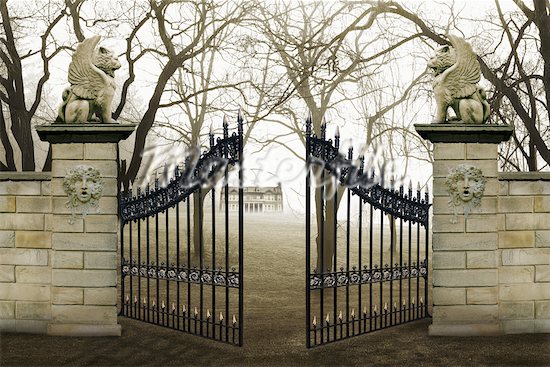
I bet I can guess something about you. As a reader, first lines are important to you. In both literature and theater, we view first words as the opening gates into another world. As lovers of literature we yearn to cross the threshold beyond gates, and eagerly do so if the gates look inviting enough.

How do these gates entice us? What makes for a good opening line? For some, the words are so masterfully crafted that we can’t help but to read more. Take Gabriel García Márquez’s, One Hundred Years of Solitude opening line:

Many years later, as he faced the firing squad, Colonel Aureliano Buendía was to remember that distant afternoon when his father took him to discover ice.

Though we are warned this is a sad story, we are drawn into Márquez’s world by his sublime gift of storytelling. We understand and accept his challenge to our emotions because of the power of his words.

Some opening words compel us to cross the threshold if for no other reason than for the sake of curiosity. Here’s Samuel Beckett’s, Murphy, opening line:

The sun shone, having no alternative, on the nothing new.

I don’t know about you, but I have to know where Beckett is going with this. Ten words, just ten words, yet they beg many questions. Is this world so depressing that even the sun is melancholy? Or, is the sun trapped by fate; having no say it what it does? It shines because it has to, there is no other choice. And what is this place of “nothing new”? Perhaps this world is locked in a cycle of sameness, with little or no hope to escape the boredom and fatigue that these words hint at. Brave readers will have no problem entering this world. There is something oddly seductive yet sinister about this first line. As I sat and contemplated them, a vision came to mind: I saw an rundown, dusty carnival tent flap being held open by a grinning man wearing black, promising wondrous sights and sensations. Or, will it be nightmares and horrors?

There is more to the power of opening lines. Skillful writers can use them to set the stage. A good author, using just a few words, will instruct us as to what is in store; calling on us to pay attention to what we are about to read or see. Here is one of literature’s most famous opening lines

Two households, both alike in dignity, in fair Verona, where we lay our scene, from ancient grudge break to new mutiny, where civil blood makes civil hands unclean.

In case you haven’t guessed, this is from Shakespeare’s Romeo and Juliet. Here audiences are being warned that this will be a tragedy. These words ready us enter a world in which old wounds, not quite healed, will open up to rip anew. Oh, there will be blood!

As the play unfolds and battle lines are drawn, we the audience, try in vain to figure out who to side with. Do we offer our loyalties and sympathies to the proud and rash Montagues,or do we side with the noble yet oddly blind Capulets? Which is right?

Shakespeare knows all too well that his audience will struggle with this question. He, after all, is the master of human nature. That we will pick a side is an issue he deals with from the very start of the play. Shakespeare warns us not to do this in the first six opening words: Two households, both alike in dignity.

Shakespeare is telling us that we will see two sides, yet we should not pick one over the other, as both are equally worthy of our consideration and respect. He is telling us, in this particular play, there is no right or wrong. There is no good verses evil. These are two families that will be torn apart. And as they are alike in dignity they are equally alike in blame. By the end of the play, we realize both deserve our sympathy and scorn.

I am awed by these first six words. That it only took six words to tell us so much about the play. Break it down into four and it is even more awe inspiring; both alike in dignity. Shakespeare seems to be reminding us that there is no difference between these two families, and by extension, no difference between families in general. We know this, because this is what the play is about. It is about two normal families who struggle to navigate a world that demands adherence to social norms and traditions, no matter the cost. This was Shakespeare’s world. Class structure may have been a barrier between the wealthy and working class, (illustrated by the wall surrounding the Capulet’s garden) but yet we are asked to observe that each of these two families are alike in dignity. These two families represent traditional families, in the sense that there is nothing special about them. Shakespeare’s audience would have easily recognized themselves mirrored in the Capulets and Montages.

Shakespeare wrote these lines to remind his audience that these two families deserve our attention in equal measure; that there is no good guys or bad guys. And in a broader sense, all families are like in dignity. And that what we are about to watch cannot be judged on who is right, and who is wrong. Each deserves equal consideration. What a powerful opening message. Leave it to Shakespeare to master the art of first words.

Opening lines invite us to enter into new worlds by enticing us with their beauty. Yet many times they offer us fair warning of what we are about to see. We need to pay attention to the etchings on the gates so that we fully appreciate where we are going and what we are about to see.

Amazing Waste

Repurposing Food and Reducing Waste

measurestillformeasure

Shakespeare, Classics, Theatre, Thoughts

Nerd Cactus

Quirky Intellect for the Discerning Nerd

Sillyverse

Stories of magic and mystery

Commonplace Fun Facts

Mind-Blowing Facts You Didn’t Know

Fictionophile

Fiction reviews, Bookblogger, Fiction book reviews, books, crime fiction, author interviews, mystery series, cover, love, bookish thoughts...

Patrick W. Marsh

I write literary horror - poems, short stories, and books

Shakespeare for Kids Books

Opening the door for kids to love Shakespeare and the classics

desperatelyseekingcymbeline

The 10-year Shakespeare New Year Resolution

Katzenworld

Welcome to the world of cats!

booksandopinions.com

The Book Reviews You Can Trust!

The Book Review Directory

For Readers and Writers

thelitcritguy

screams from the void

Author Adrienne Morris

Step Into the Past—Lose Yourself in the Story.

crafty theatre

ideas inspired by crafty characters

Critical Dispatches

Reports from my somewhat unusual life

The Nerd Nebula

The Nucleus of the Universe for all Nerd Hacks!