Oh how I wish I had thought of this, but alas, a wittier soul came up with it. Not only is this a brilliant take on Hamlet’s speech to his mother, Rei, manages to sneak some additional Shakespeare inspired ranting text.
HAMLET/ Rei Toei
Look here, upon this picture, and on this,
The counterfeit presentment of two brothers.
See, what a grace was seated on this brow;
Hyperion’s curls; the front of Jove himself;
An eye like Mars, to threaten and command;
A station like the herald Mercury
New-lighted on a heaven-kissing hill;
A combination and a form indeed,
Where every god did seem to set his seal,
To give the world assurance of a man:
This WAS your President.
Look you now, what follows:
HERE is your president; like a mildew’d ear,
Blasting his wholesome brother. Have you eyes?
Could you on this fair mountain leave to feed,
And batten on this moor? Ha! have you eyes?
You cannot call it love; for at your age
The hey-day in the blood is tame, it’s humble,
And waits upon the judgment: and what judgment
Would step from this to this?
Sense, sure, you have,
Else could you not have motion; but sure, that sense
Is apoplex’d; for madness would not err,
Nor sense to ecstasy was ne’er so thrall’d
But it reserved some quantity of choice,
To serve in such a difference. What devil was’t
That thus hath cozen’d you at hoodman-blind?
Eyes without feeling, feeling without sight,
Ears without hands or eyes, smelling sans all,
Or but a sickly part of one true sense
Could not so mope.
O shame! where is thy blush? Rebellious hell,
If thou canst mutine in a voter’s bones,
To flaming youth let virtue be as wax,
And melt in her own fire: proclaim no shame
When the compulsive ardour gives the charge,
Since frost itself as actively doth burn
And reason panders will.
I am eternally grateful to Rei for allowing me to post this. And for taking the time to make us all laugh and think at a time we may want to just curl up and cry.
Give sorrow words; the grief that does not speak knits up the over wrought heart and bids it break. Macbeth
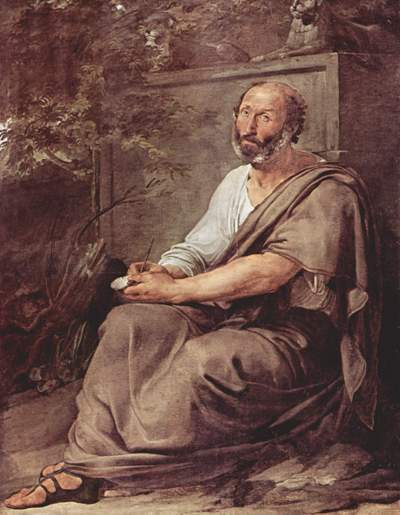
I think this painting of Aristotle looks a little like Shakespeare
As part of my graduate studies I was assigned various contemporaries of Shakespeare, and of those whose came after him, but for some unfathomable reason we were never assigned Aristotle. This is a shame because his lectures, gathered together in a book titled Poetics, is the blueprint for Shakespeare’s tragedies. In my mind it is a must read for any student of Shakespeare.
I just recently picked up the book after reading a reference to Aristotle’s criticism on Greek theater. I am very familiar with Aristotle as a philosopher, having studied philosophy as an undergrad, but had never heard of his work as it relates to drama. I suppose this work should come as no surprise as Aristotle had an opinion on everything from biology to the supernatural.
Eugene Garver, editor of Barnes & Noble’s edition of Poetics tells us: Tragedy came into existence in Athens along with democracy in the late sixth century. Performing and watching a tragedy were political acts, part of the celebration of a festival in honor of the god Dionysus.
Aristotle, being politically minded, reflected on tragedy in drama precisely because it was every man’s civic duty to engage in this type of theater. In fact in Aristotle’s day the theaters of Athens could easily hold 3,000 people. All men were expected to attend; the young men about to enter into military duty served as the chorus, while the war veterans served as the audience. No mention if women were expected to attend.
For the Greeks, tragedies served a duel purpose; they brought the citizens together to share a common experience, and in sharing that experience, were collectively learning a valuable life lesson. A reminder that character flaws led to the downfall of society. Part of the glue that held society was the idea that all things achievable should be done for the greater good. The Greeks had a name for those who whose achievements served only themselves; Pleonexia, which translates to mean “over-reaching ambition or greedy”. It was thought that the Gods punished these people, as pleonexia was a vice that they would or could not over-look. So tragedies served as imitations (Aristotle’s word) to warn men not to succumb to this vice. Aristotle expanded on this idea and outlined what made for a good tragedy.
Aristotle’s formula for tragedy
Tragedies have to contain a unity of time, place and action. The action should take place within a single 24-hour period.
The plot is the soul of the tragedy. Characters are dimensions of the object of imitation, and are subordinate to the plot. The plot drives them, though it is their flaw that allows this to happen.
Tragedy has a beginning, a middle, and an end,and has to contains a discovery and reversal.
Tragedies are caused by a tragic flaw, which is done by a tragic hero.
The experience of a tragedy causes a catharsis, the purging of pity and fear.
This list is important to Aristotle because in his words, “Knowing what kind of thing a given work of art is enables you to know what is essential and critically important to it and its evaluation”.
In my mind, this is genius take on all most all forms of literature. How many times have you watched or read something, not as it was meant to be presented, but through your personal bias and thought, “Oh this is crap”? It goes against how we usually experience art, yet it makes perfect sense! When we evaluate something we do so through our own personal experiences and expectations. Aristotle tells us to look at a piece for what it is supposed to represent, and evaluate it to see if it has elicited the proper response.
Shakespeare may not have kept to Aristotle’s list, but he was the master at making sure his tragedies provoked the proper response. He used a lot of what Aristotle had to say about tragedies, and to some extend, comedies in order to achieve a certain respones. Aristotle divided the two thusly: Tragedies depict people who are better than we are, while comedies represent people who are worse. This may seem harsh, but when is the last time you saw a Hollywood comedy based on wealthy people? True, modern tragedies can depict the every man, but in every case, the man in question is noble but flawed.
Shakespeare’s England was not democratic. As the country leaned towards Protestantism, Catholic morality plays gave way to drama as a pure form of entertainment. It was up to the English playwrights to look beyond religious lessons and define what made for a good play. Society was suspect of actors and playwrights; they were deemed by many to be immoral and spiritual corrupt, so it made sense that writers like Johnson, Marlowe, and Shakespeare made use of tragedy as a new form of morality plays. Getting superstitious people to fill play houses night after night may have been easier if they thought they may experience some type religious lesson. The beauty of Shakespeare’s tragedies is that everyone can identify with his flawed characters, though each are “better than we are”.
Shakespeare drew on the human condition that we all suffer from, and gave his characters flaws that mirror our own. Othello’s passionate nature surprises even him, and he is unable to fully understand and control this new emotion. Macbeth is ambitious and cannot find where to draw the line. Lear is too rash and is in serious need of some self-awareness. Hamlet is too melancholic and wrapped up in his own head; so much so that he reacts impulsively to each new situation. And though Juliet admits her love and marriage to Romeo is “is too rash, too unadvised, too sudden”, she is swept up in her emotions and allows them to rule her mind. We’d be dishonest if we didn’t admit to feeling a few of these emotions ourselves.
If we view Shakespeare’s tragedies for what they are, we can begin to appreciate the emotional impact he was aiming for. We may even experience catharsis, in that we are able to experience the suffering of flaws without a personal loss. We experience the purging of pity once the play is over, and if open to a lesson, may purge a fear that we too could suffer the same fate.
After reading Poetics is seems evident that this was a book also read by Shakespeare. You can almost hear Aristotle point towards Shakespeare when he talks about the proper use of language, “By language embellished, I mean language into which rhythm, harmony and song (meaning verse) center”. Because Shakespeare used Greek mythos in many of his works, one could take Aristotle’s examples and substitute them with characters found in Shakespeare’s plays.
I am not sure Aristotle would have approved of everything Shakespeare did with his formula but in the end I have to think that even he would approve of the plays outcome, provided he could take his own advice and evaluate them on for what they are supposed to be. It would be tragic if he could not.


 The View From Sari's World
You must be logged in to post a comment.