If it wasn’t for Shakespeare… Young Lust

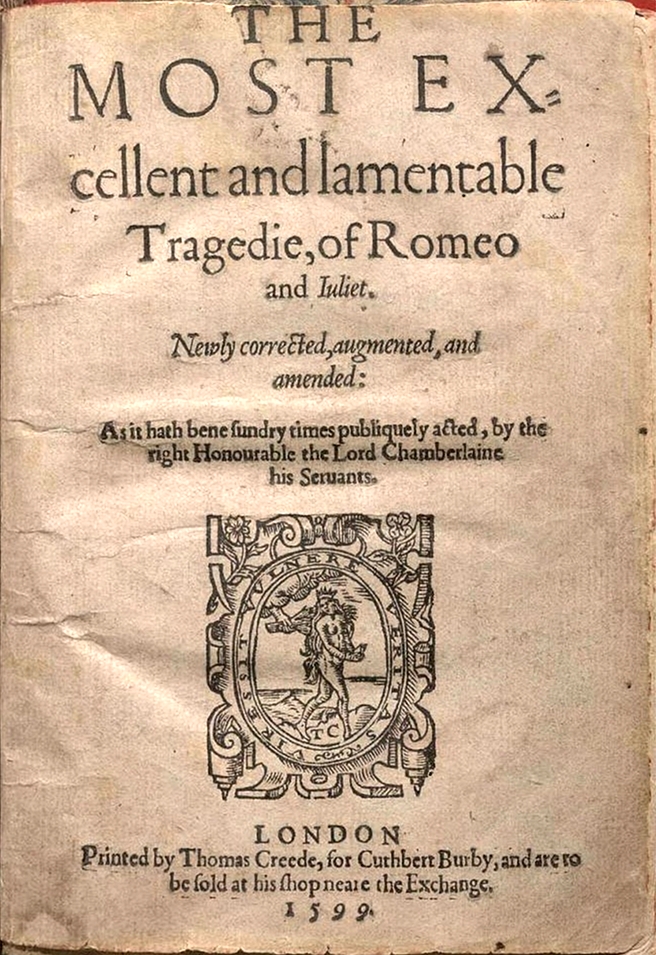
Screen-Shot-2012-05-04-at-12.04.51-PMRomeo_and_Juliet_Q2_Title_Page-2If it wasn’t for Shakespeare we wouldn’t alternatively celebrate and make fun of teen angst. Shakespeare dared to show the danger of young lust in his play Romeo and Juliet. Romeo and Juliet have become emblematic of young lovers and doomed love. Against all odds Romeo and Juliet fall in love with tragic consequences. With disapproving parents (what do they know!) and social norms standing between them, the young lover show the world what “true love” can overcome. Yet, their love is what leads to their downfall.

Critics argue over whether Shakespeare is showing young folly or whether he is demonstrating the power of love over political fractions. Are we doomed to fate because who we are, or are we doomed to follow our passion, even at our own peril? Are we better off following the rules or following our hearts?

Many critics see this play as a look at the flip side of male aggression and see Romeo’s love for Juliet as a sickness. When we first meet him, Romeo pines for Rosaline a woman who does not share his feelings.  Romeo’s relationship with Rosaline is passive.  He never speaks to her or takes any decisive action to woo his lady love.  He spends his time in anguish, wavering between simplistic adulation and utter despair.  Furthermore, Romeo spends a great deal of time in limbo, mooning over a woman who does not reciprocate his feelings.  Despite Benvolio’s urging, the lovesick teen will not move on or consider the merits of other women.
Romeo follows Rosaline to a party hosted by the Capulet family, sworn enemies to his own.  However, while there, he sulks moodily and refuses to partake in the festivities.  He isolates himself from the merrymaking both socially and physically in his refusal to dance and banter with Mercutio.  Romeo spends his time, not pursuing Rosaline, but despairing: “Under Love’s heavy burden I do sink.

Despite Romeo’s great declarations of love for Rosaline, his feelings are actually fickle, as shown by his behavior when he spies young Juliet.  He is smitten at first sight, saying, “Beauty too rich for use, for earth too dear!” (I, ).  This  is in sharp contrast to how he speaks of Rosaline.  Rather than objectifying Juliet as he does with Rosaline, he holds Juliet in  awe, “Did my heart love till now?  For swear it, sight!/ For I ne’er saw true beauty till this night (I, ).  With this, Rosaline is forgotten and Juliet becomes Romeo’s target.

Unlike how he acts towards Rosaline, Romeo actively pursues Juliet right from the start. Upon meeting, he tries to woo her and win a kiss.  Despite learning Juliet’s identity as a Capulet  Romeo ignores the feud and commits himself to Juliet.  When Juliet asks “Art thou not Romeo and Montague?” (II, ii ), Romeo pledges to deny his lineage to be with his new love and says, “My name, dear saint, is hateful to myself/ Because it is an enemy to thee” (II, ii, ). Social norms be damned! Unapproving parents be damned.  Realizing that their lust for each other is sincere, Romeo presses Juliet for vows of love, though they have just met. Romeo convinces Juliet their love is true and the two sneak off to marry.  Romeo aggressively both woes and pushes Juliet into a hasty relationship. His superficial notions of love drives his actions once he meets Juliet. He must conquer her and in doing so is blinded by passionate rage. His killing of Tybalt shows us Romeo is not yet mature enough to be in such a complicated relationship. His love sickness the the driving force behind his aggressive behavior.

That the two lovers are convinced they cannot live without the other is yet another sign that these two are not yet ready to experience a complex relationship. As grownups we role our eyes as we watch as Romeo holds his “dead” wife

For fear of that, I still will stay with thee,
And never from this palace of dim night
Depart again. Here, here will I remain
With worms that are thy chamber maids. Oh, here
Will I set up my everlasting rest,
And shake the yoke of inauspicious stars
From this world-wearied flesh. Eyes, look your last.
Arms, take your last embrace. And, lips, O you
The doors of breath, seal with a righteous kiss
A dateless bargain to engrossing death. (1115-124)

Yet, how many of us can honestly say we did not feel as these two did in our younger days? Romeo and Juliet, despite it’s complex themes and tragic ending is one of the worlds most beloved love story.


Why we read, part 2


remembrance-of-things-past

Have you ever found yourself disagreeing with a fictitious character’s actions based on your experiences and or culture? Or judging their decisions because it is something you would never do?

While I shouldn’t say this is wrong for the everyday reader (but I think it is) I will say it is wrong for those of us who have chosen the path of higher education, at least as it pertains to the humanities. We humanities majors have committed ourselves to studying more about the world so that we may learn among other things, empathy and understanding. We have committed ourselves to not just learn about people and events, both past and present, but from other people as well. We are not to sit in our ivory towers tossing our chamber pots over the heads of anyone passing that we find culturally unappealing or acting in ways that do not fit our understanding of the rules of social engagement.

Sadly, not everyone who decides to earn a humanities degree understands this. Yet this lack of understanding keeps them from the beauty and heartbreak of those different from themselves.

I am currently taking a class titled “Non-western lit”. The name says it all. We are reading a novel a week (which is why my blogs have been few and far between) from authors outside of our western culture and cannon, with the understanding that we are to read from their point of view. In other words, we are to drop our Orientalist and post-colonial views, and see the world through the eyes of the characters presented to us.

There is a woman in my class who, despite being a self professed world traveler, refuses to see the non-western world as it is but instead comments on behavior that disgusts her. She sits in judgment as if all people walk the same path and have the same life experiences as her.

Take for instance, Jhumpa Lahiri’s Pulitzer Prize wining, interpreter of maladies. In this beautifully written but heart wrenching collection of short stories there are people who make decisions or do things that may not make sense if we look at them from the western perspective. Some of the stories contain characters that we can identify with even if we do not agree with their behavior.  But just because we do not agree with them does not mean we in a position to judge them. Yet, at every turn this woman will blurt out, “My husband would never do that”, or, “my husband would never act that way”.

The story When Mr. Pirzada comes to dine”, is a perfect example of what this woman is missing as she sits in judgment. Mr. Pirzada (a professor we assume) comes to America to study botany on a government scholarship.  While he is in America an Indian couple and their daughter befriend him. While he is in America the Pakistani army invades Mr. Pirzada’s home country of Dacca. The couple and Mr. Pirzada sit night after night watching the news for any signs of hope as they watch teachers being dragged out of their homes and shot in the streets. Mr. Pirzada clearly cannot safely return home to his wife and six children.

The theme of this story is family. The ones we have and the ones we make. This unnamed Hindu couple takes in Mr. Pirzada, a Muslim, in because they share a cultural heritage.  And, even though Hindus and Muslims have been at each other’s throats for hundreds of years, the couple become his surrogate family in a time when he needs family the most.  This is what we were supposed to get from the story.

What did my aforementioned classmate complain about? That Mr. Pirzada did not return home to his real family! She asserted, “Her husband would never do that!” When I asked if her she and her husband had ever lived a country that was ravaged by war, she admitted they had not but held firm in her conviction that her husband would return to her if  he found himself in this situation. When our professor asked her how Mr. Pirzada was supposed to fly home during an invasion, she became silent but unconvinced that Mr. Pirzada did the right thing by staying in America until it was safe to return. My classmate was focused on the theme of family responsibility, but her absolute stance on what her husband would do, blinded her to beauty of the story.

A part of me understands why my classmate talks about her husband so often. He passed on two years ago, and clearly there is a hole she needs to fill. By remembering him as the perfect husband, she can cling to her past, as the present may be too painful for her. I don’t know. I feel for her, yet there are days I want to shake her and remind her of our commitment to grow, not from the experiences we have had, but from the ones we haven’t. What stops me is my willingness to step back and try not to judge her too harshly. As bad as I feel bad for her loss, I feel equally as bad for what she is continually loosing; a chance to grow as a person.

The next time you find yourself at odds with a character’s behavior, remember the author is not asking you to sit in judgment, rather you are being asked to understand based on the information you are being given. Allow you to learn and grow. After all, isn’t this why we read?

Amazing Waste

Repurposing Food and Reducing Waste

measurestillformeasure

Shakespeare, Classics, Theatre, Thoughts

Nerd Cactus

Quirky Intellect for the Discerning Nerd

Sillyverse

Stories of magic and mystery

Commonplace Fun Facts

Mind-Blowing Facts You Didn’t Know

Fictionophile

Fiction reviews, Bookblogger, Fiction book reviews, books, crime fiction, author interviews, mystery series, cover, love, bookish thoughts...

Patrick W. Marsh

monsters, monsters, everywhere

Shakespeare for Kids Books

Opening the door for kids to love Shakespeare and the classics

desperatelyseekingcymbeline

The 10-year Shakespeare New Year Resolution

Katzenworld

Welcome to the world of cats!

booksandopinions.com

The Book Reviews You Can Trust!

The Book Review Directory

For Readers and Writers

thelitcritguy

screams from the void

Author Adrienne Morris

Step Into the Past—Lose Yourself in the Story.

crafty theatre

ideas inspired by crafty characters

Critical Dispatches

Reports from my somewhat unusual life

The Nerd Nebula

The Nucleus of the Universe for all Nerd Hacks!