Medieval Cats – Did She Call Macbeth a Pussy?

For International Cat Day, I thought I would dredge up a 2013 (where does the time go?) post on cats. Yes, there will be a new post soon, but for now let’s celebrate medieval cats!

I have a love/hate relationship with cats. When I was in my twenties I adored cats and often would own one or two. As a matter of personal trivia, one of the ways my then boyfriend (now ex-husband) got me to move in with him was a promise of letting me own a cat. I adopted a stray who wandered into work one day. CJ was a sleek black and white cat with whom I quickly bonded. Sadly, a car hit CJ about 6 months after I rescued him.

Next came Max. Max was a smart gray cat who loved to cuddle as well as wander the neighborhood. My boyfriend and I lived off a busy street in a converted barn that backed up against a large field. Max should have been content with the field but sadly he too met his demise on the busy street near hours. He lasted four months.

The next one, whose name escapes me, convinced me that I must be a terrible cat owner. It quickly became apparent my cats would rather commit suicide than live with me. The third cat only lasted a few weeks. My boyfriend and I got married and I decided to have a child, rather than pet; that is, only after we fenced in the yard!

Jump to 2009. I had to put my beloved dog down due to cancer and decided I’d had enough of pets. My son felt othe wise and begged for a cat. I told him about my experience as a cat owner or cat killer as it was, but he continued to beg and plead. I relented, secretly sure we would not have a cat around for long and by the time he went off to college, I would be child and pet free. It’s now 2013, and Cookie the tabby cat and I share this house. I am quite sure she is still here because of her neurotic nature. She is too damn scared to venture far from home. Sigh, just my luck I am stuck with a freaky cat. She is the type of cat who will come mew and rub against you, only to rush off, tail held high, at the slightest stroke to her fur. I honestly don’t know if she wants attention or suffers from a bi-polar mental disorder.
images-1

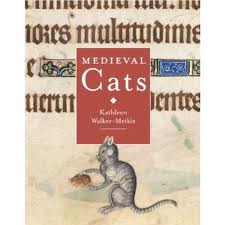
Medieval Cats by Kathleen Walker Meikle is one of the newer books in my collection. It had been on my Amazon wish list for a couple of years before my son bought it for me as a Christmas present this last year. It is a collection of pictures of cats found in medieval manuscripts with a little medieval cat trivia thrown in. The pictures alone are worth picking up the book; it would make a nice small coffee table book. The trivia may not win a round on Jeopardy, but it’s still worth reading.

Medieval cats were used as mousers, pets and fur. According to the sumptuary law of 1363, cat, lamb, rabbit and fox were the only type of fur allowed for gentlemen under the rank of knight. It seems abandoned cats were the primary source of fur.

images

The most common English name for all tomcats was Gyb, but some unimaginative people named individual cats Gyp. I know people like this, they name their cat “cat”.

Meikle tells us “Cats were often associated with the monastic order, perhaps due to their contemplative and quiet nature”(31). This could be why we see them in so many manuscripts.

We know that the reputation of Medieval cats were not always kind. They were sometimes seen as the devil’s aid. Witches were believed to commune with the dark lord through cats. Knowing this, it was surprising to learn that many high born ladies had a fondness for pet cats.

My favorite part of the book was the connection between cats and literature.

images-3

Cats appear in proverbs, as the one attributed to John Grower. He writes in his Confesio Amantis “As a cat would eat fishes, without wetting his paw. This is what Lady Macbeth is referring to when she says; “like the poor cat i’ the adage”, meaning wanting something but not willing to do what is necessary to get it. She is calling out Macbeth as a pussy.

images-4

We even find myths about cats in The Canterbury Tales. The Wife of Bath says that one of her former husbands described her thusly”

You said also I was like a cat; for a cat, if someone were to singe the cat’s skin, will always dwell at home; but if she were sleek and elegant in her fur, she will not remain in the house an hour, but before any day would dawn, will go forth to show her skin and go a-caterwauling. This is to say, sir rogue, if I am finely dressed, I will run out to show my clothes.

Come to think of it, I have friends like this too!

After reading this book, I am eager to find other books that Meikle has written. But I have promised myself they will stay on my wish list until I am done with the books I have.

Next up: Witches Werewolves and Fairies; Shapeshifters and astral doubles in the Middle Ages by Claude Lexouteux

Shakespeare’s Kings or how to understand the war of roses over a hollow crown

The War of the Roses

If you live in the U.K. I bet you are well aware that the award winning series “The Hollow Crown” part 2 The War of the Roses” is being telecast right about now. If you are not aware this may help explain why all of the young girls are giggling and staying home; Benedict Cumberbatch is playing Ricard III.

This production is a series of some of Shakespeare’s English history plays. In chronological order of setting, these are: Richard II, Henry IV Parts I and II, Henry V, Henry VI Parts I, II and III, Richard III. But if we look at the order of when they were written we see that Shakespeare may not have had a series in mind.

Henry VI part II 1590

Henry VI part III 1590

Henry VI part I   1591

Richard III          1592

Richard II           1595

Henry IV part I  1597

Henry IV part II 1597

Henry V               1598

Looking at the order above, we may wonder just what it was Shakespeare had in mind. But if we keep in mind that his primary focus was the stage, not history, we can guess that for Shakespeare the story was thing. Knowing that Henry VI part II was written first it seems to me (and this is just an educated guess) that Shakespeare wrote the plays in response to current events or in order that he found the subject matter fascinating, maybe a little of both.

Thankfully for modern audiences the plays are presented in chronological order. I say thankfully because at times they can be hard to follow, especially the Henry VI plays. I cannot imagine trying to piece the narrative together if I had to watch them in order that they were written. But to be completely honest for many Americans Shakespeare’s history plays are hard to follow no matter the order. Here’s the rub; as much as we may adore Shakespeare’s work, his history is not our history. We don’t study English history unless we seek it out in college or become armchair historians. Many of the characters and events depicted in the history plays are all we have to go on. For many these plays represent our first window view into medieval England. But the window is cloudy and at times we are unsure of what we are seeing.

I was an armchair historian before I went back to school. I fell in love with the medieval Europe and as an undergrad studied the period in which the Catholic Church became the center of politics. Even so, I had questions the first time I saw Richard II. Why was he so hated? Why was it so easy for Henry Bolingbroke to take the crown? Who were all the players in the Henry VI series and more importantly, was Shakespeare true to history?

Now with renewed interest in the Hollow Crown series, I decided it was time to do some reading.

Touchstone Press  1990
Touchstone Press
1999

I’ve had John Julius Norwich’s book “Shakespeare’s Kings” on my bookshelf for about a year. I picked it up last week in the hopes that it would answer some of my questions and further my education on medieval kings. I wish I had read it earlier.

Norwich’s book could easily be a guide to the Hollow Crown series. Norwich begins his book not with Richard II but with Edward III, a play that some earlier scholars argued that Shakespeare helped write. Today’s scholars are slowly coming to the same conclusion, though I remain unconvinced. The prose seems sloppy and lacking in depth. Yet the inclusion of Edward assists Norwich as he attempts to paint on a broad canvass. Edward is the jumping off point to Richard’s reign as King and helps explain why it is Richard was such a disappointment.

Norwich is a fine narrator. His retelling of history is engaging and informative. As a historian he does not fall into the easy trap of extrapolating facts to fit his idea of history or seeks to understand it in modern context. I was sucked into the each King’s story and never once questioned Norwich’s conclusions (he has none) or questioned his motive. This is a clean narrative and a history book that is exactly what it claims to be; a historical look at some of Shakespeare’s kings. It is rare to find such a book now days.

Norwich lays out the historical events that shape each play, one by one. Each King is then subjected to Norwich’s summary of the play in question. He breaks them down act-by-act, pointing out inaccuracies and complete fabrication. Like he does with his narrative, Norwich does not judge Shakespeare or act as his chief apologist. Instead, Norwich reminds us that Shakespeare’s focus was on story telling, not lecturing his audience on historical facts. Along the way Norwich explains what source material Shakespeare probably used (I say probably because there was so little to choose from) and how the material shaped his view of Henry V and Richard III.

Reading Norwich’s account of Henry VI’s reign and how it led to the war of the Roses I began to understand why Shakespeare decided to pen three plays on this hapless King. But even so, I was a little disappointed on the liberties Shakespeare takes with historical fact. But then again, I had to remind myself that the more educated of his audience would have had a good understanding of history and would forgive him in order to be entertained. The less educated probably wouldn’t have cared.

Norwich begins with Edward III and ends with Richard III, which encompasses the years 1337 to 1485. This is a lot to take in, so I wouldn’t be at all surprised to find that the book requires a second reading or acts as a reference guide to specific plays. It certainly will remain in arms reach for me as I eagerly await the American premier of The War of the Roses.


Amazing Waste

Repurposing Food and Reducing Waste

measurestillformeasure

Shakespeare, Classics, Theatre, Thoughts

Nerd Cactus

Quirky Intellect for the Discerning Nerd

Sillyverse

Stories of magic and mystery

Commonplace Fun Facts

Mind-Blowing Facts You Didn’t Know

Fictionophile

Fiction reviews, Bookblogger, Fiction book reviews, books, crime fiction, author interviews, mystery series, cover, love, bookish thoughts...

Patrick W. Marsh

monsters, monsters, everywhere

Shakespeare for Kids Books

Opening the door for kids to love Shakespeare and the classics

desperatelyseekingcymbeline

The 10-year Shakespeare New Year Resolution

Katzenworld

Welcome to the world of cats!

booksandopinions.com

The Book Reviews You Can Trust!

The Book Review Directory

For Readers and Writers

thelitcritguy

screams from the void

Author Adrienne Morris

Step Into the Past—Lose Yourself in the Story.

crafty theatre

ideas inspired by crafty characters

Critical Dispatches

Reports from my somewhat unusual life

The Nerd Nebula

The Nucleus of the Universe for all Nerd Hacks!