Right after Hamlet confronts his father’s ghost, he and Horatio have a brief discussion about what had just occurred.
Horatio. These are but wild and whirling words, my lord.
Hamlet. I’m sorry they offend you, heartily;
Yes, ‘faith heartily.
Horatio. There’s no offence, my lord.
Hamlet. Yes, by Saint Patrick, but there is, Horatio,
And much offence too.
– Hamlet (1.5.)
I’ve often wondered what the reference to St. Patrick, if any, signified. As with every other line in every other one of his plays, Shakespeare is telling us more than he is saying, but his modern audience does not have the benefit of quickly recognizing subtle 17th century cultural references. It is up to us to pay attention and find the double meaning, the other layer in the onion that makes Shakespeare so enjoyable.
So for this St. Patrick’s Day I decided to look into the reference. As it turns out, I learned something new about Ireland’s most famous Saint.
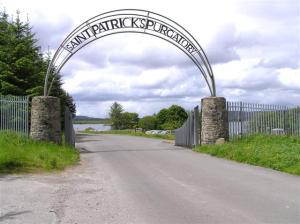
The small island of Lough Derg, off Ireland’s coast was once thought of as the gates to Purgatory or Hell, depending on which piece of lore you follow. According to myth, St. Patrick was visiting the island when he discovered a small cave and upon entering it, experienced visions of hell. Some stories go so far as to say Jesus himself showed Patrick the cave and caused the visions. In both stories Patrick used the cave to show his pagan converts that the afterlife does exist and what to expect if they did not profess belief in Christ. There is no proof that any of this took place, including Patrick even visiting the island, but that didn’t stop the locals from profiting from the story.
During the Middle Ages, the island acquired the reputation as the strictest and most demanding of European pilgrimage sites. Visitors had to complete a three day barefoot sojourn of contemplation around the island, as if already in Purgatory. The Catholic owned island still welcomes spiritual pilgrims seeking relief and rest from the modern world. This island promises:
Lough Derg is an island of pilgrimage set in calm lake waters, offers no distraction, no artificialities or interruptions. Instead you are warmly welcomed and cared for: there are no strangers here.
I don’t know about you, but this sounds like my kind of vacation.
So, what does this have to do with Hamlet’s line about St. Patrick? Well, it turns out a lot. The ghost of Hamlet’s father talks of being a spirit trapped in Purgatory.
I am thy father’s spirit,
Doom’d for a certain term to walk the night,
And for the day confined to fast in fires,
Till the foul crimes done in my days of nature
Are burnt and purged away. (1.5.9-13)
OLYMPUS DIGITAL CAMERA
Perhaps Shakespeare pictured old Hamlet going to Purgatory via Ireland, or perhaps he wrote the play in March of 1602 and had St Patrick and the story of the gates to Purgatory on his mind. Whatever the reason, this layer of the onion is further proof that Shakespeare continues to expand my world and why I enjoy sharing his work with all of you.
By now you’ve undoubtedly have heard the news: Pipes from Shakespeare’s property have been found to contain cannabis! Shakespeare was a stoner! If you haven’t heard, here’s a snippet from the Telegraph:
South African scientists have discovered that 400-year-old tobacco pipes excavated from the garden of William Shakespeare contained cannabis, suggesting the playwright might have written some of his famous works while high. Residue from early 17th century clay pipes found in the playwright’s garden, and elsewhere in Stratford-Upon-Avon, were analyzed in Pretoria using a sophisticated technique called gas chromatography mass spectrometry, the Independent reports. Of the 24 fragments of pipe loaned from the Shakespeare Birthplace Trust to University of the Witwatersrand, cannabis was found in eight samples, four of which came from Shakespeare’s property.
The author of the piece goes on to suggest Shakespeare must have smoked weed while writing his plays. She even finds “evidence” in sonnet 76.
Why is my verse so barren of new pride?
So far from variation or quick change?
Why with the time do I not glance aside
To new-found methods and to compounds strange? (She seems to think he is talking about cocaine)
Why write I still all one, ever the same,
And keep invention in a noted weed,(Ah, he must be high on weed!)
That every word doth almost tell my name,
Showing their birth and where they did proceed?
O, know, sweet love, I always write of you,
And you and love are still my argument;
So all my best is dressing old words new,
Spending again what is already spent:
For as the sun is daily new and old,
So is my love still telling what is told.
I will admit the line about “noted weed” is unclear, but I don’t see what she sees. I read a sonnet about the poet’s answer to those who question his writing skills, and possibly a charge of repurposing older works. He retorts back, “From time to time, don’t I look for new methods and strange (different/ new) compounds”? Shakespeare is suggesting his work is fresh, even as his themes are old. Love is an old theme, yet he ‘dresses old words new”. Shakespeare compares the sun to his work; each day the same sun comes up, yet each day is new. Doesn’t sound like a guy who is high or talking about getting high. Sounds more like a man who doesn’t take criticism lying down. The author of the Telegraph piece may have tried a little too hard to prove her point. Of course she is not the only one. Several “scholars’ have come forward with evidence hidden in the plays.
How about we talk about the pipes and the fact surrounding them. Let’s say the date of the cannabis is accurate, give or take just a few years. This makes the weed roughly 400 years old. Given that Shakespeare was born 450 years ago, we would have to assume that if they belonged to him ( and we don’t know that they did) this would mean he smoked weed in his fifties. Of course, this could also mean this was the last of his weed, and maybe he’d been smoking the stuff for most of his adult life. Maybe… But…
Just because the pipes were found on Shakespeare’s property, doesn’t mean they were his pipes. Here is what we do know, or at least have been told:
The study, published in the South African Journal of Science, examined 24 pipe fragments from the town of Stratford-Upon-Avon, where Shakespeare lived. Some had been excavated from Shakespeare’s garden. Using advanced gas chromatography methods, researchers detected cannabis on eight fragments — four of which were confirmed as from the Bard’s garden, the Telegraph reports. Evidence of Peruvian cocaine was found on two others, though they were not from the same property. Times
Okay, so some pipes, (obviously not ones that anyone treasured, why else be tossed?), were found in Shakespeare’s garden. Humm.. Who else lived at Stratford? Ah, yes, Anne his wife, his two daughters, and after his death, one of his son-in-laws. Could the pipes belong to one of them? How about servants or farm hands? Could they have smoked weed out of cheap, easily discarded clay pipes? How about friends? What if Shakespeare held parties (he did have the biggest estate in the area, I bet he held a lot of parties) and had friends who smoked weed from time to time? How about neighboring teenagers? Today’s teens spend hours looking for a safe, undetected place to smoke some pot. Could the same be true of 16th century teens? Shakespeare’s large garden may have attracted silent late night visitors looking to get high. Perhaps they were caught and threw the pipes down as they tried to maintain some semblance of innocence (okay, that was me and two friends once. Sorry, I digress). But the point its, it could have happened.
All of the suspects listed above are based purely on conjecture. Just as is the suggestion that Shakespeare smoked and wrote about weed. Once again we are faced with a few facts taken widely out of context. We don’t know who threw the pipes in the garden or if they were thrown in the garden at all.
Here’s another idea. What if Shakespeare ordered some soil for his garden? He may have asked a local farmer for some fertilizer. What if a cart full of soil, which just happened to contain discarded pipes, happened to find its way into Shakespeare’s garden? Considering 16th century society had little regard for where their rubbish landed, it shouldn’t be hard to image that carts of garden soil might contain refuse. Once again, this is conjecture, oh, but it’s fun to speculate!
Shakespeare at Tobacco Factory As You Like It
But none of my ideas are any less credible than thinking these pipes are the smoking gun (or, smoking pipe) evidence that Shakespeare was high while he wrote. And if he did, who cares? It’s the work that matters, not how he achieved it. Come to think of it, a very high Shakespeare could explain a lot of silly, loose plots, it could certainly explain Dogberry or Touchstone. The point is, we have no facts to back up these claims, only a lot of questions. Whose pipes were these, why were they found discarded, and most importantly, does it matter?
Until we find 400 year old pipes with Shakespeare initials on them, or an ode to weed, written by him, I will withhold judgment. There are too many characters in this drama that had the means and motive to smoke cannabis. Living in 16th century plague ridden, garbage infested England would make anyone want to get high.
It drives me nuts when new “evidence” brings out wanna-be Sherlocks, who think they can deduce something concrete about Shakespeare. Just because he used the words “weed” and “compounds strange” they point and claim proof Shakespeare was a stoner. Surly some of them must be high.




 The View From Sari's World
You must be logged in to post a comment.