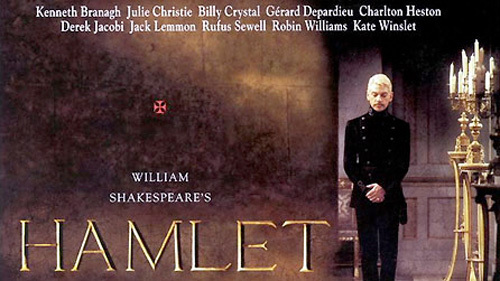
As part of my Shakespeare weekend I decide to finally sit down and watch Kenneth Branagh’s adaptation of Hamlet. Not only watch it, but take notes and hopefully come up with a review worthy of your consideration. The results? Four hours of my life I won’t get back. By the time Branagh got to Hamlet’s “To be or not to be” speech, I found myself thinking, “Not to be sounds like a really good plan”.
Now, before you start groaning or thinking I’ve lost all of my mirth, let me start with what I did like. There are few movies that are so bad as to not contain some moments of entertainment or some moments that absolutely shine; anyone who tells you differently is not paying close attention.
This is Shakespeare’s Hamlet, all four long hours of it. Branagh does little editing and restores long forgotten characters that many modern audiences have never seen. The scene between Polonius and his servant Reynaldo is here, as are the players and their play within a play. While most adaptations show little interaction between Hamlet and the players, this Hamlet focuses on them as people, making them appear to be more than mere plot devices. Charlton Heston is a wonderful First Player. His recital of the poem about Pyrrhus’ was a joy to watch. Bonus points to Branagh for including some flashes of action; we see and feel Hecuba’s pain. This allows us to understand Hamlet’s wonder at the First Player’s ability to move his audience to tears.
Branagh peppers the film with flashes of scenes that originally are just spoken words. We see Fortinbras’ war preparations and his uncle’s chiding him for them. For those unfamiliar with Hamlet these scenes may have been aids to understanding the action being described by the use of long dialog. I found the added scenes gave an added depth to the film because we see Fortinbras. This was one of the things I liked about the film; I was able to connect with characters that normally are little more that plot points. Branagh seems to want us to consider everyone’s point of view and that more than just a few people’s lives have been affected by war and the old King’s death.
One of the things that had kept me from this film was the complaint about Branagh including a sex scene between Hamlet and Ophelia. One of the fun aspects of this play is the ambiguity about their relationship. To label it “complicated” is an understatement, but just how complicated has always been left to the viewers imagination. Branagh obviously sees them as lovers, thus making their breakup all the more painful. The scene didn’t bother me as much as I thought it might, and it didn’t add anything to my understanding. I marked it as Branagh’s take on the play and nothing more. But I have to wonder how many people will now argue “of course the two were in a sexual relationship, I saw it in a movie!”
The best thing about this movie had to be Derek Jacobi. Here is a gifted Shakespearean actor doing, what so far, I’ve never seen before; making Claudius a man first and a villain second. He completely threw me off my game. From the beginning, “murderer” was not on the forefront of my mind. He was so utterly convincing as a man who was in love and was loved in return that I forgot I was supposed to hate him. I simply watched, as if I had never seen the play before, as he claims his throne and his wife. He played the first scene between Claudius and Hamlet, not as a villainous uncle who wants nothing more than for Hamlet to put aside his prevailing woe in order to legitimize Claudius’ claim to the throne, but as a caring stepfather who attempts to console Hamlet by reminding him that all things must die. In fact, he was so good that when the Ghost names him as his murderer I felt a little sad. If the first actor to ever play Claudius was half this good, I can only imagine how his betrayal must have come as a shock to anyone witnessing it.
Some years past I proposed an argument about Ophelia’s death. Though it was met with resistance (mostly among those with a mind towards theater) I still hold the view that someone was watching as Ophelia sat on a willow branch singing to her flowers, then as she fell and slowly pulled down into her watery grave. I say this because when Gertrude tells Laertes of his sister’s death, she doesn’t do so as if this is what she thinks happened, she tells him precisely what did happen. Some have counter argued that this was Shakespeare’s way of including Ophelia’s death scene in the play; he couldn’t very well have an actor fake a drowning scene. While I understand this idea I am reminded that Shakespeare always chose his words carefully. The queen could have started her lines with the words, “It seems” or “It appears”. No she goes right into the scene as if she was there when it happened. I am not saying she was, but I do think someone was watching. After all, the last time we see poor mad Ophelia the queen orders her servants to watch Ophelia. The question is; did they obey her command right up to the very end?
As I watched Julie Christe’s Gertrude I was struck by her take on the Queen’s explanation. She darted her eyes and cast them down all the while pausing between lines, as if remembering what had happen. She looked at Laertes with both sympathy and guilt. I suppose these could have been the emotions of a woman who is hesitant to admit her lack of duty; after all Ophelia was in her care when she drowned. Yet reviewing her speech it was easy to spot the halting manner in which she gives her report. She tries desperately to make the death seem peaceful and beautiful, as if this is how she or someone saw it. It was obvious from her speech and manner she did not want Laertes to ask further questions. I have to say it certainly was a different take on the Queen’s speech.
Polonius comes across less of a fool than a man who is over confident in his ability to read people and situations. His parting words to Laertes are given in a loving manner and move Laertes to see his father as a wise old man. It was touching and unexpected.
Many of the actors were given the space to breath new life into the characters and portray them in a manner modern audiences are not used to seeing. All too often shorter versions of the play regard most of the cast as secondary players, each playing their part to type; each expressing only one aspect of the human condition. In this version we see the human condition in many of its forms played out by each of the main characters. Yet despite all of this, the movie fell flat for me. It hits many more low points than good. And for brevity’s sake, I’ll only talk about a few.

Time is certainly out of joint in this play. And no example better illustrates this than Branagh’s choice for Horatio. Nicholas Farrell was forty when he played the honorable friend of Hamlet, who arrives from college to pay tribute to the late King. I laughed out loud when he first appeared on screen. Horatio with wrinkles? I may be wrong, but I doubt Branagh was going for laughs when he cast Farrell, His appearance as a much older Horatio was so distracting that no amount of fine acting could over come it. In fact when the friends appeared together (Branagh looking much older than 33) they seemed less like two young men trying to navigate an impossible situation and more like two men on the brink of middle age trying to figure out what the hell happened to their youth and innocence.
Speaking of distracting; what do Robin Williams, Billy Crystal, Jack Lemmon, and Gerard Depardieu have in common? They all make an appearance in this movie as some form of human product placements. With the exception of Crystal( as the main gravedigger), all distract more than they add. It was as if Branagh, not quite sure his and Shakespeare’s names were enough, decided to bring in well-known comedians (and one boring drunken French actor, who for reasons never fully explained by science, was “hot” in the 90’s). It occurred to me to wonder if they had paid Branagh to be in his movie, as there was no reason for them to make such brief appearances and stand out as they did.
But most distracting and confusing of all was Branagh’s Hamlet. Unlike Jacobi, whose decidedly different approach to Claudius worked, Branagh’s approach to Hamlet just didn’t work for me. I can’t quite place my finger on what exactly I didn’t like about it, other than to say, I just didn’t buy any of it, and after reviewing several key scenes, I am not sure Branagh bought it either. At least, I am not sure he knew just how to play the many layers of Hamlet.
Critics praised Branagh’s cinematic approach to his introduction to Hamlet. While everyone at court is in the great hall celebrating the marriage between Claudius and Gertrude, Hamlet is on the other side of the wall; he is the one person that should be there, yet is the only person who is not. While visually the wall was a great choice for showing the divide, Branagh’s acting choice was rather confusing as if he wanted to keep a wall between Hamlet and his audience. As if from the very start he wanted the audience to be in doubt as to his motives as well as his emotions. But this backfired as it maded his Hamlet distrustful from the first; putting into doubt who the real villain of the story would be.
From the first, it seemed that this Hamlet was in shock. He moved and spoke as if he had just heard of his father’s death only minutes before, not months before. This would have worked well, had Branagh played him this way for a while. The slow speech and vacant eyes would have worked well had we believed that grief and shock were the raw emotions that Hamlet just couldn’t shake off. The first soliloquy could have been chilling if done by a man who could not understand why he was still alive; how many of us have experienced a loss so deep we cannot fathom how we are still breathing? Or rage, if Hamlet would have raged at the thought of his mother with someone else we would have seen the first few stages of grief play out before us. But no, what we got was a little more than shock and a little less than rage. Which, this too would have worked, except the minute the soliloquy is over and he heard Horatio’s voice, all sense of grief and shock are gone and he talked to his friend as if the marriage between his mother and his uncle was no big deal. I’ve seen Hamlet be sarcastic about the thrift of the meat, but this Hamlet made it seem as if it was indeed a good idea. Branagh just throws that line out there without much emotion behind it.
And it goes on. Branagh moves from one emotion to the next in a pace that doesn’t allow for the audience to attach a lot of sense to his feelings. We see him get physically violent with Ophelia when he realizes that she is breaking up with him and why. Yet the next time we see them in the same room he lays his head on her lap and jests with her; we are asked to forget that we just saw him in rage, push her face into a mirror. It was unnerving. Did Branagh think Hamlet mad before we were introduced to him? Or was this a man so overwhelmed by his emotions that they fluctuated from moment to moment, never fully taking shape but sharp enough to drive his actions?
Historically we see Hamlet as a man who cannot bring himself to action one-way or the other. Seeing Branagh move from immobility to bombastic antic within seconds rang hollow for me. The mania this particular Hamlet displayed was part of the overall disconnect I felt watching him. Maybe this is why I couldn’t buy into Branagh’s version. Hamlet as a play is one of the best examples of the human condition ever written, we feel for the prince as he tries desperately to do the right thing, yet watching Branagh I never got the sense he could stop for a moment to consider what the right thing really was. Oh and I so wanted to love this film.
Other may disagree and I invite you to tell me why. Convince me that what I saw was Shakespeare as it was meant to be played; that Branagh nailed the role. For now though, all I can say is, so much for him.


 The View From Sari's World
You must be logged in to post a comment.