By Grabthar’s Hammer, my top five favorite Alan Rickman movies

images

I had every intention of writing a post today about Shakespeare, but with the sad news of the passing of Alan Rickman, I thought I’d pay tribute to him instead. I cannot but help admire the man . He was one of those rare actors that made the craft look easy, yet there was always depth to what he did. Because of his voice and his subtle mannerisms, it was always hard to take my eyes off him when he was on screen. What can I say about the man who transitioned from the villainous Snape to the comically depressed Marvin the robot with such ease and grace? He will be missed & we shan’t see his like again.

Here are my top five favorite Alan Rickman’s movies in descending order:

Galaxy quest Dr. Lazarus

I didn’t get a chance to see Galaxy Quest on the big screen, in fact I don’t remember how I even found the movie. But I do remember it was one of my son’s favorite movies. The movie was released in 1999, which would’ve made my son four years old. This is the age in which children can sit and watch a movie over and over again. My son was no different; I cannot count how many times I’ve seen this movie or heard it as background noise. But it never got old. Ironically Rickman played an actor who was sick of being typecast and had little use for his fans.

Rickman could have easily played the role as an insufferable jerk, but instead you felt for him and understood his dislike of the box he found himself in. Though Galaxy Quest was a silly comedy, Rickman was able to induce pathos into his character. You couldn’t help but be moved when Dr. Lazarus finally found his humanity when he embraced his alien counterpart. By Grabthar’s Hammer you will be missed!

Die Hard Hans Gruber

I don’t usually pay attention to villains in movies; I find them one-dimensional and flat. But there was something about Gruber that mesmerized me. Was it is voice, his face, His mannerisms? It was all that and more. In the hands of Rickman, Gruber came to life; I believed him to be evil and I believed every damn word he said. To be honest I thought he was the best thing about that movie.

Sense and sensibility   Col. Brandon

Ahh, here’s a secret about me. Normally I dislike l what we term “chick flicks”. I find them to be stale and wholly on believable, yet turn on Sense and Sensibility and I’m quiet for two hours (okay, I don’t cry quietly). There is nothing about this movie I don’t love. It’s the movie that made me fall in love with Alan Rickman. I’m sure it’s no coincidence that the movie came out about the same time I finally learned that it was better to fall in love with nice guys, and what better nice guy than Col. Brandon? Once again Rickman found himself playing a role that in any other hands could have been portrayed  flat and one-dimensional yet we can all agree Brandon’s smile at his wedding put a smile on our faces. We the audience felt for him and were happy for him.

Hitchhikers guide to the galaxy Marvin the depressed robot

I really, really wanted to love this film, but I also knew that it was going to disappoint me. I don’t think any director could have successfully pulled off adapting Adams’ wildly popular book into a movie to everyone’s satisfaction, but I think Garth Jennings really screwed it up for everyone. The only two things that make this movie worth watching are Martin Freeman and Alan Rickman. Rickman’s voice was perfect for the role of a depressed higher intelligent being. He was so good that now, anytime a robot of any mental state opens it’s mouth and speaks, I’m disappointed to hear it’s not Rickman. Whenever I find myself thinking or saying depressing thoughts I hear Rickman’s voice and it makes me giggle and my negative thoughts float away. Thank you sir for that gift.

Harry Potter Prof. Snape

I’m not sure I have the words to express just how perfectly Rickman embodied this role. It’s hard to believe Rowling didn’t write this character with Rickman in mind. It’s never easy to take up the challenge of bringing a much beloved (okay, loved to be hated) and popular book character to life, yet Rickman became Snape and quickly made us realize there is no one else on the earth that could have pulled this off. Why Rickman never won an Oscar for this role I’ll never understand. Shame on the Academy for not recognizing Rickman’s genius performance of Snape.

Thank you Mr. Rickman for all the wonderful role you have played and the countless gifts of entertainment. Your star shone bright and sadly went out far to quickly. I can only hope you are now at peace. As for me, like many of your fans, I will spend the day not mourning but celebrating your body of work. Well done sir, well done. Metatron, your work is now complete.
Is it Shakespeare or based on Shakespeare?

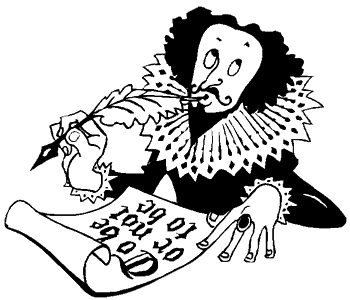
The Thinker, Shakespeare style

As I mentioned a couple of days ago, I am participating in Coursera’s “Shakespeare in Community”. It’s a course that allows students to express their thoughts and feelings about the Bard. A better title might be, “What Shakespeare Means To You”

We found ourselves discussing Carlo Carlei’s 2013, adaptation of Romeo and Juliet. I freely admit I haven’t seen the movie, and from what others have said, I don’t think I will.

Some argued that Carlei had every right to change the script; Juliet awakens right before Romeo kills himself. This was supposed to add to the drama and tragic ending. Carlei’s R&J is set in the modern world so naturally guns are the weapon of choice. Yet another change can be found in the dialog. Carlei uses Shakespeare’s most iconic lines while taking liberty with most of the lines. We have to ask, is this Shakespeare or is this based on Shakespeare?

Here are my thoughts, and please. Feel free to tell me yours.

West Side Story, Kiss Me Kate, The Lion King. These are movies based on Shakespeare. The directors unabashedly admit to adapting the plays and re-imagining them. Yet they stop short of calling their work, Shakespeare. Why? Because this allows them the ability to play loose and fast with his work. It allows them to explore ideas found in Shakespeare’s work without constraint. These directors want us to judge the work on their own merit, even if their work is not quite original. Then again, neither was Shakespeare’s.

We all know Shakespeare adapted earlier work to fit the needs of his audience. While the players could have just as easily been known as the group who performed classic works, they re-imagined them instead, and offered them in a way that their audience would accept and understand. Carlei may have felt he was doing the same. But there is a difference: Shakespeare re-wrote older literary works by changing the words, sometimes names and settings, and on several occasions re-wrote the ending. By doing this he took ownership of his work and called them his own. Like the directors mentioned above, Shakespeare did this so that his work would be judged on its merit.

Carlei’s movie is not Shakespeare, no matter what he wants us to think. His work is based on a play, just like Robert Wise’s West Side Story is not exactly Shakespeare. Carlei has been heavily criticized for his work and largely ignored by movie audiences. It is obvious Carlei is being judged, not on his merit, but on his use of someone else’s work. He doesn’t seem to understand the difference between adapting and basing.

Adapting someone else’s work usually involves a change of setting, or a re-ordering of scenes. Sometimes director remove or blend characters in order to save time and money. Yet these same directors will keep to the original dialog and endings. They want to be judged on how well they’ve used someone else’s work. Fair enough. I rather enjoyed Morgan Freeman’s Wild West version of The Taming of the Shrew. BBC did a remarkable job of placing an adaptation of Hamlet is the present day, so there video surveillance cameras in every room. This gave the play a dark, creepy feel as everyone, including the audience, felt spied upon. These two examples might not fit your definition of Shakespeare, but at least they didn’t omit the language and change the endings.

One of my classmates argued “tragedies can and should be altered”. “We don’t always require a sad ending”. Another classmate responded by asking if we always need comedies?  His point was that by tweeking the content we no longer have the same play that we started with. John came up with a brilliant illustration to make his point. I give him full credit for coming up with the following idea. What if we to re-title some of Shakespeare’s comedies? Would they still be Shakespeare? You decide.

All’s Well that end’s Poorly

As you hate it

The grumpy wives of Windsor

Midsummer’s night’s nightmare

The unemployed of Venice

Twelve Long Nights

Much ado about nothing, nothing at all

The Shaming of the Shrew

Amazing Waste

Repurposing Food and Reducing Waste

measurestillformeasure

Shakespeare, Classics, Theatre, Thoughts

Nerd Cactus

Quirky Intellect for the Discerning Nerd

Sillyverse

Stories of magic and mystery

Commonplace Fun Facts

Mind-Blowing Facts You Didn’t Know

Fictionophile

Fiction reviews, Bookblogger, Fiction book reviews, books, crime fiction, author interviews, mystery series, cover, love, bookish thoughts...

Patrick W. Marsh

monsters, monsters, everywhere

Shakespeare for Kids Books

Opening the door for kids to love Shakespeare and the classics

desperatelyseekingcymbeline

The 10-year Shakespeare New Year Resolution

Katzenworld

Welcome to the world of cats!

booksandopinions.com

The Book Reviews You Can Trust!

The Book Review Directory

For Readers and Writers

thelitcritguy

screams from the void

Author Adrienne Morris

Step Into the Past—Lose Yourself in the Story.

crafty theatre

ideas inspired by crafty characters

Critical Dispatches

Reports from my somewhat unusual life

The Nerd Nebula

The Nucleus of the Universe for all Nerd Hacks!