And we are back! That little mishap of mine took longer to recover from than expected. The doctors told me I’d have use of my finger in two weeks. Wrong! Though the wound healed nicely in about three, the pain lingered for about a month. I tried not to use the stub while typing, as every bounce on the keyboard sent burning pain up the finger, but sense memory would take over and I found myself cursing at work more than usual. And when I did manage to keep my middle finger ridged (insert joke here) the other fingers would become confused as where to be. My sentences would start to look like this; Hello, I am wrotg;m tu… Some times I compose whole e-mails without looking only to find they were full of gibberish. As if I had placed a monkey in front of my keyboard to see just how long it would take for her to compose a Shakespeare play.
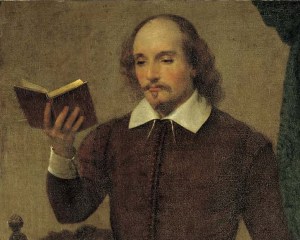
Speaking of Shakespeare, it is time I finally got started on my project in which we take each play and find a theme or a subject that speaks to today’s audience. It is my hope that by the end, we have discovered why Shakespeare still matters and answer the question I get all the time, “Why should I care about Shakespeare?”
I’ve hesitated to write about the canon as there are a lot, and I do mean a lot, of blogs out there that focus exclusively on the plays, but, to be honest, a lot these are as long as the plays themselves and lose their impact because of it. It has taken me a while to come up with what I hope, is a unique spin when it comes to blogging about Shakespeare. And besides, I don’t want to spoil the play for you. I have no intention of giving you a blow-by-blow take on each act, each scene. My hope is to wet your appetite for Shakespeare and to go out and seek a performance for yourselves.
So here is what we are going to do. We are going to go through the plays in alphabetical order. You can read the play ahead of time or watch it via a medium of your choice. I am going to pick out one, sometimes two aspects of the play that we modern audiences can relate to. After all, the incredible thing about the man was his ability to be a mirror for the human condition. Shakespeare is for all time because of his gift of illustrating our follies and our wins. We can identify with most of his characters; good and bad. It is up to us to determine if we are willing to look and then learn something about ourselves.
As much as I loathe to put Shakespeare in modern context it will be hard not to because he does still speak to us. We will look at each play in the context of his time and then see where we fit into his worldview. Some things never change. And although manners, social construct ,and values change, the human condition does not. Fore example modern scholars view many of his plays as misogynistic and therefor feel uncomfortable with them, yet we must admit misogyny is alive and well in the 21-century, and many that of the actions of Shakespeare characters (I am looking at you Petruchio) can be seen in today’s dramas and action movies(I’m looking at you Bond).
Sunday is Shakespeare’s 453 birthday, and I can think of no better day to start this project. We will begin by looking at All’s Well That Ends Well, a problem play written around the same time as Hamlet; somewhere in the early 1600s. It’s a problem play for many reasons but specifically for scholars and theater owners, it is a problem because it is one of the few plays in which the lead female does not exhibit many good qualities. Shakespeare uses a wide array of plot devises in the hopes that the audience doesn’t notice her flaws, but in this he fails, and thus it is labeled as a problem play. Would we recognize Helen if we saw her today? Absolutely, and we probably wouldn’t like or respect her much.
In case you have missed it, last week saw a new chapter emerged concerning Shakespeare and the dreaded authorship argument. Long time readers and friends know why I use the word dreaded; it is an argument born from ego and suspicion of all things labeled accepted academic. I’ve learned to stay far away from this fight as no good usually comes from it. But, if you haven’t heard of Heather Wolfe, I’d like to introduce her to you, as I have a feeling she is going to become a leading figure in Shakespeare academia.
Wolfe holds my dream job as a curator at the Folger’s Library; her expertise as a paleographer is in old English manuscripts. She has been dubbed the “Sherlock Holmes of the library” due to her ability to not only find often overlooked written clues, but forensic clues such as hair and odd bits of DNA. Scholars hold Wolfe in high esteem, which is why when she announced she had found proof that the playwright known as Shakespeare, and the Stratford born Shakespeare were one and the same, the academic world took notice.
I will link to the full news article below. For our purposes we only need to know that Wolfe found a 1602 list of “mean persons” (deemed unworthy) whose applications for a coat of arms was wrongfully “preferred” by Sir William Dethick, the Garter King of Arms. Among those who were called out as being unworthy yet somehow “preferred” was Shakespeare the player. The only application noted in the official College of Arms record at the time was an application by William Shakespeare of Stratford. This Coat of Arms Shakespeare of Stratford was petitioning for included the motto, Not without right.
The Guardian article reminds us that “Around the same time Ben Jonson, in his satire Every Man out of his Humour, poked fun at his artistic rival (Shakespeare the player) as a rustic buffoon who pays £30 for a ridiculous coat of arms with the humiliating motto ‘Not Without Mustard‘.”
So it does appear that Wolfe is right, that Shakespeare of Stratford, Shakespeare the player, and Johnson’s rival are one and the same. But what about Shakespeare the playwright? Why did the list include the word player and not playwright? Sigh, here we go…
As soon as I read the article I knew, I just knew, someone from anti-Stratfordian camp would argue that player and playwright did not mean the same thing. In fact, I mentioned this on Twitter while discussing the subject with some friends. And sure enough, a couple of days ago, a self-professed “expert” Oxfordian, tweeted out this very argument. But instead of letting my gut reaction take hold, I asked myself, “Does he have a point?”
My quest to find the answer first led me to wanting to know when the word playwright was first used. The answer was a little surprising; it seems Ben Johnson coined the term (at least this is the first recorded use of the word) in an epigram (49 to be exact) in which Johnson counterfeits a complaint against those that dare shed light on man’s darker nature:
XLIX. — TO PLAYWRIGHT.
PLAYWRIGHT me reads, and still my verses damns,
He says I want the tongue of epigrams ;
I have no salt, no bawdry he doth mean ;
For witty, in his language, is obscene.
Playwright, I loath to have thy manners known
In my chaste book; I profess them in thine own.
Epigrams, in case you are wondering, are what I would call the anti-sonnet. Sonnets by definition are usually love poems, while epigrams are usually humors complaints; mostly about women. As you might expect the use of epigrams as poems were not as popular as sonnets and so their use as poetry devices quickly died out.
Johnson uses the term playwright in a derogatory manner. The context in which he uses it begins to form an argument against the idea that player and playwright are not the same thing. You see in Johnson’s and Shakespeare’s day wrights were craftsmen; ploughwrights made ploughs, cartwrights wagons, etc. These craftsmen, or wrights were of the labor class, and as such were not looked upon as worthy for consideration. By attaching the word wright to play, Johnson was liking a dramatist to a laborer. In other words, someone unworthy for consideration. The fact that this playwright draws attention to the bawdry and obscene makes him all the more unworthy of attention. The term as we know it today was not widely used in the early 17th century. And, as I soon learned, any mention of a writer of plays during this period of history is hard to find at all.
A good primary source of information for this subject is G. Blakemore Evan’ book, Elizabethan-Jacobean Drama, The Theatre in its Time. This delightful book contains primary sources that give us a better understanding of how the theatre was viewed by critics, officials, noblemen, and ordinary people. It contains pieces of long forgotten plays, and beautiful illustrations you’d be hard pressed to find outside of academic libraries. My copy is dog-eared from the many times I’ve used it as a reference guide.
All the world’s a stage, and all the men and women merely players; they have their exits and their entrances. Jaques to Duke Senior in As You Like It
Life’s but a walking shadow, a poor player
That struts and frets his hour upon the stage
And then is heard no more: it is a tale
Told by an idiot, full of sound and fury,
Signifying nothing. Macbeth
In all of Shakespeare’s work he never uses the term “playwright”, although he does reference players several times; most notably in his stage directions for Hamlet’s play-within-a play. The acting troupe that visits Elsinore is referred to both singularly and collectively as player(s). The more I researched the subject of player vs. playwright, the more this began to make sense. Of all of the primary sources I read,( both in print and online) none used the term playwright. It’s clear that this term was not in vogue during Shakespeare’s lifetime, and therefor would not have been used in a list of “mean persons”. As a matter of fact, the term for he who writes plays in any form is hardly worth mentioning at all. The writer is absent even in the most grievous of complaints against the theater.
In an official letter against the theater from the Lord Mayor of London and the Aldermen to the Privy Council dated 28 July 1597 the word “stage-plays” shows up four times. The mayor, convinced playhouses are the “refuse for all sort of evil-disposed and ungodly people that are within and about this City”,goes on to detail the many opportunities for vice that stage-plays afforded the masses but oddly never complains about the actors and writer who put on the stage-plays. They are secondary to his concern.
In a letter about street brawls and the theater, William Fleetwood to Lord Burghley date 18 June 1584, does take the time to concern himself with the players. He uses the term collectively when talking about a particular troupe, “Upon the same night I sent for the Queen’s players and my Lord’s players”. Fleetwood’s collective use of the word player is consistent with what we see from this time period when talking about an acting troupe as a whole or in part. Fleetwood goes on to talk about the “Chiefest of the Highest players” (what ever the hell that means).
The Royal license for the King’s men, dated 19 May 1603 starts off with a list of who they are and what they do:
Pro Laurentio Fletcher et Willielmo Shakespeare et aliis.
James by the Grace of God, etc., to all Justices, Maiors, Sheriffs, Constables, Headboroughs, and other our Officers and lovinge Subjects, Greetinge. Knowe ye that wee of our Speciall Grace, certeine knowledge, and mere motion, have licensed and authorized, and by these presentes doe license and authorise these our Servaunts, Laurence Fletcher, William Shakespeare, Richard Burbage, Augustine Phillippes, John Hemings, Henrie Condell, William Sly, Robert Armyn, Richard Cowly, and the rest of their Associates, Freely to use and exercise the Art and Facultie of playing Comedies, Tragedies, Histories, Enterludes, Morals, Pastoralls, Stage Plaies and such others…
As you can see there is no direct reference to a playwright, Shakespeare or not, in this listing.
John Marston’s 1599 play Histriomastix Act II further bolsters my findings. The term player is used as a catch-all for everyone involved in a stage production. The scene opens up with Usher welcoming Lord Owlet’s men. The stage direction calls for the Players’ (King Owlet’s men) Song; not the actors, and playwright’s song, even though the writer of troupe’s plays is present . It is not until the song is over that one of the players is marked as the group’s “poet” but get ready for how he answers this…..
Belch: Here’s a gentleman scholler writes for us: I pray, Master Posthaste, declare for our credits.
Posthaste: For mine own part, though this summer season, I am desperate of a horse.
Yes, you just read that correctly. Marston’s gentleman scholler (his spelling) just admitted that he spends his summer acting in Shakespeare’s play, Richard III.
In all of my research of primary sources none besides Johnson refers to the word playwright. Nor could I find the word author, dramatist, writer, or any other word that divided he who wrote from he who acted. I am not saying the distinction is not out there, only that it would be uncommon. We also have Marston telling us that writers, or poets, are also actors. And let’s not let this nugget slip past us; Marston uses a nod to a Shakespeare play in order to get his point across. This could either mean that Richard III was a very popular play at the time of Histriomastix so he included it as a piece of cultural reference, or he used it because it was well known at the time that Shakespeare was both an actor and poet. Either way, his audience would have known exactly what Posthaste meant by that line.
Wolfe is right. This list of “mean persons” in which “Shakespeare the player” is one of, does make it clear that Shakespeare the player, and Shakespeare of Stratford are one and the same. It also seems perfectly clear that player and playwright, at least in Shakespeare’s day, meant the same thing after all.
If you can find a primary source that shows the use of the word playwright, I’d love to hear from you. If you want to argue over who wrote the plays, you’ve come to the wrong blog. And if you want to point out that Shakespeare’s home town is Stratford-upon-Avon, yes I am well aware that this is the official name, but for brevity sake, it’s okay to say Stratford, just ask the Guardian.
Works Cited
Evans, G. Blakemore Elizabethan Jacobean Drama The Theatre in its Time. New Amsterdam Press. Print edition


 The View From Sari's World
You must be logged in to post a comment.