A quick guide to Shakespeare’s Ghosts

Tis now the very witching time of night,
When churchyards yawn and hell itself breathes out
Contagion to this world.
Hamlet


Well hello October! As I sit and write this a storm is gathering in the Sierra Mountain range which means we will either see snow or a very hard frost. We’ve had a very unseasonably hot summer but almost overnight the leaves have turned brown and are now dropping faster than I can rake them. Between the autumn colors and pumpkin spiced overkill it now feels like fall which means the restless dead are ready to burst forth. October belongs to the spirits. So what say we have a bit of October holiday fun? How about we celebrate the month with a weekly look at Shakespeare’s ghosts and witches?

Here are some of my ideas so far:

How Shakespeare’s use of ghosts differ from earlier theater apparitions

How Shakespeare’s use of ghosts point to a possible Catholic faith or at least how he exploited the Catholic faith

How King James’ belief in witches may have influenced Shakespeare’s stage

I’m toying with some other ideas but if you my friends have any ideas, now is the time to comment. We will open this blog up to ideas and even guest posts if this subject haunts you too.

Today we will start the October theme with a quick look at Shakespeare’s ghosts.
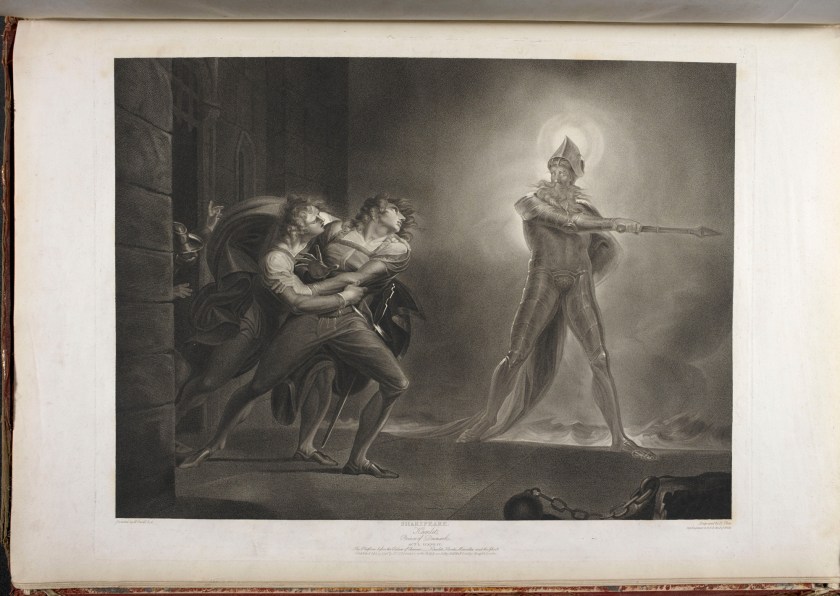
boydells-collection-of-prints-tab_599_c_84

Hamlet: Hamlet Senior

Hamlet Speak; I am bound to hear.
Ghost So art thou to revenge, when thou shalt hear.
Hamlet What?
Ghost I am thy father’s spirit.

We all know Hamlet is a play about a young man whose inability to act leads to tragic consequences. There are countless books about Hamlet’s state of mind and arguments over whether this is a man “who cannot make up his mind”, but forgotten sometimes in all of this noise is why Hamlet cannot bring himself to act.

Hamlet senior, the ghost who wants revenge,may or may not be what he claims to be and this “be or not be” is the very reason Hamlet hesitates to bring his uncle to justice. Is the ghost a wondering spirit who cannot rest until he has his revenge, a demon that seeks to mess with the young prince’s life or is he a figment of Hamlet’s already unstable mind? We could devote an entire post to this question, but for now let’s remember, Hamlet doesn’t decide to act until he is convinced that the ghost is his father and even then hesitates to out his uncle. And because of his hesitation the castle of Elsinore may have more ghostly inhabitants than living ones.

Macbeth: Banquo

Banquo’s ghost enters the room and sits in Macbeth’s chair
Macbeth The table’s full.
Lennox Here is a place reserved, sir.
Macbeth Where?
Lennox Here, my good lord. What is’t that moves your highness?
Macbeth Which of you have done this?
Lords What, my good lord?
Macbeth Thou canst not say I did it; never shake they gory locks at me.

Macbeth is responsible for quite a few deaths, but it is Banquo’s that seemingly pushes him over the edge. If Banquo was modeled on earlier ghostly plot devices he would served as a reminder to the audience that Macbeth is not a sympathetic character, but the audience is already beginning to come to grips with the horrors that Macbeth is willing to inflict on those around him. Shakespeare masterfully uses this ghostly specter to show the audience the effects of said horrors have on Macbeth’s mind.

Richard III: Everyone Richard killed or was in some or another responsible for or connected to.

Henry VI When I was mortal, my anointed body
By thee was punched full of deadly holes
Think on the Tower and me: despair, and die!
Harry the Sixth bids thee despair, and die!

Eleven ghosts cross the stage and speak to Richard the night before the battle of Bosworth. In order they are: Prince Edward; King Henry VI; Clarence; Rivers; Gray; Vaughan; the two young princes; Hastings; Lady Anne, and finally, Buckingham. Each chant “Despair, and die!”

Though they come to Richard in a dream, I include them as ghosts because they will visit Richmond as he sleeps too. Showing us that they are not merely guilty nightmarish constructs. Unlike the ghosts in Hamlet and Macbeth, who act as catalysts for change, these are ghostly prophets; acting more like Shakespearean witches than ghosts. Each foretell of Richard’s doom and Richmond’s success.
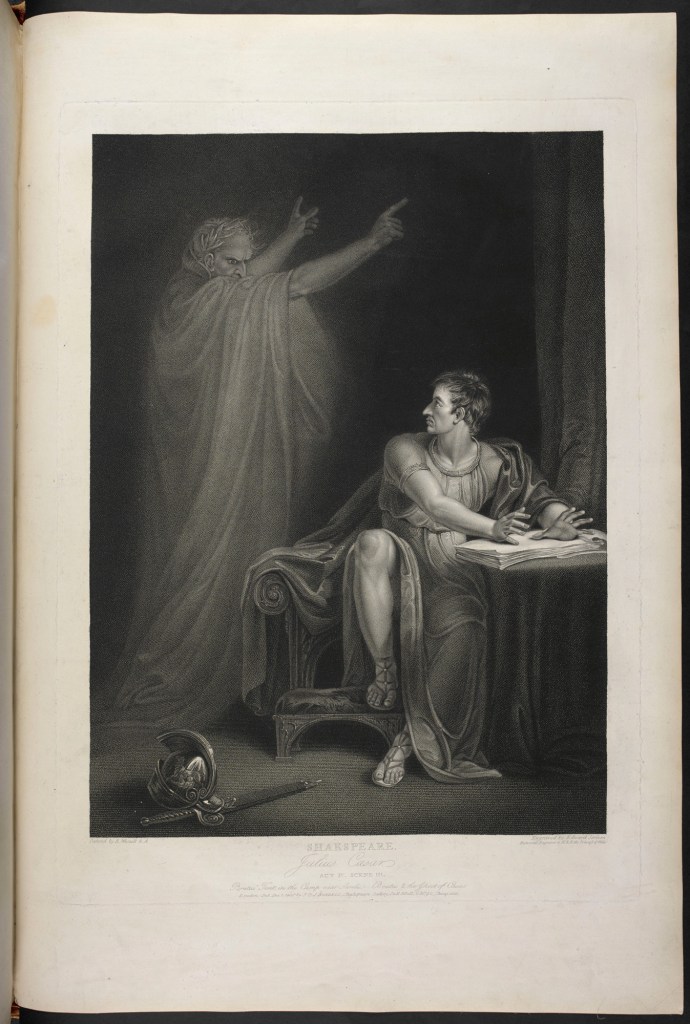
boydells-collection-of-prints-tab_599_c_70

Julius Caesar: Caesar

Brutus How ill this taper burns!—Ha, who comes here?
I think it is the weakness of mine eyes
That shapes this monstrous apparition.
It comes upon me.—Art thou any thing?
Art thou some god, some angel, or some devil
That makest my blood cold and my hair to stare?
Speak to me what thou art.
Ghost They evil spirit, Brutus.
Brutus Why comest thou?
Ghost To tell the thou shalt see me at Philippi
Brutus Well, then I shall see thee again?
Ghost Ay, at Philippi.
Brutus Why, I will see thee at Philippi, then.

Exit ghost

Taken out of context, this scene could be played for laughs. It is as if Caesar’s ghost walked into Brutus’ tent and says “Boo”. Brutus, busy reading looks up and says, “Boo to you too”. The ghost then turns and walks away mumbling, “That didn’t go as planned”. It is one of those rare clunky scenes of Shakespeare that does nothing to advance the play or inform the audience of a character’s state of mind. It does however provide some context as to why Brutus decides to commit suicide later in the play. The guilt of Caesar’s death and the ghostly visit finally take their toll on the traitor as he realizes he is about to lose everything.

Cymbeline: Pothumus’s father mother and brothers

Mother Since, Jupiter, our son is good take off his miseries.
Sicilius Leonatus Peep through thy marble mansion; help;Or we poor ghosts will cry to the shining synod of the rest against thy deity.
First and Second Brother Help, Jupiter; or we appeal, and from thy justice fly.

Once again we have “ghosts” who show up in a dream. The jailed Pothumus has a dream in which his deceased relatives implore the God Jupiter to take pity on the hero. In the dream Jupiter descends on an eagle (stop laughing, I didn’t write the play) and admonishes the “petty spirits of region low” for daring to accuse the god of turning his back on Pothumus. As well that ends well, for Jupiter assures the ghosts that Pothumus will be freed and live happily ever after.

These are Shakespeare’s strangest and most annoying ghosts. After lecturing the ghosts about Pothumus’ fate, Jupiter commands them to be gone; “away: no further with your din express impatience, lest you stir up mine”. Yet they keep talking! The play is long and weird enough without these chatty ghosts. I doubt the audience paid much attention to them as they watched in awe as Jupiter ascended back into the heavens on an eagle!

From a chair stealing ghostly apparitions to spirits that don’t know when to shut up, Shakespeare has given us some of the stages’ most talked about ghosts. Because of Shakespeare we now have fully fleshed out ghosts (pun intended). Apparitions are no longer just plot devices, mutely hovering over the stage. This will be the topic for our next look at Shakespeare’s Ghosts.

Works cited

The Complete Works of Williams Shakespeare, Yale University Press

Paintings from the British Museum collection https://www.bl.uk/shakespeare/articles/ghosts-in-shakespeare  

Shakespeare and the first Gothic novel

ab6db0a9-406a-4eaa-850a-4ff09bcc27c5img100

I’m a big fan of Gothic novels, much to the amusement of my friend Michelle who patiently waits as I scour bookstore shelves in search of a good Gothic read. It does not say much about our American bookstore literary acumen that I have to do this but I have yet to ask for recommendations from an employee without getting that deer- in- the- headlights look. Though a special nod must be given to the employees of Reno’s Grassroots Books for looking the term up and suggesting titles based on their new gained knowledge. Two of the ladies gave me several suggestions, but alas, I’ve read them all.

For those of you who may be unfamiliar with this genre, let me give a brief description:

A novel that (usually) uses medieval buildings and ruins, castles or monasteries equipped with subterranean passages, dark battlements, hidden panels, and trapdoors. There must be a ghostly or paranormal element to the story, otherwise what’s the point of using castles and ruins? The original Gothic novels offered some mystery or twist but the modern Gothic almost always offers a twist.

Some of the best-known Gothic novels:

Dracula
Frankenstein
The Monk
The Turn of the Screw
Jane Eyre
The Thirteenth Tale

There is even an American sub-genre, Southern Gothic that includes two of my all time favorite novels: Robert McCammon’s A Boy’s Life, and Harper Lee’s To Kill a Mockingbird.

Gothic novels begin appearing in the late 17th century. It has been widely assumed the genre started with Matthew Gregory Lewis’ 1796 The Monk and was quickly adopted by other writers because of the success of The Monk. Lewis’ novel touched on varying taboo subjects such as rape, blasphemy, incest, and devil worship. It was sharply criticized by the elites and the Church.

Can you imagine the outcry over this? Modern church members wanted the Harry Potter books banned; I can’t begin to imagine what they would have wanted to do with the book or even Lewis himself. But even with the outcry  it was a hit with the general public and remains on the list as the best Gothic novel of all times.

Though The Monk is accepted as the greatest Gothic novels ever written, and mentioned as the first, it is in fact not the first Gothic novel. This honor goes to Horace Walpole and his short novel, The Castle of Otranto, published in 1765, first anonymously, as a “found” Italian manuscript and then after becoming a best-seller, as a novel by Walpole (to the disappointment of the general reading audience who thought they had been reading a semi-true account of some long ago Italian horror).

Horace Walpole, 4th earl of Oxford was born in London on September 24th, 1717 and died on March 2, 1797. Walpole was a celebrated writer and collector, though his passion for collecting became an obsession. Walpole bought a small villa in Twickenham in 1747, where he spent years adding turrets, battlements and cloisters. The estate became known as Strawberry Hill. It was here that Walpole housed his collection of curios (more on that in a minute), pictures, and a large library. He opened it up to the public and it is thought that Hill was the stimulus for the Gothic resurgence in English architecture.

Straweberry Hill The villa that became a castle
Straweberry Hill
The villa that became a castle

Today, Walpole is remembered for two things: his prolific letter writing (over 3,000 and counting have been collected) and his supposed offer of payment to anyone who would bring him Shakespeare’s skull. You may remember I wrote about the story of Shakespeare’s missing skull and how an 18th century story, A Warwickshire Gentleman is the only “proof” that Shakespeare’s grave was robbed. It said that Walpole was the one who put the idea out there, yet the folklore says that when presented with the skull, he drew back in horror and declined to purchase it. Given that Walpole as we know from his letters, venerated Shakespeare and had a taste for the macabre, it is strange that he would recoil in horror. On the other hand, actual grave robbing may have been the line even he refused to cross. But then again, it is so far as we can tell, just a story, so I shouldn’t speculate on his motives for declining such an offer.

Yale University houses a digital version of a 48-volume collection of Walpole’s letters. Thankfully they allow users to search through them by category, date, and subject matter. I spent most of the morning reading letters that mention Shakespeare. After just a few minutes it became clear this man idolized the Bard. One of most humors letters I read concerned the Shakespearean actor, David Garrick, one of Walpoles’ contemporaries. In the letter, Walpole is exchanging ideas about the famous actor. He argues that while Garrick is a “great” actor, he is terrible writer. “His prologues and epilogues and forty such pieces of trash are below Mediocrity.” He then goes on about Shakespeare: It is said Shakespeare was a bad actor; why do not his divine plays make our wise judges conclude that he was a good one?

I am not sure I follow his argument but I did notice his use of the word ‘divine”. This type of description can be found throughout Walpole’s letters. So, given that Walpole worshiped Shakespeare, would it surprise you to learn his idolatry bled into his work of fiction? Of course not.

I don’t want to give too much away in a review of The Castle of Otranto. I read it last night not know much about it myself, other than Walpole borrows from Hamlet. I don’t want to spoil the unease you may feel when first reading about the sinister plot that begins to unravel early in the novel. The basic plot centers on the castle of the Prince of Otranto. His son is killed on the way to his wedding and very quickly paranormal events shape the next few days. Something is haunting the castle, but what and why are only reveled at the end.

To say this play is based only on Hamlet is wrong. Whoever wrote the foreword for the Di Lernia edition must have never read beyond Hamlet. Walpole calls upon many of Shakespeare’s plays in this short novel. The Prince of Otranto’s wife is named Hippolita, an obvious take on Hippolyta from A Midsummer’s Night Dream. The friar who runs the church next to the Castle is a mirror image of the friar of Romeo and Juliet. One of the guards who is tasked with the unfortunate job of explaining a haunting to the unbelieving Prince has a touch of Dogberry in him. There is even a take on Robert Greene’s charge of Shakespeare as an “up-start crow”. Whoever weds Isabella, it shall not be Father Falconara’s started-up son”.

The only Hamlet like elements of the play are the many deaths either shown or recounted. Death by poison, drowning, and mistaken murder by blade are found in this novel. And like Hamlet, all these deaths seem to stem from a prince who cannot keep his emotions in check.

The Castle of Otranto is an entertaining read, though at times it is unintentionally funny. I don’t know if its because as a modern reader I found the “horror” element lacking or because it is truly absurd. Walpole wrote that the idea for the book came to him in a dream. Perhaps like most dreams, what scares us in our sleep sounds silly when we recount the tale. And speaking of dreams, Mary Shelly also claims it was a dream that prompted her to write her own Gothic novel. The Castle and Frankenstein have another common thread. Both are about “monsters” but the real monsters in both come in human form.

I recommend reading the novel for its Gothic historical value and for the pleasure of seeing how many Shakespeare references you can spot. But if you really like reading history from the perspective of the time, I suggest finding some time to read The Yale collection of Walpole’s letters. In them, there is much ado about everything.

Works cited

Horace Walpole, The Castle of Otranto Di Lernia Publishers, e-book edition
Horace Walpole, The Correspondence with Cole, Yale University online edition

Works Referenced

Rev Charles Langston Vicar of Beoley A Warwickshire Gentleman The Argosy, online thanks to Google Books.
Horace Walpole, 4th Earl of Oxford, Encyclopædia Britannica online edition


Amazing Waste

Repurposing Food and Reducing Waste

measurestillformeasure

Shakespeare, Classics, Theatre, Thoughts

Nerd Cactus

Quirky Intellect for the Discerning Nerd

Sillyverse

Stories of magic and mystery

Commonplace Fun Facts

Mind-Blowing Facts You Didn’t Know

Fictionophile

Fiction reviews, Bookblogger, Fiction book reviews, books, crime fiction, author interviews, mystery series, cover, love, bookish thoughts...

Patrick W. Marsh

monsters, monsters, everywhere

Shakespeare for Kids Books

Opening the door for kids to love Shakespeare and the classics

desperatelyseekingcymbeline

The 10-year Shakespeare New Year Resolution

Katzenworld

Welcome to the world of cats!

booksandopinions.com

The Book Reviews You Can Trust!

The Book Review Directory

For Readers and Writers

thelitcritguy

screams from the void

Author Adrienne Morris

Step Into the Past—Lose Yourself in the Story.

crafty theatre

ideas inspired by crafty characters

Critical Dispatches

Reports from my somewhat unusual life

The Nerd Nebula

The Nucleus of the Universe for all Nerd Hacks!