Did Shakespeare inspire Disney?

Henry Meynell Rheam
Henry Meynell Rheam

The origin story of the fairy-tale we know as “Sleeping Beauty” is the stuff of nightmares. The earliest known written horror-story account follows decades of oral tradition. God only knows what people must of thought of the French troubadours who recounted this gruesome tale.

If you’ve never encountered Giambattista Basile’s 1634 story, “Sun, Moon, and Talia”, consider yourself lucky. His is is so far removed from what we know as now it’s hardly surprising Basile’s name is lost to the ages. And if he made it up, good riddance sir!

In Basile’s story, the young sleeping princess is found not by a young prince, but by a married king who rapes the comatose girl and then returns home as if nothing out of ordinary had just happened. Unfortunately for the king, he is married to a heartless shrew and begins to think about the girl who just lay there. And the story only gets worse from there! In short:

The young princess gives birth to twins one of whom suckles her finger causing the enchanted splinter to fall out, which in turns causes the princess to wake up and see that she inexplicably has two babies at her breast. The king comes back, tells her what he has done, and promises to find a way to bring her to his castle, because for reasons that defy explanation, the two fall in love. The story only gets worse from there! The queen finds out about the princess and her children. She is furious and demands to have the babies brought to her so that she can have them cooked and feed them to the king. The cook (the only decent person in the story) decides against cooking the children and instead tells the king of his wife’s plan. In the end the king, the princess, and children all live happily ever after.

Thankfully, by the time the Grimm brothers recounted the tale as “Brier-Rose” all mention of rape and cannibalism is gone. Their story is one in which the young princess sleeps for “many long years” until a passing prince, upon hearing about the beautiful girl, decides to find her and behold her beauty for himself. He awakens her with a kiss and they live happily ever after.

What does this have to do with Shakespeare? He my have had some influence on Disney’s 1959 version of the story. This thought occurred to me as I listened to an audio version of “The Winter’s Tale”.

Disney could have easily used the Grimm version of the tale, yet they chose to have their prince be someone who would have married the princess anyway. As you may recall, the two were betrothed right after she was born. This version did not have the grieving parents die childless; rather, everyone lived happily ever after. But only after some “Winter Tale” like mishaps.

If memory serves, Aurora is singing "Once upon a dream" when the princes encounters her
If memory serves, Aurora is singing “Once upon a dream” when the princes encounters her

In both tales, a young princess is brought up thinking she is a shepherdess.  In both tales a young prince falls in love with the shepherdess due of her beauty and singing voice. In both tales the two would have been wed since their fathers were good friends. In both tales the prince is forbidden to see her again, but because both end on happy notes, it is assumed both pairs marry. And to add more fuel to the speculation fire, Florizell (the prince in Shakespeare’s play) calls Perdita (the princess) “Flora”. “No shepherdess, but Flora peering in April’s front”. Flora is the name of one of the three fairies tasked with keeping Aurora (the Disney princess) safe. In case you forgot, they are: Flora, Fauna, and Merryweather.
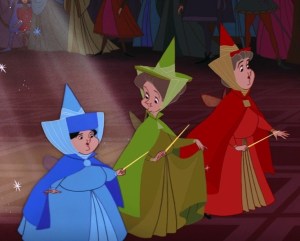
695371dc44ef1c396fc9542a16d5a5fd

This is all wild speculation on my part. I have no idea if the writers of “Sleeping Beauty” had Shakespeare in mind when they came up with their plot, but if so, we have yet another example of Shakespeare’s influence on modern pop culture. Thankfully they left out the bear.

Works referenced

D. L. Ashliman’s Folktexts, University of Pittsburgh.

Lit2Go, Grimm Brothers Sleeping Beauty

William Shakespeare, The Winter’s Tale. Folger Press
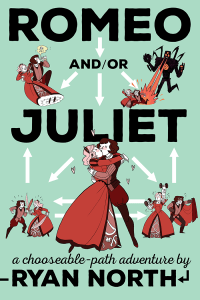
Romeo and/or Juliet by Ryan North The dumbing down of Shakespeare

Ryan North Riverhead Books Penguin Random House 2016
Ryan North
Riverhead Books
Penguin Random House
2016

“You are Sari! Right now you are standing in a library looking at the books in the “New Arrival” rack, wondering if “Romeo and/or Juliet a chooseable-path adventure” would smell just as sweet as the original story. You hesitantly reach out to pick it up.

If you pick it up continue to paragraph 2.

If you laugh and think, “oh hell no”, stop reading this post.

You pick it up wondering if this is truly something that would encourage your average teen to become engaged with Shakespeare. You flip to a random page out of curiosity. With mild trepidation you read a paragraph. The first thing you notice is the simplistic writing style. The author uses short, concise sentences. You wonder if he does this out of fear that his audience has a short attention span. As you read on, you wonder if the author has a short attention span. As you flip to the next page to read more, you wonder if the author is 10 years old. You begin to regret your current life choices, beginning when you read the title of the book you now hold in your hand.

It’s occurred to me that with the plethora of books we’ve seen published in the last 24 months with “Shakespeare” in their titles that my best course of action would be to smother my keyboard with tuna and allow my cat license to stomp around my computer for a few hours and then submit the mess to a publisher under the title “A Feline’s Guide to Shakespeare”. My luck it would hit the bestseller’s list and my cat would become the academic hero of the family. When will publishers say, “Enough is enough”!

Oh sure this book by Ryan North is full of words, words, words, but as an intro to Shakespeare it is useless. The library has classified the book as suitable for ages 8 to 16. Did the publisher suggest this? I’m not sure a book that makes use of several sexual references is suitable for 8 year olds and the writing is far too simplistic for 16 year olds.

In this adventure you start out as Juliet but quickly become Romeo who can choose to fall in love with Juliet or fall in love with a dude (North’s word, not mine), making it very un-Shakespeare like and more of a modern “politically correct” book. So much for Shakespeare.

There is very little in the way of Shakespeare’s work in this book. Most of it consists of Ryan’s self-indulging humor(I could almost hear him laughing at his own jokes). He starts off on the wrong foot when he says it’s Juliet’s 17th birthday (she’s actually 14) and quickly goes off the rails from there.

You have things to do too, Juliet. You tear through some quick stomach crunches (three reps of ten) and some pec blasts (four reps of eight), and your ready to start your day. So! Your well muscled and your family’s rich. What’s for breakfast? (page 4)

This is modern Shakespeare?

How are we to take this book? Surly this cannot be taken as a serious effort to get teens into classical literature. And if this is indicative of modern teen books, it shouldn’t surprise us that fewer and fewer teens are choosing to read as a leisurely pursuit.

It appears Mr. North does have an audience. His first choose an adventure book, Hamlet, was funded by Kickstarter. That book turned out to be the most funded publishing project for the company to date. This must have emboldened Mr. North to try again with Random House behind the project. I just wish I understood his aim (besides monetary gain). Did he really believe he this would bring teens closer to Shakespeare or did he also notice that anything with Shakespeare in its title would be easy to publish?

Personally I don’t think dumbing down Shakespeare or turning his work into adventure stories is doing our culture any favors. I see this type of art as part of the problem we are now facing. The government’s emphasis on more science-based education is pushing the Humanities to the outer edges. Colleges are bemoaning the fact that students are not receiving a well-rounded education because of this. Books like North’s do little in the way of helping the situation, as his simplistic approach to “Shakespeare” is little more than an adventure into the land of pop-fiction. And lousy pop-fiction at that.

I’d recommend skipping this adventure.

Amazing Waste

Repurposing Food and Reducing Waste

measurestillformeasure

Shakespeare, Classics, Theatre, Thoughts

Nerd Cactus

Quirky Intellect for the Discerning Nerd

Sillyverse

Stories of magic and mystery

Commonplace Fun Facts

Mind-Blowing Facts You Didn’t Know

Fictionophile

Fiction reviews, Bookblogger, Fiction book reviews, books, crime fiction, author interviews, mystery series, cover, love, bookish thoughts...

Patrick W. Marsh

monsters, monsters, everywhere

Shakespeare for Kids Books

Opening the door for kids to love Shakespeare and the classics

desperatelyseekingcymbeline

The 10-year Shakespeare New Year Resolution

Katzenworld

Welcome to the world of cats!

booksandopinions.com

The Book Reviews You Can Trust!

The Book Review Directory

For Readers and Writers

thelitcritguy

screams from the void

Author Adrienne Morris

Step Into the Past—Lose Yourself in the Story.

crafty theatre

ideas inspired by crafty characters

Critical Dispatches

Reports from my somewhat unusual life

The Nerd Nebula

The Nucleus of the Universe for all Nerd Hacks!