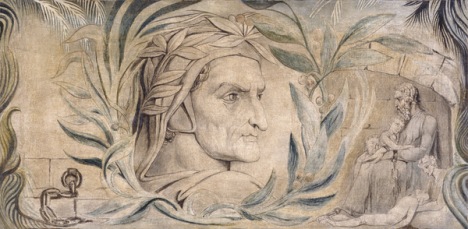
Blake, Dante and our own Hell

blakedanteportrait_0

Religion has been on my mind this last week. From Pope Francis’ view that humans, as God’s children are rejecting our parent, “When we exploit Creation we destroy the sign of God’s love for us”, to the Supreme Court’s ruling on marriage equality, and the Christian fundamentalist “the sky is falling” reaction to it, it would almost be impossible to think about anything else.

Perhaps this is why Eric Pyle’s book, “William Blake’s Illustrations for Dante’s Divine Comedy”, resonated with me. I picked it up as I have been meaning to read and review it for a few weeks now. McFarland Press, as part of Librarything’s Early Reviewer program, kindly sent it to me. I thank them both.

William Blake (1757-1827) was an early modern poet, artist, and theological philosopher. The last two years of his life was devoted to illustrating Dante’s epic poem. Blake’s works included watercolors and etchings. Sadly, he died before the work was complete, and tragically many of the finished products were either destroyed or edited after his death.

Pyle, a professor of Dante studies, collected copies of what remains of Blake’s work and his notes, and has produced a book that looks at both Blake’s criticism of Dante’s philosophy and his idea of the 9 circles of Hell. Blake lived during what we call the Romantic era, when artists and philosophers sought out social justice and fought against the idea of a cold soulless world. In many ways Blake’s drawings and accompanying notes updated Dante’s ideas of social injustice as seen through the Romantic point of view.

As I read the book and learned about Blake’s ideas, one thought stood out. It ties Blake to Dante and why the artist may have taken it upon himself to work on the project up to his dying day.

In one of his notes Blake writes about God and his handing the reins of good to his son and evil to Satan.

He (God) could have never have Builded Dante’s Hell nor the Hell of the Bible neither in the way our Parsons explain it. It must have been formed by the Devil himself. Whatever Book is for Vengeance for Sin and whatever Book is Against the Forgiveness of Sins is not of the Father but of Satan the Accuser and Father of Hell. (E.690)

Think about that for a second. What Blake is telling us is that evil, not love, created Hell and those who are unforgiving are part of this creation.

Pyle tells us that Blake “doesn’t think that a just God would send anyone to Hell for eternity.”(80) And, if I’m reading Pyle correctly, Blake believed that rather than creating an actual hell, humans construct hell out of their perception of good and evil. Unlike Dante, Blake believed not in a physical place but in an imagined Hell and that individuals condom themselves to it. But like Dante, Blake believed punishment reflects the evil actions. It gets a little deeper, but for brevity sake, let’s break it down to this, Blake believed that we create our own Hell, which can, depending on our perception of the world around us, show up as real and imagined social injustice while we are still living.

This self-styled Hell joins Dante’s lesson on self-responsibility and the type of punishment that follows when we “sin”. Yet it is the perceived social injustice this living Hell is what captured my attention. Let’s look at this a little more closely as it relates to the events of this last week.

It could be argued, by Blake’s ideas, that if you, as a fundamentalist Christian, truly believe that marriage equality will destroy your way of life, a personal Hell is forming in your mind. Your worldview becomes colored by the idea that there are threats or evil deeds going on all around you. As such, the way you perceive the world around you demands that you have locked yourself in a personal Hell; one that has you surrounded by “sinners”. This self-styled Hell is compounded upon by the intolerance, anger and hate you now feel. Let’s go back to Blake’s words; “Whatever Book is for Vengeance for Sin and whatever Book is Against the Forgiveness of Sins is not of the Father but of Satan the Accuser and Father of Hell”. By accusing others of sin, and acting to oppress the “sinners” are we not doing Satan’s work? Blake says yes and further more, by doing Satan’s work, we are creating a living Hell for ourselves, and society at large. It is when we find ourselves in such “dire” situations that we lash out and our personal hell bleeds out onto society. Perceived social injustice leads to actualized social injustice in the form of repressive laws and bigotry.

When we view the world as a scary place it manifests as a scary place, just as it becomes filled with wonder and awe when we are filled with love. Our perceptions become self-fulfilling; it is our choice to live in either Heaven or Hell. So instead of worrying about how others live, or trying to keep others down, wouldn’t it be better to look inward, to find some measure of peace so that we aren’t condemning ourselves to Hell?

Pyle, Eric. William Blake’s Illustrations for Dante’s Divine Comedy. Mc Farland Press 2015.

Sunday Rant Let’s talk about the social contract


Sunday Weekly rant, I mean wrap upThe act of association comprises a mutual undertaking between the public and the individuals, and that each individual, in making a contract, as we may say, with himself, is bound in a double capacity; as a member of the Sovereign he is bound to the individuals, and as a member of the State to the Sovereign. But the maxim of civil right, that no one is bound by undertakings made to himself, does not apply in this case; for there is a great difference between incurring an obligation to yourself and incurring one to a whole of which you form a part”. Jean-Jacques Rousseau

I don’t know about you, but I think we should once again teach the basic principals of Rousseau’s Social Contract as part of high school civics. As a society that’s increasingly more self-absorbed than ever, we need desperately need Rousseau. It’s a sad comment on American society to say that we need to be reminded of our social obligations, but it’s true nonetheless.

In his book, Rousseau outlined the need for a political community that worked by addressing both individual and society’s rights and how the two were not mutually exclusive; one cannot work without the other. Although his book and the philosophy behind it pointedly addressed political ideas (some of which laid the foundation of American politics) Rousseau was quick to point out that this contract extended to citizenship; society is made up of both individuals and a collective whole. Rousseau reminded his readers that individuals who value their rights or freedom and self-expression must also admit that this freedom only works if smaller rights are given up for the common good.

A good example of this can be seen on our roadways. We have the freedom to choose our car and when we drive it, but we don’t have complete freedom of how we drive. Because each individual has this freedom there are thousands of cars on our streets and highways. We have rules governing our driving; i.e., stop signs; lights; and speed limits. When we ignore these rules we are ignoring our obligation to the social contract.

Rousseau is not the first to want to outline a set of rules for societal behavior. We can look to the 174 B.C. E. Babylonia Code of Hammurabi. This code, or set of rules of law is one of oldest we’ve found to date. This set of codes were posted on stone blocks, some posted as you entered Hammurabi’s city. These codes covered everything from contract law to marriage laws. Some historians believe that this set of finely detailed codes were written in response to a growing society whose members needed reminding of their social obligations as well as political authority. Some things never change.

Though the 10 Commandments were part of the covenant between the Jewish god Yahweh and his chosen people, Christians have adopted them as part of their social contract. Some even suggest that these laws should part of our secular social contract to be posted on government buildings. I disagree for the following reasons:

  • The commandments are too basic. If you don’t know the “Thou shalt not kill” rule before you are an adult member of society, you probably don’t belong in society, period. Here’s one that we do need: Thou shalt not text or talk and drive. If you are an individual whose phone call can’t wait, you’d have a limo driver. Come to think of it, if you don’t know this rule by the time you are old enough to drive, you shouldn’t have a license.
  • America is home to many religions and if we start putting up rules based on one, we’d have to put them all up. Who’s going to take the time to read all the rules? What if they contradict each other? Which ones do you follow?
  • Having rules based on religious text is the definition of Sharia; A Middle Eastern approach to political and social lawmaking. I find it hysterical that conservative religious Americans do not see the irony that while panicking over the idea of Sharia taking over their towns, they are trying to force it upon themselves. But I digress…

We need to study and learn about Rousseau’s social contract because as we are given more and more freedom and choices, we are unwilling to give any up. We are forgetting that society only works because historically we have agreed to limit our freedoms or “rights”.

I’ve touched on this before in another post, but as our lifestyle choices have expanded so too has the erroneous belief that we can “do what we want”. Or in some cases, don’t do what we want. Yes, if you live on a deserted island or deep underground than by all means don’t vaccinate your kids if you don’t want to. But because you live in a large society, your personal choice does affect those around you, so you better get your children vaccinated if you want them to be part of the collective whole.

We have forgotten that in shared public areas there are limits to our individual rights. This is where a good civics lesson comes in. We need to teach our children that society only works when its members agree and adhere to its rules. Respect for society reflects our need for individual respect, yet too many people refuse to acknowledge this basic tenant. Instead of posting the 10 commandments, maybe we should come up with a list of 10 basic social contract rules.

  1. Thou shalt not talk in a movie theater. This is what a home theater is for. We don’t want or need to know that you’ve seen this move already and can’t wait for your friend to see….
  1. Thou shalt not be so lazy that you cannot put your shopping cart away. Or didn’t your mother teach you to put things away when you were done using them? Someone else would like to use that parking space after you are finished.
  1. Thou shalt not sigh loudly while in line. You are not the only person on the planet who has things to do. Be happy you have the money to purchase items and aren’t standing in a soup kitchen line. Oh and if you are, don’t sigh then either, remember, your getting a free meal.
  1. Thou shalt not say, “I know” when in fact you don’t know. There is nothing more irritating to the gods than hearing people say they know something to be true when in reality they have no facts or evidence to support such claims. The gods really hate it when you post this kind nonsense on Facebook.
  1. Thou shalt not open carry a gun on the public shared space. No, you aren’t telling us you have the ability to defend yourself, your telling us you have a small penis and that is way too much personal information. If you want to carry a concealed weapon for personal safety, you have that right. But you do not have the right to freak the rest of us out. How are we supposed to know you aren’t the real threat?
  1. Thou shalt not bring screaming babies into restaurants. Some of us paid to leave our screaming kids at home and don’t want to hear yours.
  1. Thou shalt stop being offended by every little thing that you don’t agree with or upsets you or you don’t find funny. Society has an obligation to ensure all are treated equally but under no such obligation to ensure your personal pet peeves are dealt with. Life does not come with trigger warning so grow up and get over it.

That’s only seven but you get the point. It is increasingly clear that in almost every area of society there are those who refuse to acknowledge their role and obligation to the social contract. This is why we desperately need Rousseau and renew basic civil lessons. A society is only as good as its members. If we continue down this path of self-absorption, how long can society really last?


Please feel free to comment and add to the list of modern commandments.

Amazing Waste

Repurposing Food and Reducing Waste

measurestillformeasure

Shakespeare, Classics, Theatre, Thoughts

Nerd Cactus

Quirky Intellect for the Discerning Nerd

Sillyverse

Stories of magic and mystery

Commonplace Fun Facts

Mind-Blowing Facts You Didn’t Know

Fictionophile

Fiction reviews, Bookblogger, Fiction book reviews, books, crime fiction, author interviews, mystery series, cover, love, bookish thoughts...

Patrick W. Marsh

monsters, monsters, everywhere

Shakespeare for Kids Books

Opening the door for kids to love Shakespeare and the classics

desperatelyseekingcymbeline

The 10-year Shakespeare New Year Resolution

Katzenworld

Welcome to the world of cats!

booksandopinions.com

The Book Reviews You Can Trust!

The Book Review Directory

For Readers and Writers

thelitcritguy

screams from the void

Author Adrienne Morris

Step Into the Past—Lose Yourself in the Story.

crafty theatre

ideas inspired by crafty characters

Critical Dispatches

Reports from my somewhat unusual life

The Nerd Nebula

The Nucleus of the Universe for all Nerd Hacks!