Did Shakespeare inspire Disney?

Henry Meynell Rheam
Henry Meynell Rheam

The origin story of the fairy-tale we know as “Sleeping Beauty” is the stuff of nightmares. The earliest known written horror-story account follows decades of oral tradition. God only knows what people must of thought of the French troubadours who recounted this gruesome tale.

If you’ve never encountered Giambattista Basile’s 1634 story, “Sun, Moon, and Talia”, consider yourself lucky. His is is so far removed from what we know as now it’s hardly surprising Basile’s name is lost to the ages. And if he made it up, good riddance sir!

In Basile’s story, the young sleeping princess is found not by a young prince, but by a married king who rapes the comatose girl and then returns home as if nothing out of ordinary had just happened. Unfortunately for the king, he is married to a heartless shrew and begins to think about the girl who just lay there. And the story only gets worse from there! In short:

The young princess gives birth to twins one of whom suckles her finger causing the enchanted splinter to fall out, which in turns causes the princess to wake up and see that she inexplicably has two babies at her breast. The king comes back, tells her what he has done, and promises to find a way to bring her to his castle, because for reasons that defy explanation, the two fall in love. The story only gets worse from there! The queen finds out about the princess and her children. She is furious and demands to have the babies brought to her so that she can have them cooked and feed them to the king. The cook (the only decent person in the story) decides against cooking the children and instead tells the king of his wife’s plan. In the end the king, the princess, and children all live happily ever after.

Thankfully, by the time the Grimm brothers recounted the tale as “Brier-Rose” all mention of rape and cannibalism is gone. Their story is one in which the young princess sleeps for “many long years” until a passing prince, upon hearing about the beautiful girl, decides to find her and behold her beauty for himself. He awakens her with a kiss and they live happily ever after.

What does this have to do with Shakespeare? He my have had some influence on Disney’s 1959 version of the story. This thought occurred to me as I listened to an audio version of “The Winter’s Tale”.

Disney could have easily used the Grimm version of the tale, yet they chose to have their prince be someone who would have married the princess anyway. As you may recall, the two were betrothed right after she was born. This version did not have the grieving parents die childless; rather, everyone lived happily ever after. But only after some “Winter Tale” like mishaps.

If memory serves, Aurora is singing "Once upon a dream" when the princes encounters her
If memory serves, Aurora is singing “Once upon a dream” when the princes encounters her

In both tales, a young princess is brought up thinking she is a shepherdess.  In both tales a young prince falls in love with the shepherdess due of her beauty and singing voice. In both tales the two would have been wed since their fathers were good friends. In both tales the prince is forbidden to see her again, but because both end on happy notes, it is assumed both pairs marry. And to add more fuel to the speculation fire, Florizell (the prince in Shakespeare’s play) calls Perdita (the princess) “Flora”. “No shepherdess, but Flora peering in April’s front”. Flora is the name of one of the three fairies tasked with keeping Aurora (the Disney princess) safe. In case you forgot, they are: Flora, Fauna, and Merryweather.
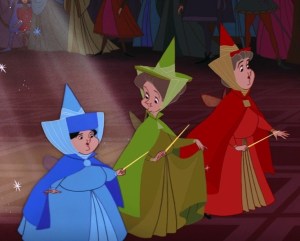
695371dc44ef1c396fc9542a16d5a5fd

This is all wild speculation on my part. I have no idea if the writers of “Sleeping Beauty” had Shakespeare in mind when they came up with their plot, but if so, we have yet another example of Shakespeare’s influence on modern pop culture. Thankfully they left out the bear.

Works referenced

D. L. Ashliman’s Folktexts, University of Pittsburgh.

Lit2Go, Grimm Brothers Sleeping Beauty

William Shakespeare, The Winter’s Tale. Folger Press

Shakespeare’s Prop Room- a review

9781476663364
McFarland & Company 2016


“Shakespeare’s Prop Room an Inventory” is hard to pin down. While at times it offers insight into Elizabethan theater life and may prove useful to theater groups, its arguments tend to be self-serving and a little questionable. If you are wondering why a book about props would propose arguments at all, let me assure you, this book offers more than a scholarly look at props; at times is reads as if the authors believe the plays to be some missing Christian gospels, which left me with a feeling of unease.

I blame Ralph Alan Cohen for setting me up. I was so eager to dive into the book after reading his foreword. In it he writes in part:

Crass considerations can get us deeper into the plays…What might a show look like? What was on stage? What were they holding? What objects are we dealing with?”

“And that is the question that Shakespeare’s props asks so well, questions that unlocks so much…It is a book that points but does not push the reader towards answers. …it is material to an understanding of the plays and matters to the production of a performance”.

I am not convinced Cohen read the entire book before he wrote the foreword. The first two chapters “Bring out your dead”, and “Off with his head” are highly enjoyable and as promised, offer some understanding of the plays; I can see both chapters as valuable material to any modern theater group looking for a deeper understanding of the norms and customs of Shakespeare’s day. But starting with chapter 3, Exit pursued by a bear” ,the book shifts focus and uses biblical passages to make the argument that Shakespeare relied heavily on the Bible for his imagery and made good use of his plays as arguments for Christianity. This is an odd argument to make, given that scholars know he used Ovid and older plays as his primary source material. The chapter is brief, (and possibly unnecessary as there are few animals in the plays) but somehow manages to talk about everything from Macbeth’s hounds of hell, to that of man taming his own inner beast, and then jumps to Caliban-is he man or fish-which somehow turns to Jonah and the whale. The author even finds the time to remind us on page 46 that, “God assures us we are made in his image, in his likeness, and like Prospero, have dominion over the fish of the sea…”

This short rambling chapter seemed so widely out of place that I had to read it twice to find any connection to the book it sits in. I am still not sure what any of this has to do with Shakespeare’s prop room.

In chapter 9, Welcome to our table”, the authors state “Behind every dinner lurked the last supper”. So much for Cohen’s claim that the authors points but does not push the reader towards answers. As part of their biblical argument the authors cite Jan Kott, a critic known to have interpreted the plays in light of existentialism, and his own personal experiences. The choice of Kott seems a little odd until one realizes he is used to bolster the authors’ Shakespeare/Christian argument.

A few chapters later we return to talking of props and their use with no mention of Christian leanings. As I read these later chapters, it dawned on me that the two authors may not have collaborated much. Perhaps each took a few chapter subjects and wrote separately. If this were true it would go a long way to explain why some chapters tend towards the utilitarian use of props while others towards the Bible as a metaphorical prop in Shakespeare’s plays.

If you sift through the biblical references and table some of the arguments for later, you may enjoy the book as a theater prop guide. Be warned, it is not the book Ralph Alan Cohen read, which is too bad because that book sounds amazing.

I received this book from Librarything’s Early Reader program in exchange for a fair and honest review.

Amazing Waste

Repurposing Food and Reducing Waste

measurestillformeasure

Shakespeare, Classics, Theatre, Thoughts

Nerd Cactus

Quirky Intellect for the Discerning Nerd

Sillyverse

Stories of magic and mystery

Commonplace Fun Facts

Mind-Blowing Facts You Didn’t Know

Fictionophile

Fiction reviews, Bookblogger, Fiction book reviews, books, crime fiction, author interviews, mystery series, cover, love, bookish thoughts...

Patrick W. Marsh

monsters, monsters, everywhere

Shakespeare for Kids Books

Opening the door for kids to love Shakespeare and the classics

desperatelyseekingcymbeline

The 10-year Shakespeare New Year Resolution

Katzenworld

Welcome to the world of cats!

booksandopinions.com

The Book Reviews You Can Trust!

The Book Review Directory

For Readers and Writers

thelitcritguy

screams from the void

Author Adrienne Morris

Step Into the Past—Lose Yourself in the Story.

crafty theatre

ideas inspired by crafty characters

Critical Dispatches

Reports from my somewhat unusual life

The Nerd Nebula

The Nucleus of the Universe for all Nerd Hacks!