Hamlet & St. Patrick’s Gate to Purgatory

St Patrick

Right after Hamlet confronts his father’s ghost, he and Horatio have a brief discussion about what had just occurred.

Horatio. These are but wild and whirling words, my lord.
Hamlet. I’m sorry they offend you, heartily;
Yes, ‘faith heartily.
Horatio. There’s no offence, my lord.
Hamlet. Yes, by Saint Patrick, but there is, Horatio,
And much offence too.
– Hamlet (1.5.)

I’ve often wondered what the reference to St. Patrick, if any, signified. As with every other line in every other one of his plays, Shakespeare is telling us more than he is saying, but his modern audience does not have the benefit of quickly recognizing subtle 17th century cultural references. It is up to us to pay attention and find the double meaning, the other layer in the onion that makes Shakespeare so enjoyable.

So for this St. Patrick’s Day I decided to look into the reference. As it turns out, I learned something new about Ireland’s most famous Saint.

St Patrick showing the cave of Purgatory

The small island of Lough Derg, off Ireland’s coast was once thought of as the gates to Purgatory or Hell, depending on which piece of lore you follow. According to myth, St. Patrick was visiting the island when he discovered a small cave and upon entering it, experienced visions of hell. Some stories go so far as to say Jesus himself showed Patrick the cave and caused the visions. In both stories Patrick used the cave to show his pagan converts that the afterlife does exist and what to expect if they did not profess belief in Christ. There is no proof that any of this took place, including Patrick even visiting the island, but that didn’t stop the locals from profiting from the story.

During the Middle Ages, the island acquired the reputation as the strictest and most demanding of European pilgrimage sites. Visitors had to complete a three day barefoot sojourn of contemplation around the island, as if already in Purgatory. The Catholic owned island still welcomes spiritual pilgrims seeking relief and rest from the modern world. This island promises:

Lough Derg is an island of pilgrimage set in calm lake waters, offers no distraction, no artificialities or interruptions. Instead you are warmly welcomed and cared for: there are no strangers here. 

I don’t know about you, but this sounds like my kind of vacation.

So, what does this have to do with Hamlet’s line about St. Patrick? Well, it turns out a lot. The ghost of Hamlet’s father talks of being a spirit trapped in Purgatory.

I am thy father’s spirit,
Doom’d for a certain term to walk the night,
And for the day confined to fast in fires,
Till the foul crimes done in my days of nature
Are burnt and purged away. (1.5.9-13)
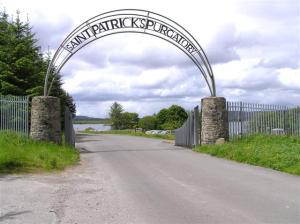
OLYMPUS DIGITAL CAMERA

Perhaps Shakespeare pictured old Hamlet going to Purgatory via Ireland, or perhaps he wrote the play in March of 1602 and had St Patrick and the story of the gates to Purgatory on his mind. Whatever the reason, this layer of the onion is further proof that Shakespeare continues to expand my world and why I enjoy sharing his work with all of you.

Happy St. Patrick’s Day!

Works Referenced

Hamlet quick quotes Shakespeare on-line.com

Lough Derg  .loughderg.org/

St. Patrick’s Purgatory Newadvent.org
All hail Macbeth? More like all manipulate Macbeth

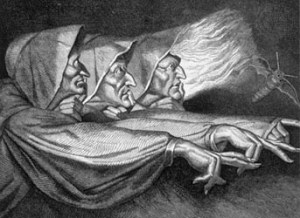
The Weird Sisters of Macbeth, engraving by Losay from the painting by Henry Fuseli

Do we have free will? This is one of mankind’s most loaded questions because the answer depends on the answerer’s worldview and how he perceive and react to circumstances beyond his control.

The question of free will can become a theological argument for those who seek to find meaning in tragedy or everyday disappointments. “Yes”, they may argue, “we have some free will but ultimately God is in control”. For others who do not ascribe to divine intervention, this argument is viewed as an exercise of rational philosophy (though first they argue over the term “free will”). Some feel that those who are not enslaved have absolute free will, while others feel agents of free will can only act upon their own will as long as circumstances allow; you may want to go outside but if a snow storm prevents it, then you cannot act upon your will. Of course no well-rounded debate over free will would be complete without the argument for moral constraints; and this too is a very loaded question and must remain in the shadows least this post becomes a ten page essay on ethics and free will. The point to all of this is simple; most arguments for and against free will come from a position of arguing over the role that outside forces have as impediments to absolute free will. But what about internal forces?

Psychologists might argue that there are some free agents who absolutely do not have free will (in fact we may not want to call them free agents); that the ability to act as they wish is hampered by the mind that drives their behavior. We would never say of the mentally ill that they will themselves into depression or delusions nor can we (or should never) say that they have the ability to will themselves well.

But what about those who are not mentally ill, but find themselves driven to certain behaviors through either the will of others or through their own inability to do little more than react to each moment without the much inner reflection? Do these people possess free will or is their internal hard wiring such that they cannot act on anything but impulse?

A classic example of someone who seems driven, not by will, but by impulse and external forces is Shakespeare’s Macbeth. Yes, all of the above rambling came to me as I re-read Macbeth last night as preparation for a viewing of Justin Kurzel’s adaption starting Michael Fassbender as the tragic king.

As I read the play it occurred to me that Macbeth was a man who never stopped to consider his actions and was continually pushed to action by either wild imagined impulse or the will of those around him. His own will or call to action stemmed from his fears of what may come next and this fear stemmed from what had just happened. His action can be seen as driven by thoughts of previous action and the idea of what is to come. This is not a man who spends much time contemplating how his bloody deeds are affecting his will. It is Macbeth’s imagination not his will that compels him to only consider the present moment and even then he is unsure how to act rationally. His thoughts are driven by his impulsive imagination.

For me, this was a new way to look at Macbeth and a good example of the many layers Shakespeare gave to each play. My earlier focus had been on Macbeth as a personification of the saying, “Absolute power corrupts absolutely”. Last night’s reading of the play was an opportunity to see that Shakespeare had more to say about the human condition and what drives our behavior. Shakespeare may have asked us to look at what happens when we don’t stop to analyze our behavior or take into consideration that as limited as it might feel, we do have free will and the consequences of not exercising it can have damaging effects on us and those around us.

This morning I looked to see if my ideas had merit. I was pleased to find that I was not the only one who noticed this. William Hazlitt, a noted 17th century Shakespeare scholar agrees:

Macbeth himself appears driven along by the violence of his fate like a vessel drifting before a storm: he reels to and fro like a drunken man; he staggers under the weight of his own purposes and the suggestions of others; he stands at bay with his situation; and from the superstitious awe and breathless suspense into which the communications of the Weird Sisters throw him, is hurried on with daring impatience to verify their predictions, and with impious and bloody hand to tear aside the veil which hides the uncertainty of the future. He is not equal to the struggle with fate and conscience. He now “bends up each corporal instrument to the terrible feat.

As for the Fassbender adaptation I viewed last night? Skip it. I was prepared to watch for any clues that might have given my idea credence. I wanted to see an impulsive Macbeth, one who staggered under the weight of his own purpose as Hazlitt so aptly put it. I am sorry to report that what I saw was an entire film stagger under the weight of its purpose. As if Shakespeare was too much for any of the actors to bear. The movie’s atmosphere felt heavy; the grey tones and misty landscape seemed to drag the movie down. The setting could have worked if the actors had given us energy, but their lack of enthusiasm only enhanced the dreariness of the film. I kept waiting for the actors to fall asleep, as they seemed drugged by the fog that surrounded them. I would not have believed it possible but Kurzel managed to make Macbeth boring. About 45 minutes into the movie I exercised my free will and turned it off. Don’t believe me? This clip shows Fassbender at his most agitated state, and the only time Macbeth considers his actions.

Please, feel free to leave a comment below.

Works cited

Hazlitt, Macbeth AbsolutShakespeare.com

Amazing Waste

Repurposing Food and Reducing Waste

measurestillformeasure

Shakespeare, Classics, Theatre, Thoughts

Nerd Cactus

Quirky Intellect for the Discerning Nerd

Sillyverse

Stories of magic and mystery

Commonplace Fun Facts

Mind-Blowing Facts You Didn’t Know

Fictionophile

Fiction reviews, Bookblogger, Fiction book reviews, books, crime fiction, author interviews, mystery series, cover, love, bookish thoughts...

Patrick W. Marsh

monsters, monsters, everywhere

Shakespeare for Kids Books

Opening the door for kids to love Shakespeare and the classics

desperatelyseekingcymbeline

The 10-year Shakespeare New Year Resolution

Katzenworld

Welcome to the world of cats!

booksandopinions.com

The Book Reviews You Can Trust!

The Book Review Directory

For Readers and Writers

thelitcritguy

screams from the void

Author Adrienne Morris

Step Into the Past—Lose Yourself in the Story.

crafty theatre

ideas inspired by crafty characters

Critical Dispatches

Reports from my somewhat unusual life

The Nerd Nebula

The Nucleus of the Universe for all Nerd Hacks!